

Maddy summaryThe Accessible Voting Act of 2024 establishes an Office of Accessibility within the Election Assistance Commission to advocate for voters with disabilities, older individuals (60+ years), Native Americans, Alaska Natives, and those with limited English proficiency. It requires states to create accessible election websites with voting information, designate a single office to provide voting assistance to these groups, and ensure polling places are fully accessible. The bill expands access to absentee voting for all voters, prohibits denying voting rights based solely on guardianship status, and provides $100 million in federal funding for states to implement these accessibility requirements. These provisions aim to address longstanding barriers to voting experienced by approximately 28.7 million voting-age individuals with disabilities and 26 million people with limited English proficiency.
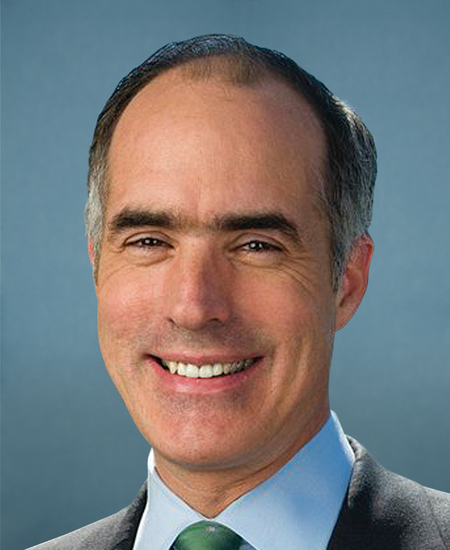
Sen. Robert P. Casey, Jr.
Sponsored bills
Maddy summaryThis bill creates a federal grant program to help local governments provide reasonable accommodations for elected or appointed officials with disabilities. It directly affects qualifying local governments (with populations under 200,000, in rural areas, or with high poverty rates) that have an official needing accommodations like office modifications, specialized software, or sign language interpreters to perform their work duties. Grants range from $3,000 to $50,000 annually, requiring local governments to contribute 25% in matching funds, which must be maintained for four years after the grant ends. The program aims to increase disability representation in local government by addressing ADA compliance gaps in funding for necessary accommodations.
Maddy summaryThis bill amends the VA's transportation grant program to better serve rural veterans. It expands eligibility to include County Veterans Service Organizations and Tribal Organizations, increases the maximum grant amount to $80,000 for recipients needing to purchase ADA-compliant vehicles, and updates the definition of "rural" to align with USDA's RUCA system. The changes directly affect rural veterans by improving access to transportation for medical care and benefit appointments through local service providers. Funding is no longer capped at fixed annual amounts, instead using "such sums as may be necessary" to support these services.
Maddy summaryThe Words Matter Act of 2024 updates federal law to replace outdated terms like "mental retardation" and "mentally retarded" with "intellectual disability" and "individuals with intellectual disabilities" across numerous statutes. It affects healthcare programs (including Medicare, Medicaid, and mental health courts), education (such as school lunch programs), and social services by revising language in over 30 provisions of federal law. The bill explicitly states this terminology change does not alter eligibility, coverage, rights, or service requirements for individuals with intellectual disabilities. This update aligns federal language with current respectful terminology while maintaining existing program structures and benefits.
Maddy summaryS 2669 requires digital asset service providers - including unhosted wallet providers, validators, miners, and digital asset kiosks (crypto ATMs) - to register with the Financial Crimes Enforcement Network (FinCEN) and verify customer identities. It mandates that entities handling anonymity-enhancing tools (like mixers that obscure transactions) implement anti-money laundering controls and report holdings over $10,000 abroad. The bill sets deadlines for implementing these rules: registration within 180 days, identity verification for kiosks within 18 months, and reporting requirements within 18 months of enactment. These provisions directly affect crypto businesses, wallet services, and kiosks operating in the U.S., aiming to reduce illicit finance risks in digital asset transactions.
Maddy summaryThis bill expands access to methadone treatment for opioid use disorder by allowing more healthcare providers to prescribe it for unsupervised use through pharmacies. Specifically, it waives federal restrictions to permit addiction medicine specialists, program employees, and certified physicians to prescribe methadone electronically for 30-day supplies, with patients receiving it directly from pharmacies instead of only through specialized clinics. The bill requires annual reporting to Congress on the number of registered providers, patients served, and participating states. It directly affects patients with opioid use disorder seeking treatment and healthcare providers currently authorized to prescribe methadone.
Maddy summaryThis resolution (SRES 539) is a symbolic Senate gesture supporting National Catholic Schools Week, celebrating its 50th anniversary. It recognizes Catholic schools' educational contributions - highlighting their role serving 1.7 million students, diverse demographics, and strong academic outcomes like a 98.9% graduation rate - without creating new laws or funding. The resolution formally applauds the National Catholic Educational Association and U.S. Conference of Catholic Bishops for organizing the week (January 28-February 3, 2024), themed "United in Faith and Community." It does not affect policy or funding but affirms the schools' community impact.
Maddy summaryThis bill would create "401Kids Savings Accounts" for every U.S. citizen child under 18, automatically established at birth or naturalization (including children in foster care). The accounts would receive annual government deposits of $500 (or $750 for families receiving the Earned Income Tax Credit), with an additional matching contribution of up to $250 for EITC-eligible families. Account funds could be used for qualified education expenses, home purchases, or rolled into ABLE accounts or Roth IRAs after age 18, with funds generally disregarded for means-tested federal benefits. The program would be administered through either state programs (with federal certification requirements) or a new Federal program established by the Treasury Department. Contributions would be limited to $2,500 per year (excluding government deposits), and the bill includes specific provisions for handling accounts of children in foster care and for deceased account holders.
Maddy summaryThis bill adds a new provision to the Family and Medical Leave Act, granting eligible employees up to 40 hours of job-protected leave per 12 months for bone marrow or blood stem cell donation. It covers all donation-related activities: pre-donation preparation, the donation itself, and post-donation recovery. Employees can use accrued paid leave (like vacation or sick days) to supplement this unpaid leave, though employers aren’t required to provide paid leave in this scenario. The law requires employees to give 30 days’ notice (or as soon as possible if urgent) and ensures this leave doesn’t reduce their existing FMLA entitlements.
Maddy summaryThis bill increases the Child and Dependent Care Tax Credit for eligible taxpayers. It raises the maximum credit rate from 35% to 50% (with income phaseouts), doubles the annual dollar limits from $3,000/$6,000 to $8,000/$16,000 for one/two or more dependents, and makes the credit refundable for qualifying taxpayers. The credit becomes refundable, meaning families can receive payments even if they owe no income tax. The bill also includes automatic annual inflation adjustments starting in 2025 to maintain the credit's value. It directly benefits working families with childcare costs, particularly those earning between $125,000 and $400,000 in adjusted gross income.