

Maddy summarySRES 523 is a Senate resolution honoring the late Senator Herb Kohl of Wisconsin. The resolution expresses the Senate's sorrow at his death, directs the Secretary of the Senate to communicate it to the House of Representatives and send a copy to his family, and instructs the Senate to adjourn as a mark of respect. This procedural resolution does not create new laws or affect policy, but formally commemorates Kohl's service and legacy. It was introduced by a bipartisan group of Senators and passed unanimously on January 11, 2024.
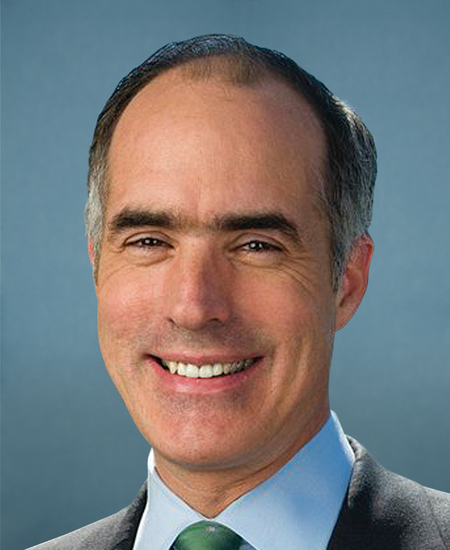
Sen. Robert P. Casey, Jr.
Sponsored bills
Maddy summaryThis bill amends federal law to ensure military offenses under the Uniform Code of Military Justice (UCMJ) are treated equally with civilian offenses in child exploitation cases. It updates references throughout Title 18 to replace outdated phrasing (like "section 920 of title 10") with "the Uniform Code of Military Justice" in key provisions. The changes directly affect military personnel facing federal prosecution for child exploitation, ensuring their cases align with civilian legal standards. The bill makes no new penalties but clarifies that UCMJ offenses are considered equivalent to state offenses under federal sentencing guidelines.
Maddy summaryS 3627, the Distribution Transformer Efficiency and Supply Chain Reliability Act of 2024, prevents federal rules from requiring distribution transformers to meet efficiency levels stricter than "trial standard level 2" for liquid-immersed and dry-type transformers. It directly affects manufacturers of these transformers by limiting future efficiency standards. The key provision delays any finalized rule for "trial standard level 1 or 2" efficiency from taking effect for 10 years after finalization. This bill aims to provide stability for the supply chain by slowing the implementation of stricter efficiency requirements.
Maddy summaryThis bill establishes a federal right for patients to access fertility treatments without unreasonable restrictions, protects health care providers who offer these services, and requires insurance coverage for such treatments. It guarantees patients the right to continue ongoing treatments under written agreements and retain control over reproductive materials. States cannot impose requirements that are more burdensome than those for comparable medical procedures or that don’t significantly advance safety. Violations can be challenged in federal court by the government, patients, or providers, while states may still enforce health/safety regulations that are necessary and least restrictive.
Maddy summaryThe Stop Fentanyl at the Border Act allocates $6.3 billion in federal funding for border security operations focused on intercepting fentanyl and related drug trafficking. It directs $3.4 billion to U.S. Customs and Border Protection (CBP) for hiring additional personnel (including border agents and processing coordinators), mental health support, and infrastructure upgrades. An additional $1.09 billion funds advanced scanning technology at ports of entry to detect drugs, while $285 million enhances outbound inspections for firearms and currency. The bill also allocates $511 million to ICE, DEA, and DOJ to expand fentanyl interdiction efforts and disrupt transnational criminal networks along the border. These provisions directly affect CBP, ICE, DEA, and DOJ personnel responsible for border enforcement and drug interdiction operations.
Maddy summaryThe Protecting Students on Campus Act of 2024 requires colleges and universities receiving federal funds to prominently display links to the Department of Education’s civil rights complaint portal on their websites and annually post awareness materials about Title VI rights (prohibiting race, color, or national origin discrimination) in high-traffic campus locations like student centers and digital hubs. It mandates annual reports from institutions detailing discrimination complaints received, with the Education Department’s Inspector General auditing the top 5% of institutions by complaint rate and studying why some complaints stay at the college level versus being reported to federal authorities. The bill also requires monthly congressional briefings on complaint data, broken down by discrimination type, and prevents the federal Office for Civil Rights from dismissing complaints resolved internally by schools. These provisions aim to increase transparency, accessibility of civil rights protections, and accountability for handling discrimination complaints on campuses.
Maddy summaryS 1507, the POWER Act, authorizes $20 million in federal funding for fiscal year 2023 to provide grants to state, local, territorial, and Tribal law enforcement agencies. The grants allow agencies to purchase chemical screening devices and train personnel to identify substances like fentanyl, methamphetamine, and other narcotics. Agencies must certify that at least one employee will be trained to operate the devices and interpret results, and must share devices with neighboring agencies when applicable. Recipients must submit annual reports on how funds were used to meet identified needs, such as improving substance identification speed and officer safety.
Maddy summaryS 993, the Combating Illicit Xylazine Act, makes the illicit distribution and use of xylazine illegal under federal drug laws. The bill defines xylazine broadly (including multiple chemical variants) and prohibits all human use or non-lici distribution, while allowing only veterinary and pharmaceutical uses approved under existing regulations. It requires the DEA and FDA to report to Congress within a year on xylazine's spread and impacts, with a follow-up report four years later. This directly affects drug traffickers and distributors adding xylazine to illicit drugs like fentanyl, aiming to address a public health threat linked to severe health consequences including necrosis.
Maddy summaryThe Affordable Connectivity Program Extension Act of 2024 allocates $7 billion in federal funding for the Affordable Connectivity Program (ACP) in 2024. The ACP provides internet subsidies to help low-income households afford service, directly supporting millions of qualifying families. This funding ensures the program can continue operating throughout 2024, with the money remaining available until fully spent.
Maddy summaryThis Senate resolution condemns attacks by Iran-backed militia groups on U.S. military personnel in Iraq and Syria, which have injured over 60 service members and damaged infrastructure. It urges the Biden administration to increase pressure on Iran to stop supporting such attacks and to take steps to deter future incidents, including maintaining U.S. military presence in the region. The resolution also emphasizes the importance of U.S. forces in Iraq and Syria for regional stability and counterterrorism efforts, while commending military actions taken in self-defense.