

Maddy summaryThe Grandfamily Housing Act of 2023 establishes a federal grant program for owners of intergenerational housing units - homes where grandparents or other relatives live with grandchildren. Grants cover costs for service coordinators to provide onsite support (like tutoring, healthcare, and after-school care), community outreach, and property modifications to support these families. The program requires coordination with local kinship navigator programs and mandates a report to Congress on the program's effectiveness within two years. It directly affects property owners in qualifying intergenerational housing units and aims to strengthen support services for these families through HUD-administered grants.
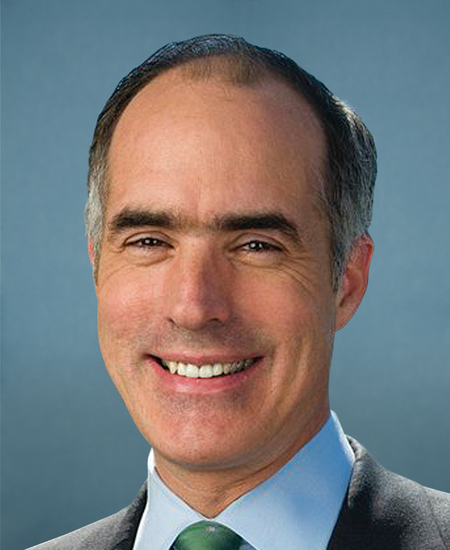
Sen. Robert P. Casey, Jr.
Sponsored bills
Maddy summaryS 3901, the Time Off to Vote Act, requires employers with 25 or more employees to provide up to 2 hours of paid leave during open polls for federal elections, allowing workers to vote or return mail-in ballots. It directly affects employees at qualifying businesses, ensuring they can vote without losing pay or benefits. Key provisions include employers designating the leave timing (excluding lunch breaks), prohibiting retaliation for using the leave, and imposing civil penalties up to $10,000 for violations. The law takes effect for the first federal election after enactment and does not override stricter state voting leave laws.
Community Health Worker Access Act This bill provides for coverage of community health services under Medicare. Community health services are services provided by a community health agency in accordance with an individual needs assessment, including preventive services (e.g., screenings) and services to address social determinants of health (e.g., educational home visits). Community health agencies include nonprofits, federally qualified health centers, and other organizations that employ health workers (in accordance with certain labor standards) who have lived experience in the communities served. The bill also allows state Medicaid programs to cover these services and provides for an increased Medicaid federal matching rate, also known as the Federal Medical Assistance Percentage (FMAP), for these services.
Maddy summaryThis bill requires states to develop and implement plans coordinating Medicare and Medicaid benefits for people eligible for both programs (dual-eligible individuals). States must create approved "Dual Coordination and Integration Plans" with input from beneficiaries, providers, and advocates, covering areas like data sharing, mental health integration, and enrollment outreach. The federal government provides planning grants (up to $5 million per state) and covers 50% of implementation costs (80% for the first two years) for approved plans. States must publicly share plans, update them regularly, and report annually on progress using federal funds.
Maddy summaryThis bill provides $280 million in federal funding for the Office for Civil Rights (OCR) within the Department of Education for fiscal year 2024, with funds available through 2025. The OCR enforces civil rights laws in schools, investigating complaints related to discrimination based on race, gender, disability, or other protected characteristics. This funding directly supports the OCR's existing operations to address inequities in educational settings nationwide. It does not create new student programs or directly affect specific individuals, but rather strengthens the agency's capacity to handle civil rights cases in schools.
Maddy summarySRES 571 is a ceremonial Senate resolution honoring Edwin Walker, the Deputy Assistant Secretary for Aging at the Administration for Community Living, upon his retirement after a 30+ year career. The resolution recognizes his leadership in advancing the Older Americans Act, supporting older adults and caregivers, and managing pandemic relief efforts. It does not create new laws or policies - it simply expresses the Senate’s appreciation for his service and celebrates his retirement. The resolution has no direct policy impact or effect on legislation.
Maddy summarySRES 569 is a symbolic Senate resolution recognizing religious freedom as a fundamental human right and expressing concern over global threats to religious freedom. It condemns efforts to suppress religious expression - including criminalizing conversion, advocacy, or religious site construction - and urges the State Department to prioritize religious freedom in foreign policy, including through diplomatic engagement and sanctions. The resolution does not create new laws but emphasizes the importance of religious freedom for democracy and global stability, referencing ongoing violations in countries like China, Burma, and Iran. It calls for continued support for religious freedom advocates and the application of existing tools like the International Religious Freedom Act.
Maddy summaryThis bill establishes a federal task force to study and improve the use of inland waterways in the Ohio, Allegheny, and Monongahela River corridors. The task force, made up of federal agencies, state representatives from Pennsylvania, West Virginia, Indiana, Illinois, Kentucky, Ohio, and Tennessee, and local stakeholders, will identify projects and connect them with funding to boost waterway freight and economic development. It directs $5 million annually from 2024 to 2034 to support this work, focusing on regions impacted by deindustrialization. The bill aims to maximize the impact of existing infrastructure investments by promoting waterways as a safe, efficient, and environmentally responsible freight option.
Maddy summaryThe John R. Lewis Voting Rights Advancement Act of 2024 updates the Voting Rights Act of 1965 to strengthen protections against voting discrimination. It clarifies how to prove vote dilution, denial, or abridgement claims and expands the types of voting changes requiring federal preclearance, including changes to election methods, boundaries, voter ID requirements, and polling locations. The bill requires states to provide public notice of voting changes at least 48 hours in advance and mandates transparency about demographic data related to polling places. This legislation directly affects states and political subdivisions with a history of voting rights violations, aiming to protect minority voters from discriminatory voting practices.
Maddy summaryThis bill (S 3832) creates new Medicare Part D coverage rules for specific non-opioid pain management drugs starting in 2025. It requires Medicare plans to waive deductibles and place these drugs on the lowest copay tier for beneficiaries, while banning step therapy (forcing opioid use first) and prior authorization for them. The bill applies to Medicare Part D beneficiaries seeking pain treatment and directly affects Medicare plans' coverage rules. To qualify, drugs must be FDA-approved for pain, non-opioid, have no equally effective alternative drug available, and meet cost limits set by the government.