

Resident Physician Shortage Reduction Act of 2023 This bill increases the number of residency positions eligible for graduate medical education payments under Medicare for qualifying hospitals, including hospitals in rural areas and health professional shortage areas. Current law provides for an increase of up to 200 positions per fiscal year beginning in FY2023, with a total increase of 1,000 positions; each hospital may receive up to 25 additional positions. Current law also provides for an additional increase of up to 200 positions for FY2026, with at least 100 of these positions for psychiatry or related specialties; each hospital may receive up to 10 additional positions. The bill provides for an additional increase of 2,000 positions per fiscal year from FY2025-FY2031; during this period, each hospital may receive up to 75 additional positions in total under the bill and current law. The bill also requires the Government Accountability Office to report on strategies to increase the diversity of the health professional workforce, including with respect to representation from rural, low-income, and minority communities.
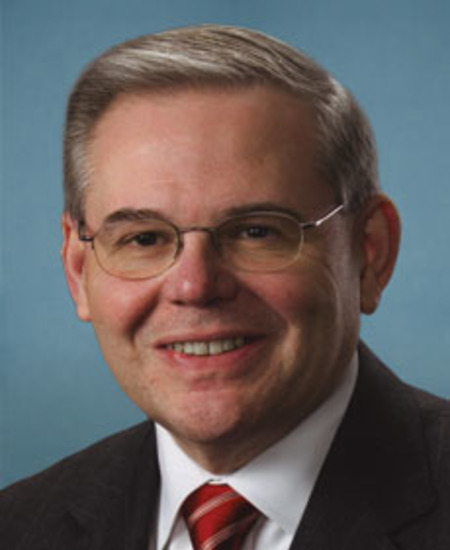
Sen. Robert Menendez
Sponsored bills
Maddy summaryThis bill authorizes the U.S. Treasury to mint three commemorative coins in 2026 to honor Golda Meir (Israel’s first female Prime Minister) and mark the 75th anniversary of U.S.-Israel relations. It specifies $5 gold, $1 silver, and half-dollar coins bearing her image and inscriptions like "Golda Meir, Israel 75, 2026," with surcharges of $35, $10, and $5 per coin respectively. All surcharge revenue will fund Kiryat Sanz Laniado Hospital in Israel, while the coins - minted only in 2026 - will be sold as collectibles with no net cost to the U.S. government.
Maddy summaryThis bill requires federal agencies (Attorney General, Homeland Security, and Treasury) to create a strategy within 120 days to prevent trafficking of machinegun conversion devices - parts that can convert standard firearms into machineguns. The strategy must cover detecting and intercepting these devices at borders, coordinating with state/local law enforcement, tracing devices used in crimes, and addressing domestic production (including 3D printing). Agencies must report the strategy to Congress within 120 days and provide biennial updates. Additionally, the annual firearms trafficking report must include data on crimes involving these devices and whether they originated domestically or abroad.
Maddy summaryThis bill would designate approximately 1.3 million acres of public land across Utah's Colorado Plateau and Great Basin regions as wilderness areas, protecting them from development and extractive industries. It specifically creates 77 wilderness areas across eight designated regions including the Grand Staircase-Escalante, Moab-La Sal Canyons, Henry Mountains, and San Rafael Swell areas. The bill maintains existing recreational uses like hiking, camping, and fishing while allowing continued livestock grazing under certain conditions and protecting water rights and Tribal cultural resources. It withdraws the designated lands from mining, mineral leasing, and other forms of development under federal law. The Bureau of Land Management would manage these areas according to wilderness preservation standards under the Wilderness Act.
Maddy summaryThis bill (S 1090) requires the Veterans Affairs (VA) Secretary to update the VA's payment system within 90 days of enactment to allow electronic fund transfers (EFTs) for educational benefits to foreign institutions of higher education. It directly affects veterans using VA education benefits who attend qualifying foreign schools. The key provision enables EFTs to foreign institutions that offer approved courses to veterans but lack either a U.S. employer identification number (EIN) or a U.S. bank account. This change specifically addresses a barrier preventing direct payments to eligible foreign schools that cannot receive standard domestic bank transfers. The bill does not alter benefit amounts or eligibility, only the payment method for approved foreign education programs.
Maddy summaryThis bill strengthens penalties for individuals or organizations charging veterans unauthorized fees when assisting with VA benefit claims. It directly affects veterans who might be targeted by unscrupulous representatives and the representatives themselves who attempt to charge such fees. The key provision adds a new subsection (b) to Section 5905, making it illegal to solicit, charge, or receive any fee for preparing or submitting VA claims - except as allowed under specific other sections. Violations can result in fines, up to one year in prison, or both.
Maddy summaryThis bill requires businesses contracting with the U.S. Department of Agriculture (USDA) to annually disclose, within the past three years, whether they or their subcontractors faced serious labor law violations - including violations of the Fair Labor Standards Act, Occupational Safety and Health Act, or anti-discrimination laws. Entities found to have committed serious, repeated, or pervasive violations, or to have failed to complete corrective measures, would be placed on a list barring them from USDA contracts for up to five years. The Secretary of Labor would coordinate with agencies like the Equal Employment Opportunity Commission to verify disclosures and negotiate corrective steps. The bill aims to hold USDA contractors accountable for labor compliance, directly affecting businesses seeking federal agricultural contracts.
Maddy summaryS 1231 (SAD Act) prohibits crisis pregnancy centers (CPCs) from making deceptive claims about providing abortion services, contraception, or employing licensed medical staff. It directly affects CPCs that falsely represent themselves as reproductive health providers, which the bill states often target underserved communities. The law authorizes the Federal Trade Commission (FTC) to enforce this prohibition under existing consumer protection laws, imposing civil penalties of up to $100,000 or 50% of a CPC's revenue. The FTC must also submit biennial reports to Congress on enforcement actions. The bill aims to ensure patients receive accurate information about reproductive health services.
Maddy summaryThe Do No Harm Act amends the Religious Freedom Restoration Act (RFRA) to clarify that RFRA does not apply when federal laws protect against discrimination (like the Civil Rights Act of 1964), guarantee workplace protections (such as the Family and Medical Leave Act), prevent child exploitation, or ensure health care access. It specifically prevents religious freedom claims from blocking enforcement of these existing laws. The bill directly affects individuals or entities attempting to use RFRA to challenge such federal protections in court. This amendment ensures that religious freedom arguments cannot override established civil rights, workplace, child safety, or health care regulations.
Maddy summarySRES 159 is a symbolic Senate resolution designating April 11-17, 2023, as "Black Maternal Health Week" to highlight the maternal health crisis affecting Black women and birthing persons in the U.S. It references data showing Black women are 2.6 times more likely to die from pregnancy-related causes than White women, with higher rates of complications and disparities across income and education levels. The resolution calls for national attention to address systemic racism and inequities in maternal care but does not create new laws, funding, or mandates. It serves solely as a recognition effort to amplify community-led solutions and policy discussions around racial disparities in maternal health.