

Affordable Medications Act This bill revises and expands various requirements relating to prescription drug pricing and affordability. Specifically, the bill expands financial reporting requirements for drug manufacturers and establishes corresponding civil penalties for noncompliance; it also adds reporting requirements for certain nonprofit patient-assistance programs. Further, the bill requires the Centers for Medicare & Medicaid Services (CMS) to negotiate prices for certain prescription drugs under Medicare and requires the Centers for Medicare and Medicaid Innovation within the CMS to test specified models for negotiating drug prices. It also establishes reporting requirements, and corresponding civil penalties for noncompliance, for pharmaceutical companies with respect to spikes in prescription drug prices. The bill establishes an excise tax on prescription drugs subject to price spikes, lessens prescription drug cost-sharing requirements under qualified health plans and group health plans, and modifies requirements for the importation of prescription drugs. It also requires drug manufacturers to provide rebates for drugs dispensed to certain low-income individuals under the Medicare program and limits the time frame that trade agreements are required to provide market exclusivity for biological products. Additionally, the bill (1) requires the Food and Drug Administration to establish a database of generic drugs; (2) modifies other provisions related to generic drugs, prescription drug advertising, disclosure of wholesale acquisition prices, and patent-infringement proceedings; and (3) revises certain time frames and conditions related to drug exclusivity. Finally, it establishes an innovation incentive fund for new or more effective treatments of bacterial infections and establishes the Center for Clinical Research within the National Institutes of Health.
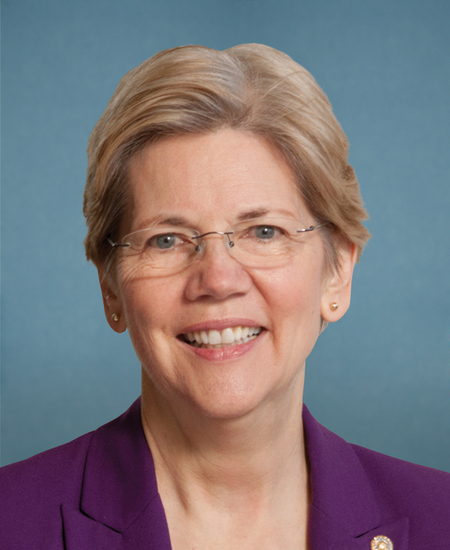
Sen. Elizabeth Warren
Sponsored bills
This resolution offers the condolences of the Senate regarding the death of Senator David Henry Gambrell and honors his life and legacy.
This resolution designates May 2021 as Older Americans Month.
Clean Ocean And Safe Tourism Anti-Drilling Act or the COAST Anti-Drilling Act This bill prohibits the Department of the Interior from authorizing the exploration, development, or production (i.e., offshore drilling) of oil or natural gas in specified planning areas of the Outer Continental Shelf along the Atlantic Coast, including the Straits of Florida.
John Lewis Every Child Deserves a Family Act This bill prohibits discrimination on the basis of sexual orientation, gender identity, marital status, or religion in the provision of child welfare programs and services by entities receiving federal funding. The Department of Health and Human Services (HHS) must provide technical assistance to help states follow this requirement, including (1) guidance for bringing state laws into compliance, (2) developing training to increase cultural competency related to social identity, and (3) training for judges and attorneys involved in child welfare cases, among other supports. Additionally, HHS must establish the National Resource Center on Safety, Well-Being, Placement Stability, and Permanency for LGBTQ Children and Youth Involved with Child Welfare Services to provide training, technical assistance, and guidance to applicable state and local agencies and service providers. Further, the Religious Freedom Restoration Act may not be the basis for challenging the application or enforcement of this bill. The Government Accountability Office must study and report on states' compliance with the requirements of the bill no later than three years after enactment.
Keeping All Students Safe Act This bill prohibits the use of seclusion and limits the use of physical restraint in schools and Head Start programs that receive federal funding. Specifically, the bill prohibits the use of seclusion, which is the involuntary confinement of a student alone in a room or area from which the student is physically prevented from leaving. The term does not include a time out, which may involve separating the student from others in a non-locked setting. The bill prohibits the use of mechanical or chemical restraints or physical restraints that restrict breathing or are life threatening. The bill outlines the requirements for the use of physical restraint, including that the student's behavior must pose an imminent danger of serious physical injury to the student or other individual. Each state must ensure that a sufficient number of program personnel are trained and certified by a state-approved crisis intervention training program. Additionally, each program must establish procedures to follow after an incident involving physical restraint. Further, the bill establishes enforcement provisions, including a private right of action for a student who has been subjected to unlawful seclusion or restraint. The Department of Education and the Department of Health and Human Services must withhold payments from a program for unlawful seclusion or restraint. Finally, the bill requires each state educational agency (SEA) to establish, implement, and enforce policies and procedures required by the bill. It also creates a grant program to assist SEAs with these activities.
Rights for the Transportation Security Administration Workforce Act of 2021 or the Rights for the TSA Workforce Act of 2021 This bill modifies the workplace rights, protections, and benefits applicable to Transportation Security Administration (TSA) personnel. Specifically, the bill within 180 days, eliminates personnel authorities of the Department of Homeland Security (DHS) and the Department of Transportation governing the conditions of employment for TSA employees, thus making TSA employees subject to the personnel management system applicable to other federal employees; sets forth transition rules that protect the pay rates, leave rights, and other rights of TSA and Federal Air Marshal Service employees; and requires DHS to consult with the labor organization certified by the Federal Labor Relations Authority to carry out the conversion of such positions. The bill also directs the TSA to implement in-person or remote mental health programs at each field office of the Federal Air Marshal Service and consult with labor associations to address concerns regarding federal air marshals, including mental health and suicide rates; requires DHS to prioritize the hiring of veterans, including disabled veterans; and directs the TSA to ensure its employees are provided proper guidance regarding prevention and protections against the coronavirus.
Building Rail Across Intercity Networks To Ride Around Interior of the Nation Act or the BRAIN TRAIN Act This bill directs the Department of Transportation (DOT) to establish an intercity passenger rail service investment program to promote high-performance rail transportation options. DOT may award competitive grants under the program to finance capital projects for high-performance rail, including grants awarded in installments for projects lasting longer than one year. In awarding grants, DOT must select high-performance rail projects (1) that are anticipated to result in significant improvements to intercity rail passenger service, (2) for which there is a high degree of confidence that the proposed projects are feasible and will result in the anticipated benefits, and (3) for which the level of the anticipated benefits compares favorably to the amount of federal funding requested. The federal share of the cost of a capital project shall not exceed 90% of the project's net capital cost.
Building Child Care for a Better Future Act This bill (1) increases funding for child care assistance under the Temporary Assistance for Needy Families (TANF) program, and (2) funds grants to support access to child care in areas of particular need.
Used Car Safety Recall Repair Act This bill prohibits a dealer from selling, leasing, or loaning a used motor vehicle until a defect of the motor vehicle or motor vehicle equipment or noncompliance with a federal motor vehicle safety standard has been remedied, with specified exceptions. The prohibition does not apply if the recall information regarding the used vehicle was not available at the time of sale or lease and was not on the manufacturer's website; notification of the defect or noncompliance is required, but enforcement of an order to notify of and remedy the defect or noncompliance is set aside in a civil action on a motion for change of venue; the used vehicle is sold at wholesale; or the used vehicle is a junk automobile with all required information reported to the National Motor Vehicle Title Information System. If a vehicle manufacturer fails to provide the dealer with a remedy for a used vehicle's safety defect within 60 days, the manufacture must pay the dealer an amount that is not less than one percent of the fair-market value of the vehicle per month. The total payment amount may not exceed the fair-market value of the vehicle.