This resolution offers the condolences of the Senate regarding the death of Senator John William Warner and expresses deep appreciation for his outstanding and important service to his country.
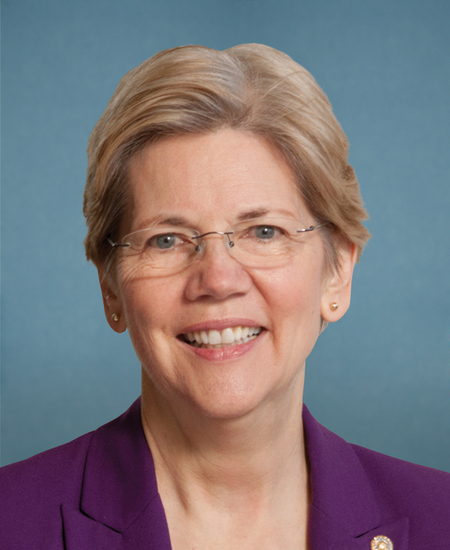
Sen. Elizabeth Warren
Sponsored bills
This resolution recognizes the significance of Asian/Pacific American Heritage Month as an important time to celebrate the contributions of Asian Americans and Pacific Islanders to the history of the United States. The resolution also recognizes that the Asian American and Pacific Islander communities enhance the rich diversity of the United States.
Algorithmic Justice and Online Platform Transparency Act This bill establishes requirements for certain commercial online platforms (e.g., social media sites) that withhold or promote content through algorithms and related computational processes that use personal information. The platforms must make disclosures about their collection and use of personal information and their content moderation practices; retain specified records that describe how the algorithms use personal information and assess whether the algorithms produce disparate outcomes based on race and other demographic factors in terms of access to housing, employment, financial services, and related matters; employ algorithms safely and effectively; and allow users to access and transfer their personal information. If a platform uses algorithms to publish or sell advertising, it must maintain a library of the advertisements. The Federal Trade Commission must also adopt rules concerning deceptive advertising. A platform's chief executive officer or other senior officer must certify compliance with disclosure requirements. Additionally, platforms may not (1) employ algorithms or other design features that result in discrimination or similar harms based on demographic or biometric factors, or (2) process information such that it impairs voting rights. Further, users of a platform may not violate civil rights laws using the platform's algorithms. The bill prohibits waivers or other methods that limit rights under the bill; provides whistleblower protections for individuals who report violations; and authorizes enforcement by specified federal agencies, states, and private individuals. The bill also provides funding for an interagency task force to study the discriminatory use of personal information by platforms' algorithms.
National Origin-Based Antidiscrimination for Nonimmigrants Act or the NO BAN Act This bill imposes limitations on the President's authority to suspend or restrict aliens from entering the United States. It also prohibits religious discrimination in various immigration-related decisions, such as whether to issue an immigrant or nonimmigrant visa, unless there is a statutory basis for such discrimination. The President may temporarily restrict the entry of any aliens or class of aliens after the Department of State determines that the restriction would address specific and credible facts that threaten U.S. interests such as security or public safety. The bill also imposes limitations on such restrictions, such as requiring the President, State Department, and the Department of Homeland Security (DHS) to (1) only issue a restriction when required to address a compelling government interest, and (2) narrowly tailor the suspension to use the least restrictive means to achieve such an interest. Before imposing a restriction, the State Department and DHS shall consult with Congress. The State Department and DHS shall report to Congress about the restriction within 48 hours of the restriction's imposition. If such a report is not made, the restriction shall immediately terminate. Individuals or entities present in the United States and unlawfully harmed by such a restriction may sue in federal court. DHS may suspend the entry of aliens traveling to the United States on a commercial airline that failed to comply with regulations related to detecting fraudulent travel documents.
Clean Water Standards for PFAS Act of 2021 This bill directs the Environmental Protection Agency (EPA) to develop requirements and incentives to limit the discharge of perfluoroalkyl and polyfluoroalkyl substances (PFAS) into certain waters of the United States. PFAS are man-made and may have adverse human health effects. A variety of products contain the compounds, such as nonstick cookware or weatherproof clothing. Within two years, the EPA must publish water quality criteria for each measurable perfluoroalkyl substance, polyfluoroalkyl substance, and class of PFAS. The water quality criteria must determine how much of these substances can be present in water before it is likely to harm human health. Within four years, the EPA must publish a final rule that establishes, for each priority industry category specified in the bill, effluent limitations guidelines and standards for the discharge of each measurable perfluoroalkyl substance, polyfluoroalkyl substance, and class of PFAS. Under the Clean Water Act, effluent limitations restrict the quantities, rates, and concentrations of chemical, physical, biological, and other constituents which are discharged from point sources (e.g., a discernible source such as a pipe) into navigable waters, the ocean, or other specified waters. In addition, the EPA must award grants to owners and operators of publicly owned treatment works for implementing the effluent limitations guidelines and standards.

Climate Change Financial Risk Act of 2021 This bill addresses climate change risk and its potential impact on the financial system. The Federal Reserve Board must develop financial risk analyses relating to climate change for specified large nonbank financial companies and bank holding companies. Specifically, these entities will be evaluated every two years on whether they have the capital necessary to absorb financial losses that would arise under several different climate change risk scenarios. The bill also establishes the Climate Risk Scenario Technical Development Group to provide recommendations to the board regarding such climate change risk scenarios, and determine the financial and economic risks of these scenarios. The Financial Stability Oversight Council of the Department of the Treasury must establish a committee to assist it in identifying risks and responding to threats to the financial system as a result of climate change.
This bill authorizes the Department of the Interior to take land into trust for all federally recognized Indian tribes. Specifically, the bill applies the Indian Reorganization Act to all federally recognized Indian tribes, regardless of when a tribe became recognized. The amendments made by this bill are retroactively effective as if included in the Indian Reorganization Act. This effectively overrules the Supreme Court's decision in Carcieri v. Salazar, which held that Interior could not take land into trust for a specified tribe because that tribe had not been under federal jurisdiction when the Indian Reorganization Act was enacted in 1934.
Access to Counsel Act of 2021 This bill provides various protections for covered individuals subject to secondary or deferred inspections when seeking admission into the United States. Covered individuals include U.S. nationals, lawful permanent residents, aliens in possession of a visa, returning asylees, and refugees. The Department of Homeland Security shall ensure that a covered individual subject to secondary or deferred inspection has a meaningful opportunity to consult with counsel and certain related parties, such as a relative, within an hour of the start of the secondary inspection and as necessary during the inspection process. The counsel and related party shall be allowed to advocate on behalf of the covered individual, including by providing evidence and information to the examining immigration officer. A lawful permanent resident subject to secondary or deferred inspection may not abandon lawful permanent resident status until the individual has had a meaningful opportunity to seek advice from counsel, unless the individual voluntarily and knowingly waives in writing this opportunity to seek counsel's advice.
National Institutes of Clean Energy Act of 2021 This bill establishes the National Institutes of Clean Energy within the Department of Energy. The institute must invest in clean energy science, climate science, innovation, and research and development to reduce emissions and build climate resilience. In addition, the institute must support (1) clean energy research areas; (2) research and development projects focusing on the impacts of energy production in certain communities that have been disproportionately impacted by environmental injustices; and (3) research and development projects focused on impacts of clean energy and energy production on job loss, job creation, and workforce development, particularly in heavily unionized workforce sectors.
Access to Contraception Expansion for Veterans Act or the ACE Veterans Act This bill directs the Department of Veterans Affairs to authorize veterans to fill prescriptions for a year's supply of contraceptive pills, transdermal patches, vaginal rings, or other hormonal contraceptive products.