

American Indian and Alaska Native Child Abuse Prevention and Treatment Act, the AI/AN Child Abuse Prevention and Treatment Act, or the AI/AN CAPTA This bill establishes additional resources to assist tribal communities with preventing and treating child abuse and neglect. First, the bill requires the Government Accountability Office to report on child abuse and neglect in tribal communities for the purpose of making recommendations to Congress regarding these issues. Additionally, the Department of Health and Human Services must include Indian tribes and tribal organizations in its equitable distribution of assistance for programs and projects related to child abuse prevention and treatment.
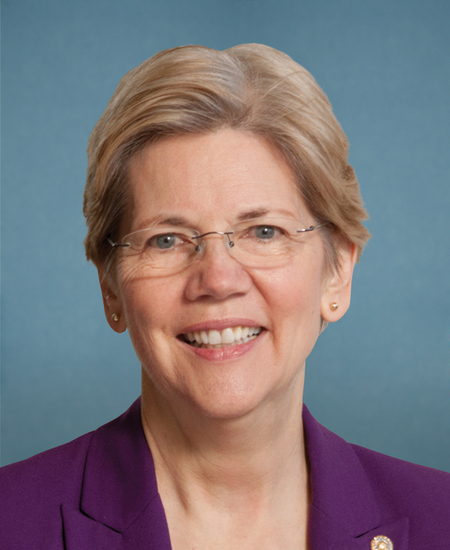
Sen. Elizabeth Warren
Sponsored bills
Safe Gun Storage Act of 20 21 This bill requires safety standards for firearm locks and safes. Under such standards, firearm locks must be reasonably designed to (1) prevent the firearm from discharging while the lock is activated, and (2) prevent unauthorized access to the firearm. Further, firearm safes must be reasonably designed to (1) secure firearms, and (2) prevent unauthorized access to the safe through physical manipulation or damage.
Accelerating Access to Critical Therapies for ALS Act This bill establishes grant programs to address neurodegenerative diseases, such as amyotrophic lateral sclerosis (also known as ALS or Lou Gehrig's disease), and contains other related provisions. The Department of Health and Human Services (HHS) shall award grants to eligible entities to facilitate patients' access to investigational drugs that diagnose or treat ALS. The Food and Drug Administration (FDA) shall award grants to public and private entities to cover the costs of research and development of drugs that diagnose or treat ALS and other severely debilitating neurodegenerative diseases. HHS shall also establish the Public-Private Partnership for Neurodegenerative Diseases between the National Institutes of Health, the FDA, and at least one eligible entity (generally, an institution of higher education or a nonprofit organization). The partnership shall support the development and regulatory review of drugs that address ALS and other rare neurodegenerative diseases. The FDA shall publish on its website a five-year action plan for fostering the development of drugs that improve or extend the lives of people living with rare neurodegenerative diseases.
Conrad State 30 and Physician Access Reauthorization Act This bill modifies the Conrad 30 Waiver program, which incentivizes qualified foreign physicians to serve in underserved communities. It also extends statutory authority for the program for three years from this bill's enactment. Aliens coming to the United States under a J-1 nonimmigrant visa to receive medical training typically must leave the country and reside for two years abroad before being eligible to apply for an immigrant visa or permanent residence. The Conrad program waives this requirement for individuals who meet certain qualifications, including serving for a number of years at a health care facility in an underserved area. The bill increases the number of waivers that a state may obtain each fiscal year from 30 to 35 if a certain number of waivers were used the previous year, and provides for further adjustments depending on demand. An alien physician may be employed at an academic medical center to meet the Conrad program's employment requirements if the alien's work is in the public interest, even if the medical center is not in an underserved area. Employment contracts for alien physicians under the Conrad program shall contain certain information, such as the maximum number of on-call hours per week the physician shall have to work. Certain alien physicians (along with the physician's spouse and children) shall be exempt from the direct annual numerical limits on immigration, including those physicians that have met certain requirements related to visas for physicians to serve in underserved areas.
Voters on the Move Registration Act of 2021 This bill requires the Consumer Financial Protection Bureau to develop, and specified agencies to distribute, a statement providing individuals with information on how to register to vote and their voting rights. This information must be provided to individuals upon their participation in certain rental assistance programs or application for certain residential mortgages.
Extreme Risk Protection Order Act of 2021 This bill establishes grants to support the implementation of extreme risk protection order laws at the state and local levels, extends federal firearms restrictions to individuals who are subject to extreme risk protection orders, and expands related data collection. Extreme risk protection order laws, or red flag laws, generally allow certain individuals (e.g., law enforcement officers or family members) to petition a court for a temporary order that prohibits an at-risk individual from purchasing and possessing firearms. Among its provisions, the bill directs the Department of Justice to establish a grant program to help states, local governments, Indian tribes, and other entities implement extreme risk protection order laws; extends federal restrictions on the receipt, possession, shipment, and transportation of firearms and ammunition to individuals who are subject to extreme risk protection orders; and requires the Federal Bureau of Investigation to compile records from federal, tribal, and state courts and other agencies that identify individuals who are subject to extreme risk protection orders.
Restoring the IRS Act This bill provides additional appropriations after FY2021 for the expenses of the Internal Revenue Service (IRS) for taxpayer services, enforcement activities, and business systems modernization. The bill establishes new reporting requirements for certain banks or other financial institutions and increases enforcement penalties for accuracy-related underpayments of tax up to a maximum of 40% of the underpayment for taxpayers with taxable incomes greater than $5 million. The IRS must report to Congress annually on plans to shift more of its auditing and enforcement assets toward high-income tax filers. The report must also include a tax gap analysis and a comprehensive analysis and description of whether there are any racial disparities in its enforcement activities or audits. The bill also applies false claims rules to claims, records, or statements made by taxpayers whose gross income equals or exceeds $10 million for the taxable year, and the damages sustained by the government due to such false claims exceed $1 million.
Pursuing Equity in Mental Health Act This bill establishes and expands programs to address racial and ethnic disparities in mental health. Specifically, the Department of Health and Human Services (HHS) must award grants to establish interprofessional behavioral health care teams in areas with a high proportion of racial and ethnic minority groups. In addition, HHS may award grants to incorporate best practices and competencies to address mental health disparities in curricula for training social workers, psychologists, and other behavioral health professionals. HHS must also promote behavioral and mental health and reduce stigma associated with mental health conditions and substance use disorder through outreach to racial and ethnic minority groups. HHS must consult with appropriate advocacy groups and behavioral health organizations to develop a strategy for this outreach. The bill also (1) reauthorizes the minority fellowship program to support the education of mental health professionals who provide services to racial and ethnic minorities, and (2) requires studies on mental health disparities and the effects of social media use on adolescents.
Diversifying by Investing in Educators and Students To Improve Outcomes For Youth Act or the Diversify Act This bill revises the Teacher Education Assistance for College and Higher Education (TEACH) grant program. The TEACH program awards grants to undergraduate and graduate students who commit to teaching in a high-need field and in an elementary or secondary school that serves low-income students. First, the bill raises the maximum amount for TEACH grants. Second, the bill allows TEACH grants to cover the full cost of attendance. Currently, these grants may be used only for tuition, fees, and on-campus housing. The bill allows teaching in a high-need early childhood education program to count toward service requirements for the program. Next, the bill eliminates the process for converting a TEACH grant to a loan if a recipient does not complete the requirements of the program. Further, the bill prohibits the Department of Education (ED) from instituting or creating a monetary penalty for failure or refusal to complete the service requirement. In addition, the bill requires ED to send an electronic certificate to grant recipients who have completed their service requirement. The bill also exempts the TEACH program from sequestration, which is a process of automatic, usually across-the-board spending reductions under which budgetary resources are permanently cancelled to enforce specific budget policy goals.
Retirement Savings Lost and Found Act of 2021 This bill establishes an online Retirement Savings Lost and Found (RSLF), managed by the Pension Benefit Guaranty Corporation (PBGC), to assist individuals in locating certain employer-sponsored retirement accounts. The RSLF must provide plan participants or beneficiaries only with the ability to view contact information for the administrator of a plan that is sufficient to locate the plan. The bill sets forth additional reporting and notification requirements for retirement plans. The PBGC must take precautions to (1) safeguard the privacy and security of participants' plan information, and (2) permit plan participants to opt out of inclusion in the RSLF. The bill also revises provisions that permit mandatory distributions of the balances of small retirement accounts using a rollover into an Individual Retirement Account (IRA). The bill modifies the investment options available for the distributions and increases the maximum account balance that may be subject to such a distribution. A plan must transfer unclaimed mandatory distributions that are $1,000 or less to the RSLF, and the RSLF must pay the balance upon locating a plan participant or beneficiary.