

Maddy summary# Summary of the Gun Violence Prevention and Community Safety Act of 2023 This comprehensive legislation proposes significant gun control measures with several key provisions: 1. **Restrictions on Semiautomatic Assault Weapons**: - Requires background checks for transfers of grandfathered semiautomatic assault weapons - Mandates secure storage requirements for these weapons - Includes a buy-back program for these weapons 2. **Bans on Untraceable Firearms**: - Prohibits "ghost guns" (firearms without serial numbers) - Requires all firearms to have unique serial numbers - Bans the distribution of 3D printing files for firearms 3. **Prohibition on Certain Accessories**: - Bans bump-fire devices and trigger cranks - Bans firearm silencers and mufflers (with limited exceptions for law enforcement) 4. **Dealer and Manufacturer Requirements**: - Mandates enhanced security measures for gun dealers - Requires annual security inspections - Requires employee background checks - Increases record keeping requirements - Requires reporting of lost or stolen firearms 5. **Restrictions on Multiple Purchases**: - Prohibits purchasing more than one firearm within a 30-day period 6. **Research and Community Programs**: - Creates a $120 million annual grant program for community violence intervention - Funds $60 million annually for research on gun violence prevention - Establishes a Community Violence Intervention Fund 7. **Increased Taxes**: - Increases excise taxes on firearms (30%) and ammunition (50%) - Allocates 39% of ammunition tax revenue to violence prevention programs The legislation also repeals certain provisions of the Protection of Lawful Commerce in Arms Act and modifies various existing firearms laws to strengthen federal gun control measures.
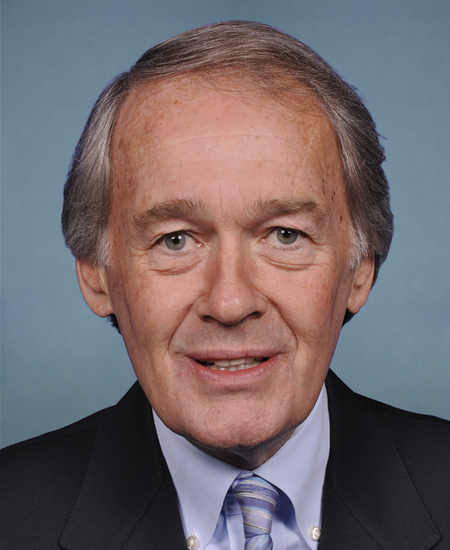
Sen. Edward J. Markey
Sponsored bills
Maddy summaryThe WEATHER Act of 2023 would create a new federal crop insurance policy to protect farmers from income losses caused by specific weather events like drought, floods, extreme heat, wildfires, and hail. This policy would cover all 50 states and territories, allowing farmers to adjust coverage levels (from 5% to 150% of the median county farm income) and offering faster payments (within 30 days) after a weather event. It prioritizes support for small-scale farms (under $350,000 income) and underserved producers, with reduced paperwork and special consideration for on-farm processing losses. The bill requires the federal crop insurance corporation to research and develop this policy, report findings within one year, and recommend next steps to Congress - making it a proposal for future policy, not an immediate law.
Maddy summaryThe End Solitary Confinement Act (S 3409) would prohibit solitary confinement in Federal correctional facilities, requiring all incarcerated people to have at least 14 hours daily of out-of-cell congregate interaction including programming, recreation, and social activities. The bill establishes strict limits on confinement (no more than 4 hours total in a 24-hour period for emergencies), creates a community monitoring body to oversee compliance, and provides incentives for states to adopt similar standards by tying federal funding to compliance. It also includes due process protections for people placed in restrictive housing, requiring neutral hearings with legal representation and medical assessments. The bill directly affects all people incarcerated in Federal facilities and would impact state and local facilities receiving Federal funding through the Edward Byrne Memorial Justice Assistance Grant Program.
Maddy summaryThis resolution (SRES 464) expresses the U.S. Senate's support for Transgender Day of Remembrance by recognizing the epidemic of violence against transgender people in the U.S. and memorializing those who died in acts of violence between October 2022 and September 2023. It specifically highlights the disproportionate impact on transgender women of color and references 33 documented fatalities in 2023. The resolution does not create new laws or policies but formally acknowledges the crisis and honors victims, aligning with the annual observance established to remember transgender lives lost to violence.
Maddy summaryThis bill requires commercial fishing vessel operators and crew to receive safety training addressing behavioral and physical health risks, including substance use disorder and fatigue. It increases annual funding for these programs from $3 million to $6 million for fiscal years 2024 and 2025. The bill also allows the Department of Transportation to transfer funds to the Department of Health and Human Services to administer the training grant programs. These changes directly affect commercial fishing crews and vessel operators by mandating new wellness-focused safety training and providing dedicated funding for implementation.
Maddy summaryThe Ensuring Safe and Toxic-Free Foods Act of 2023 requires the Food and Drug Administration (FDA) to revise its rules for determining if food substances are "generally recognized as safe" (GRAS), with stricter safety standards. Manufacturers must now provide evidence that a substance does not cause cancer, reproductive harm, or disproportionately affect vulnerable populations (such as children, pregnant women, or older adults) before marketing it as GRAS. The FDA must publish a revised rule within one year, including public access to all GRAS determinations and a 90-day review period for public feedback. Additionally, the bill creates a new FDA office to reassess the safety of at least 10 food substances every three years, focusing on cumulative health impacts and safety factors for vulnerable groups.
Maddy summaryThe EFFECTIVE Food Procurement Act (S 3390) requires the U.S. Department of Agriculture (USDA) to change how it purchases food, directing it to prioritize foods from specific groups and categories. It mandates USDA to increase purchases from beginning/veteran/socially disadvantaged farmers, foods supporting worker rights (like unionized vendors), climate-friendly options (with deforestation policies), and diversified supply chains (like local food hubs). The bill also requires annual public reports tracking spending across these categories and greenhouse gas emissions from USDA food procurement. This directly affects USDA’s $10+ billion annual food procurement programs, impacting small farms, food banks, school meal programs, and food suppliers nationwide.
Maddy summaryThe GOSAFE Act prohibits the sale, manufacture, transfer, and possession of gas-operated semi-automatic firearms and large capacity ammunition magazines (holding more than 10 rounds) in interstate or foreign commerce, with limited exceptions for law enforcement, pre-enactment owners, and certain firearms like single-shot weapons. It requires the Attorney General to publish a list of prohibited firearms within 180 days and establishes a process for manufacturers to seek approval for new firearm designs before selling them to civilians. The bill also authorizes buy-back programs using Byrne grants to compensate individuals who surrender prohibited firearms and magazines, with penalties including fines up to $5,000 or up to 12 months in prison for violations.
Maddy summaryThe Billionaires Income Tax Act requires individuals with annual income over $100 million or assets over $1 billion to pay taxes annually on their wealth gains, rather than deferring taxes through strategies like "buy, borrow, die." It eliminates tax deferral by implementing mark-to-market taxation, requiring billionaires to pay tax on asset appreciation each year as if they had sold the assets. The bill closes loopholes that allow the ultra-wealthy to transfer assets tax-free to heirs, requiring heirs to pay tax on gains when they sell assets. This means billionaires would pay taxes on their income as it's earned, just like working people pay taxes on wages.
Maddy summaryThe Beyond the Box for Higher Education Act of 2023 directs the U.S. Department of Education to provide guidance to colleges and universities on removing criminal and juvenile justice history questions from admissions applications. It recommends institutions evaluate whether such questions are necessary, and if kept, requires specific safeguards like delaying inquiries until after admission decisions and training staff on handling this information fairly. The bill also mandates training for admissions, financial aid, and campus employment staff on supporting students with justice system involvement, and establishes a resource center for best practices. This policy directly affects higher education institutions and applicants with criminal or juvenile records, aiming to reduce barriers to college access. The guidance focuses on concrete changes to application processes, not on altering enrollment outcomes or funding.