

Maddy summaryThe John R. Lewis Voting Rights Advancement Act of 2024 updates the Voting Rights Act of 1965 to strengthen protections against voting discrimination. It clarifies how to prove vote dilution, denial, or abridgement claims and expands the types of voting changes requiring federal preclearance, including changes to election methods, boundaries, voter ID requirements, and polling locations. The bill requires states to provide public notice of voting changes at least 48 hours in advance and mandates transparency about demographic data related to polling places. This legislation directly affects states and political subdivisions with a history of voting rights violations, aiming to protect minority voters from discriminatory voting practices.
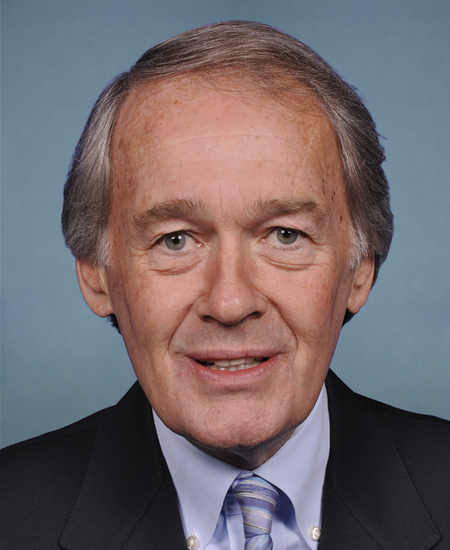
Sen. Edward J. Markey
Sponsored bills
Maddy summaryThe Connect the Grid Act of 2024 removes special exemptions for Texas' ERCOT grid, requiring it to connect with neighboring grids (SPP, MISO, and the Western Interconnection) by mandating minimum electricity transfer capacity - such as 4.3-12.6 gigawatts between ERCOT and SPP. It requires grid operators to jointly submit plans by 2025 for new or upgraded transmission projects, prioritizing grid-enhancing technologies, existing infrastructure corridors, degraded land sites (like brownfields), and community engagement with environmental justice and Tribal communities. The bill also increases federal transmission funding by $11 billion and directs a study on benefits of interconnecting U.S. and Mexican power facilities. This directly affects ERCOT, neighboring grid operators, and communities near proposed transmission projects.
Maddy summaryThis bill amends the Food and Nutrition Act to exclude certain Social Security payments from income calculations for SNAP (Supplemental Nutrition Assistance Program) eligibility. Specifically, it adds a new exclusion for "supplementary payments" under Section 1616(a) of the Social Security Act (42 U.S.C. 1382e(a)), which affects SNAP recipients who receive these payments. The change modifies the effective date for income calculations from July 1 to January 1 for these payments. The policy takes effect October 1, 2024, directly impacting SNAP beneficiaries whose income includes these excluded Social Security payments.
Maddy summarySRES 553 is a ceremonial Senate resolution honoring Jean A. Carnahan, who served as Missouri’s first female U.S. Senator from 2001 to 2002 after her husband’s passing. The resolution expresses the Senate’s sorrow over her death, recognizes her service as First Lady of Missouri and U.S. Senator, and her advocacy for families and veterans. It directs the Senate Secretary to share the resolution with the House and Carnahan’s family, with no substantive policy changes or affected parties. This is a standard commemorative measure with no legislative impact.
Maddy summarySRES 551 is a symbolic Senate resolution (not a law) introduced by multiple senators on February 8, 2024, to formally celebrate Black History Month. It acknowledges the historical contributions of African Americans to U.S. society and encourages the public to reflect on their legacy during February. The resolution contains no new policies or requirements - it simply expresses the Senate's recognition of Black History Month as an opportunity to honor these contributions and learn from history. It does not affect any individuals, groups, or government programs. This is a standard annual commemorative resolution, consistent with similar resolutions passed each February.
Maddy summaryS 2385, the Tribal Access to Clean Water Act of 2023, provides federal funding to improve clean water access for Native American and Native Hawaiian communities. It authorizes $100 million annually (2024-2028) through the USDA for water infrastructure projects, $30 million for technical assistance to help tribes access funding, and $100 million annually for operation/maintenance of water facilities. The bill directly affects tribes and Native Hawaiian communities where nearly half lack reliable water access, addressing gaps in existing infrastructure funding. Key provisions include no requirement for matching funds, prioritization for communities most in need, and long-term maintenance support for completed projects.
Maddy summaryThis bill removes a barrier for people with disabilities seeking elected office by ensuring campaign work they perform doesn't affect their eligibility for federal or state benefits. Specifically, it requires that any campaign work done by a candidate with a disability - and any compensation received for that work - be disregarded when calculating benefits under programs like Social Security Disability Insurance (Title II) or Supplemental Security Income (Title XVI). This means individuals receiving disability benefits could run for office without risking loss of support due to campaign earnings. The law directly affects disabled candidates for federal, state, or local office who rely on these benefits.
Maddy summaryThe Accessible Voting Act of 2024 establishes an Office of Accessibility within the Election Assistance Commission to advocate for voters with disabilities, older individuals (60+ years), Native Americans, Alaska Natives, and those with limited English proficiency. It requires states to create accessible election websites with voting information, designate a single office to provide voting assistance to these groups, and ensure polling places are fully accessible. The bill expands access to absentee voting for all voters, prohibits denying voting rights based solely on guardianship status, and provides $100 million in federal funding for states to implement these accessibility requirements. These provisions aim to address longstanding barriers to voting experienced by approximately 28.7 million voting-age individuals with disabilities and 26 million people with limited English proficiency.
Maddy summarySenate Resolution 540 requests the U.S. State Department to provide Congress with a detailed report within 30 days on Azerbaijan's human rights practices, including specific violations like unlawful killings, torture, and restrictions on freedom of speech. The report must cover Azerbaijan's treatment of ethnic Armenians, judicial independence, and assessments of U.S. security assistance to Azerbaijan. This resolution does not alter existing law but mandates a review to inform future U.S. policy decisions regarding aid and diplomatic engagement.
Maddy summarySRES 529 is a symbolic Senate resolution recognizing January 2024 as "National Mentoring Month." It does not create new laws or allocate funds, but formally acknowledges the value of mentoring relationships for youth development. The resolution highlights mentoring's benefits - including improved academic outcomes, mental health, and career readiness - while noting that one-third of U.S. youth lack a mentor. It urges support for mentoring programs but has no direct effect on individuals or policy implementation.