

Maddy summaryThis bill directs the EPA, Energy Department, and other agencies to study AI's full environmental lifecycle impacts - including energy use, water consumption, e-waste, and pollution from hardware and data centers - within two years. It establishes a voluntary reporting system for AI developers and operators to share data on their environmental footprint, along with a stakeholder consortium to create standardized measurement tools. The bill requires a public report to Congress within four years detailing study findings, the reporting system, and recommendations for reducing negative impacts or promoting positive ones. It affects companies developing or operating AI systems (designated as "voluntary reporting entities") but does not mandate specific actions or penalties.
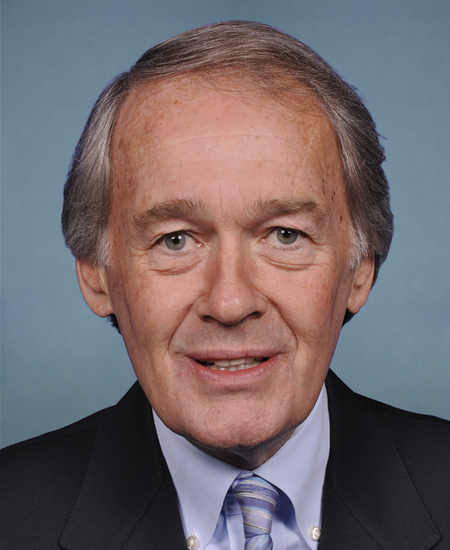
Sen. Edward J. Markey
Sponsored bills
Maddy summaryThis bill expands access to methadone treatment for opioid use disorder by allowing more healthcare providers to prescribe it for unsupervised use through pharmacies. Specifically, it waives federal restrictions to permit addiction medicine specialists, program employees, and certified physicians to prescribe methadone electronically for 30-day supplies, with patients receiving it directly from pharmacies instead of only through specialized clinics. The bill requires annual reporting to Congress on the number of registered providers, patients served, and participating states. It directly affects patients with opioid use disorder seeking treatment and healthcare providers currently authorized to prescribe methadone.
Maddy summaryThe GRACE Act establishes a minimum annual refugee admission level of 125,000, requiring the U.S. to admit at least that many refugees each fiscal year unless the President sets a higher number (with 125,000 automatically applying if no determination is made). It mandates that the President consider the United Nations High Commissioner for Refugees' global resettlement needs when setting annual numbers and allocate refugees regionally, including an unallocated reserve for unexpected regional needs after notifying Congress. The bill also requires quarterly reports to Congress on refugee admissions, including regional breakdowns, security clearance rates, processing times, and plans to meet annual goals, enhancing transparency in the refugee admissions process.
Maddy summaryThe Human Rights Defenders Protection Act of 2024 establishes a comprehensive U.S. strategy to protect global human rights defenders facing violence, threats, and reprisals for their work. It creates a new visa category (101(a)(15)(W)) allowing human rights defenders at urgent risk to enter the U.S. for safety, while requiring the President to develop an annual strategy for U.S. embassies to monitor threats, train diplomats, and coordinate protection efforts. The bill mandates U.S. embassies to identify designated points of contact for human rights defenders, track patterns of reprisals, and integrate protection measures into diplomatic and development activities. It also expands the Reagan-Fascell Democracy Fellows Program to support democracy advocates at risk and requires annual country reports detailing treatment of human rights defenders worldwide. The legislation directly affects human rights defenders advocating for environmental protection, democracy, women's rights, minority rights, and LGBTQI+ rights who face threats from governments or non-state actors.
Maddy summaryS 3694 (SWIMS Act of 2024) bans the public display of orcas, beluga whales, false killer whales, and pilot whales by prohibiting their export, import, taking, and breeding for such purposes under federal law. It directly affects marine parks, aquariums, and facilities that currently display these species, requiring any movement to be for sanctuary placement (non-profit, natural-environment settings) or wild release. The bill amends the Marine Mammal Protection Act and Animal Welfare Act to make it unlawful to permit these whales for public display or breeding for display, while allowing limited exceptions for individual animal well-being in designated sanctuaries.
Maddy summaryThis bill provides federal grants to states to help recruit and retain paraprofessionals - school support staff like teaching assistants - in public elementary, secondary, and preschool programs. States receive funds based on prior Title I funding and distribute them via competitive subgrants to school districts or consortia serving high-need schools (e.g., those with many low-income students or rural locations). Funds can support wage increases, bonuses, mentoring programs, professional development, and credentials like special education or English learner certifications. The bill prioritizes schools serving high-need populations and requires annual reporting on wage baselines and retention outcomes.
Maddy summaryS 3688, the FAIR Act, sets pay adjustments for federal employees in 2025. It increases base pay by 4% for most federal workers covered under statutory pay systems and prevailing rate employees (those paid according to local market rates). Additionally, it raises locality pay adjustments by 3.4% for 2025. The bill directly affects all federal employees whose pay is determined under these specific pay systems. These changes are mandated by statute and apply to calendar year 2025.
Maddy summaryThis bill increases civil penalties for violations of the Consumer Product Safety Act. It raises the maximum penalty per violation from $100,000 to $250,000 and requires annual adjustments for inflation using the Consumer Price Index. These changes directly affect manufacturers and sellers of consumer products who face safety violations. The key mechanism is an automatic inflation adjustment process that updates penalty amounts each year, rounded to the nearest $1, based on the previous year's Consumer Price Index data.
Maddy summaryThe Complete Streets Act of 2024 requires states to establish programs that ensure transportation infrastructure accommodates all users, including pedestrians, cyclists, public transit riders, and motorists, with a focus on safety and accessibility for people of all ages and abilities. States must create competitive grant programs for eligible entities (such as local governments, transit agencies, and tribal governments) to design and construct complete streets projects, using 5% of their transportation funds. The bill sets minimum standards for complete streets policies and design requirements, including protected bike lanes, accessible sidewalks, and appropriate lighting, with new projects required to comply within 2-5 years. It prioritizes projects in areas where nonmotorized users are most vulnerable and mandates states to report on their implementation progress.
Maddy summaryThe GREEN Streets Act requires states to establish minimum standards for reducing greenhouse gas emissions on public roads, including decreasing per capita vehicle miles traveled and improving transportation system resilience. It mandates that states analyze projects increasing traffic capacity before approval, with special consideration for environmental justice communities that experience higher health or environmental impacts. States failing to meet emissions targets must obligate more federal funds toward emissions-reducing projects like transit expansion, active transportation infrastructure, or land use changes. The bill also establishes new performance measures for transit accessibility, stop distance, and mode share that metropolitan areas must report on annually. This legislation directly affects state transportation departments, metropolitan planning organizations, and public transit agencies across the country.