

Maddy summaryThe A. Donald McEachin Environmental Justice For All Act requires all federal agencies to address disproportionate environmental burdens faced by communities of color, low-income communities, Tribal and Indigenous communities, and other vulnerable populations. Key provisions include mandating federal agencies to develop environmental justice strategies, consider cumulative impacts in permitting decisions, establish an Environmental Justice Clearinghouse, and create grant programs for environmental justice communities. The bill also creates a White House Environmental Justice Interagency Council to coordinate federal efforts and requires federal employees to complete environmental justice training. It strengthens community protections under the National Environmental Policy Act by requiring agencies to assess potential impacts on environmental justice communities before approving projects. The legislation directly affects federal agencies, environmental justice communities, and communities disproportionately burdened by pollution and environmental hazards.
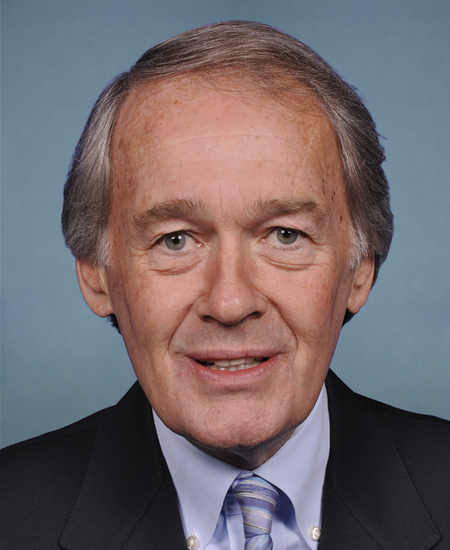
Sen. Edward J. Markey
Sponsored bills
Maddy summaryThis bill amends U.S. foreign aid law to remove restrictions preventing federal funds from supporting abortion services as part of comprehensive reproductive health care. It directly affects U.S. international health programs and people in low- and middle-income countries who rely on U.S.-funded reproductive health services. The key provision explicitly allows foreign assistance funds to cover abortion services, training, and equipment for safe abortion care, alongside other reproductive health services. This changes how U.S. aid is allocated globally, aiming to increase access to safe abortion care in countries where it is legal.
Maddy summaryThe New Deal for New Americans Act of 2023 establishes a National Office of New Americans within the Executive Office of the President to coordinate federal efforts supporting immigrant and refugee integration. The bill creates multiple grant programs including Legal Services and Immigration Assistance, English as a Gateway to Integration, and Workforce Development and Shared Prosperity grants to provide legal assistance, language training, and job skills development. It includes specific provisions to reduce barriers to citizenship, such as waiving English requirements for seniors, reducing naturalization fees, and creating a "Proud to Be a United States Citizen" outreach program. The bill also establishes automatic voter registration for newly naturalized citizens and includes provisions for refugee resettlement and integration support. These measures directly affect immigrants and refugees seeking to integrate into U.S. society and become citizens.
Maddy summaryThe E-BIKE Act (S 881) creates a 30% federal tax credit for individuals who purchase new, qualified electric bicycles, up to $5,000 per bike. It directly affects individual consumers by reducing the cost of qualifying e-bikes, which must meet specific safety and technical standards (e.g., motors under 750 watts, speed limits of 20-28 mph, UL 2849 certification, and unique VIN labeling). The credit phases out for higher earners, with income limits of $150,000 (single), $225,000 (head of household), and $300,000 (joint returns). The bill also includes rules to prevent double benefits and requires retailers to provide clear pricing details if consumers transfer the credit to them at purchase.
Maddy summarySRES 114 is a non-binding Senate resolution urging Thailand's government to protect democratic rights and human rights. It specifically calls on Thailand to release political activists (including over 280 children), drop charges against protesters, stop using spyware against dissidents, and abandon restrictive laws like the Draft Act on Not-for-Profit Organizations. The resolution also demands reforms to Thailand's lèse majesté law, sedition laws, and computer crime statutes that limit free expression. It warns that continued rights violations would prevent the U.S. from recognizing Thailand's 2023 elections as fair, and could jeopardize U.S. security and economic assistance.
Maddy summaryThis bill allows federal appellate and district court judges to permit public media coverage (photography, recording, broadcasting) of court proceedings, subject to specific rules. Judges may deny coverage if it violates due process rights, and must obscure the identity of vulnerable witnesses (like crime victims, minors, or undercover officers) upon request or if safety is threatened. The law prohibits broadcasting jurors, attorney-client conferences, and requires judges to follow new guidelines for witness protection within six months. The district court media allowance expires after three years.
Maddy summarySRES 109 is a Senate resolution requesting the U.S. State Department to provide a detailed report on Saudi Arabia’s human rights practices within 30 days. It requires the State Department to include documented information on alleged violations - such as torture, executions for nonviolent offenses, discrimination against women, religious restrictions, forced disappearances, and actions in Yemen - along with U.S. efforts to promote human rights and assess whether security assistance should continue. The resolution also asks for specifics on end-use monitoring of weapons sold to Saudi Arabia, impacts on Israel’s military edge, and actions regarding U.S. citizens detained or harassed by Saudi authorities. This is a procedural request for information under existing law, not a policy change.
Maddy summaryThis is a ceremonial Senate resolution (SRES 110) honoring the late James George Abourezk, the first Arab American to serve in the U.S. Senate (1973-1979) from South Dakota. It commemorates his legacy, including his work re-establishing the Senate Committee on Indian Affairs and co-authoring key Native American rights legislation like the Indian Child Welfare Act. The resolution directs the Senate to adjourn in his memory and send a copy to his family, acknowledging his service as a representative and advocate for Native American communities. As a procedural resolution, it has no legislative effect beyond commemoration.
Maddy summaryThe CARE for Long COVID Act establishes a national patient registry to collect data on Long COVID symptoms, treatments, and demographic information to improve understanding of the condition. It allocates $30 million for the registry in 2024, $15 million for research on healthcare disparities related to Long COVID, and $30 million annually for public and provider education programs about symptoms and treatments. The bill also creates interagency coordination to inform people about their rights in employment, education, and disability benefits related to Long COVID, with $30 million annually for this purpose. Additionally, it provides $50 million annually to support legal and social services assistance for people with Long COVID seeking disability benefits, healthcare access, and other services. The bill directly affects individuals with Long COVID, healthcare providers, and legal service organizations by improving data collection, education, and access to support services.
Maddy summaryS 817, the SVB Act, repeals Title IV of the 2018 Economic Growth, Regulatory Relief, and Consumer Protection Act (Public Law 115-174). This bill restores the banking regulations that existed before Title IV was enacted, effectively undoing the 2018 changes to financial oversight. It directly affects banking regulations governing financial institutions by reverting to the prior regulatory framework. The key mechanism is the explicit repeal of Title IV and the restoration of pre-2018 provisions as if the 2018 law had never applied.