

Maddy summaryThis bill establishes emergency grants to health care facilities for hazard pay to essential workers during declared emergencies. It directly affects health care workers who cannot work remotely (like nurses, lab techs, and facility cleaners) during federal, state, or local disasters. Facilities receive funds to pay up to $13 per hour in hazard pay (capped at $25,000 yearly per worker) or for safety measures like PPE and transit options. The pay applies only when work or commutes are deemed hazardous by the Secretary during qualifying emergencies.
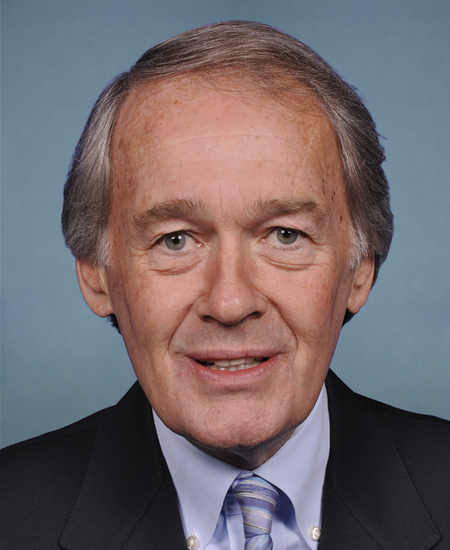
Sen. Edward J. Markey
Sponsored bills
Maddy summaryThe Smarter Approaches to Nuclear Expenditures Act (S 1754) imposes specific spending limits and prohibitions on U.S. nuclear weapons programs to address cost concerns. It caps deployed strategic warheads at 1,000 (aligned with New START Treaty definitions), limits submarines to eight Columbia-class vessels, restricts intercontinental ballistic missiles to 150, and bans funding for new systems like the F-35 nuclear mission, W76-2 warheads, LGM-35 Sentinel ICBMs, and new submarine-launched cruise missiles. The bill also prohibits expansion of plutonium pit production without congressional reporting and bans the W-93 warhead and space-based missile defense development. Required reports will track implementation, cost savings, and annual nuclear program spending to ensure accountability.
Maddy summaryThis bill designates the U.S. Postal Service facility at 25 Dorchester Avenue, Room 1, in Boston, Massachusetts, as the "Caroline Chang Post Office." It directly affects the postal facility and all official U.S. government references to it. The key provision updates all federal documents, maps, and records to use the new name, ensuring consistency in official communications. This is a ceremonial naming resolution with no policy changes or funding impacts.
Maddy summarySRES 221 is a Senate resolution supporting National Minority Health Month in April 2023 by raising awareness of health disparities affecting specific minority populations. It highlights documented inequities, such as higher rates of diabetes, cancer, and mortality among American Indians, Alaska Natives, Asian Americans, African Americans, Hispanics, and Native Hawaiians or Pacific Islanders compared to non-Hispanic White populations. The resolution does not create new laws or allocate funding but serves as a symbolic acknowledgment of these disparities through a series of cited statistics from health data. It aims to promote public understanding of these issues during the designated awareness month.
Maddy summaryThis resolution (SRES 209) is a symbolic Senate measure recognizing May as Asian American, Native Hawaiian, and Pacific Islander Heritage Month. It formally celebrates the historical contributions of these communities to the United States, highlighting their diverse cultural impact and achievements. The resolution does not create new laws or policies - it simply encourages the Senate to observe the month with recognition of these communities' roles in U.S. history. It follows longstanding tradition, as May was chosen to honor key milestones including the arrival of Japanese immigrants and Chinese laborers on the transcontinental railroad.
Maddy summaryThe Democracy Restoration Act of 2023 (S 1677) would restore voting rights for most U.S. citizens with criminal convictions who are not serving a felony sentence in prison. It requires states to notify individuals when they regain voting rights, with specific timelines for notification after sentencing or release from custody. The bill prohibits states from requiring payment of fines or fees to restore voting rights, affecting over 4.6 million disenfranchised citizens. It applies only to federal elections and would take effect for elections held after enactment.
Maddy summaryThis bill creates a federal grant program to fund training for law enforcement officers on interacting with people with disabilities and older adults with cognitive impairments. Nonprofit disability organizations will receive grants to develop training programs requiring at least 8 hours of mandatory training for new officers (including 4 hours of interactive learning with covered individuals) and 4 hours of annual refresher training for existing officers. The training covers communication strategies, de-escalation techniques, identifying disabilities, and community resources, with a requirement that covered individuals serve as instructors. Funded at $100 million annually through 2026, the program aims to reduce violent encounters based on findings that people with disabilities are 2.5 times more likely to be victims of violent crime and disproportionately affected by police violence.
Maddy summaryThe EVs for All Act of 2023 establishes a Department of Energy grant program to fund electric vehicle (EV) sharing services at public housing projects. It provides grants (up to $1 million per project, with $50,000 additional per fast charger) to public housing agencies, local governments, and nonprofits for purchasing used EVs, installing charging equipment, and running community outreach. The bill requires projects to prioritize marginalized communities with high pollution or transportation barriers, mandates 40% local workforce hiring with specific demographic targets, and ensures affordable charging fees. Grants also require tracking emissions reductions, user data, and adherence to fair labor standards for EV infrastructure installation. The program is funded at $50 million annually from 2024-2033.
Maddy summaryThe Neighbors Not Enemies Act (S 1747) repeals sections 50 U.S.C. 21-24, which formed the Alien Enemies Act - a law permitting the president to detain or deport non-citizens from enemy nations during wartime. This repeal removes a specific wartime authority from U.S. law, directly affecting the executive branch's legal powers during conflicts and non-citizens potentially subject to such actions. The bill does not create new policies but eliminates an existing legal provision without altering other immigration or national security statutes. It focuses solely on repealing this historical wartime measure, with no new requirements or affected groups beyond the scope of the repealed law.
Maddy summaryThe Responsible Firearms Marketing Act requires the Federal Trade Commission (FTC) to study firearm advertising practices, specifically examining ads that may target minors, imply illegal use, or promote semiautomatic assault weapons. Within two years, the FTC must report findings and recommend regulations to ban such deceptive practices. If enacted, the FTC would create rules prohibiting firearm manufacturers, dealers, and importers from using ads that appeal to children, suggest illegal activity, or market assault weapons. The law would apply existing FTC enforcement authority under the Federal Trade Commission Act to these new regulations. This directly affects gun industry businesses by restricting certain advertising tactics.