

Maddy summaryThe "Fight Inflation Through Balanced Budgets Act" requires Senate budget resolutions to include a plan to eliminate the deficit within nine years, or face a point of order that can only be overridden by a two-thirds vote. It also creates a point of order to strike appropriations exceeding legally authorized spending levels (or $0 if no authorization exists), which would be removed from bills unless waived by a three-fifths vote. The bill further restricts waiver procedures by prohibiting multiple waivers in a single motion and requiring that waiver requests follow a specific point of order being raised. These rules apply directly to Senate budget and appropriations processes, aiming to enforce fiscal discipline through procedural barriers.
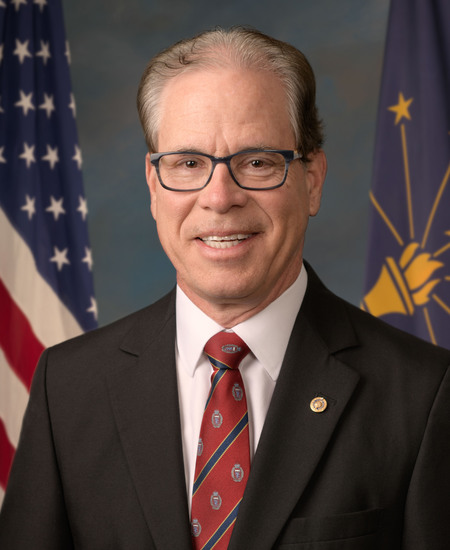
Sen. Mike Braun
Sponsored bills
Maddy summaryThis bill prevents brand-name drug companies from using patents related to drug safety programs (REMS) to delay generic drug approvals. It ensures that generic drug makers' certifications about these safety program patents do not delay their applications' approval dates. The bill also limits legal claims against generic makers who use safety program elements, allowing only monetary damages for infringement - not injunctions. It does not change required safety programs or affect antitrust laws. The bill directly affects drug manufacturers seeking approvals under FDA regulations and generic drug applicants.
Maddy summaryThis bill amends a 2000 law restricting U.S. military contacts with China's People's Liberation Army (PLA). It narrows the scope of prohibited interactions by changing "Advanced logistical operations" to "Logistical operations" and removes an existing exception (subsection (c)). The policy change directly affects U.S. military personnel and Chinese military officials by banning all military logistical coordination with the PLA, not just advanced operations. It does not create new restrictions but clarifies and tightens existing ones. The bill focuses on preventing potential security risks during military logistical exchanges.
Maddy summaryS 606, the "Protecting Americans from Dangerous Opioids Act," requires the Health Secretary to revoke approval of an existing opioid drug whenever a new opioid is approved. Specifically, the Secretary must prioritize revoking non-abuse deterrent opioid formulations and consider public health impact when choosing which drug to remove. This directly affects opioid manufacturers and prescribers by reducing the number of less-safe opioid options available on the market. The bill targets the opioid crisis by linking new drug approvals to the removal of existing high-risk medications, based on data showing overdose deaths have quadrupled since 1999.
Maddy summaryThis bill (S 607, the EFFECTIVE Act) requires the FDA to deny approval for new opioid painkiller drugs unless they demonstrate a significant safety or effectiveness advantage over existing comparable drugs. It directly affects pharmaceutical companies seeking to market new opioid analgesics by adding a new standard to the drug approval process. The key provision amends the Federal Food, Drug, and Cosmetic Act to give the FDA Secretary authority to reject opioid drug applications that don't meet this "significant advantage" threshold. This policy change aims to ensure new opioid medications offer meaningful benefits before reaching patients.
Maddy summaryThe "Stopping Overdoses of Fentanyl Analogues Act" (S 600) amends federal drug laws to automatically classify a broad range of fentanyl-like substances as illegal under Schedule I. It defines "fentanyl-related substances" to include any compound with specific structural changes to fentanyl - such as modifications to its ring structures or chemical groups - making these analogues automatically controlled without needing individual bans. This directly affects drug manufacturers, distributors, and users of these substances, as well as law enforcement agencies tasked with identifying and regulating new fentanyl variants. The bill aims to close loopholes that allow dangerous, unregulated fentanyl analogues to enter the market before being specifically prohibited. It takes effect one day after enactment.
Maddy summaryS 603 requires the FDA Commissioner to personally approve opioid drugs against an advisory committee's recommendation (instead of delegating the decision), directly affecting opioid drug approvals. It mandates detailed reports to Congress explaining the safety evidence supporting such approvals and disclosing any potential conflicts of interest involving FDA officials. The bill also prohibits marketing the drug until these reports are submitted to Congress. These provisions aim to increase transparency and accountability in FDA decisions on opioid medications.
Maddy summaryThis bill prohibits federally funded schools and athletic programs from allowing individuals assigned male at birth to participate in women's or girls' sports teams. It defines "sex" for this purpose solely based on biological sex assigned at birth, including reproductive anatomy and genetics. The law amends Title IX of the Education Amendments of 1972 to make such participation a violation of federal civil rights law. It directly affects all schools, colleges, and organizations receiving federal funds that operate athletic programs for women or girls.
Maddy summaryThis bill repeals two provisions that reduce Social Security benefits for certain public-sector retirees. It eliminates the government pension offset (GPO), which currently cuts Social Security checks for people with government pensions, and removes the windfall elimination provision (WEP), which reduces benefits for those with pensions from jobs not covered by Social Security. The changes directly affect public employees (like teachers, firefighters, and state/local government workers) who have pensions from jobs that didn't pay into Social Security. The bill takes effect for Social Security benefits paid after December 2023, restoring full benefits for eligible retirees.
Maddy summaryThis bill (S 588) requires the U.S. President to impose sanctions on specific Chinese officials and block U.S. funding for joint research with China if China fails to allow a transparent international investigation into the origins of COVID-19 at Wuhan laboratories within 90 days of the bill’s enactment. It targets officials involved in concealing the outbreak or obstructing the investigation, including leaders of China’s Chinese Academy of Sciences (CAS) and agencies like the Ministry of Health. Key provisions include blocking assets of sanctioned individuals, denying visas to them, and banning U.S. federal-funded researchers from collaborating with China on certain virus-related research. The bill aims to compel China to grant unrestricted access to labs, data, and personnel for an independent origin investigation.