

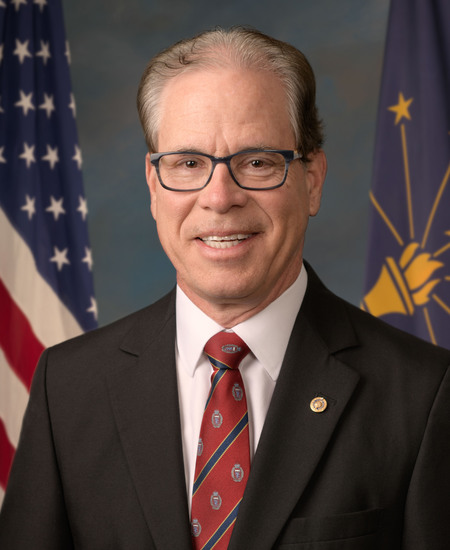
Photo of Mike Braun
R United States Senate · Former member · Indiana

Sen. Mike Braun

Compare
Total votes
597
all sessions
Attendance
95%
29 missed
Lower than 93% of chamber peers
With party
85%
of cast votes
Lower than 96% of chamber peers
Bipartisan score
9%
crosses aisle rarely
Higher than 95% of chamber peers
Sponsored
1,529
bills & resolutions
Higher than 98% of chamber peers
Committees
0
assignments
1,529 bills and resolutions

Sponsored bills

Total
1,529
Primary
258
Co-sponsor
1,271
This page
1,529
matching current filters
Co-sponsor SCONRES 8
In committee · United States Senate · Co-sponsor
A concurrent resolution expressing the sense of Congress that tax-exempt fraternal benefit societies have historically provided and continue to provide critical benefits to the people and communities of the United States.

Maddy summaryThis concurrent resolution (SCONRES 8) expresses Congress's formal opinion that tax-exempt fraternal benefit societies - mutual aid organizations operating under IRS Section 501(c)(8) - have long provided essential community benefits. It highlights that these societies, with approximately 7 million members nationwide, contribute over $3.8 billion annually through charitable work, volunteerism, and financial security programs. The resolution affirms that their tax-exempt status continues to support their mission and relieve pressure on government safety net programs. As a non-binding statement of congressional sentiment, it does not change tax law or create new obligations.

In committee Mar 23, 2023 1 co-sponsor
Co-sponsor S 967
In committee · United States Senate · Co-sponsor
No CBDC Act

Maddy summaryThis bill prohibits the Federal Reserve, Treasury Department, and other federal agencies from creating or distributing a central bank digital currency (CBDC) directly to individuals or maintaining accounts for individuals using CBDCs. It explicitly bans any federal entity from minting, issuing, offering CBDC-related services, or holding CBDCs as assets on their balance sheets. The bill directly affects federal financial institutions and prevents them from developing or implementing a government-run digital currency system.

In committee Mar 23, 2023 1 co-sponsor
Co-sponsor S 960
In committee · United States Senate · Co-sponsor
NIH Reform Act

Maddy summaryThe NIH Reform Act (S 960) reorganizes the National Institutes of Health by splitting the existing National Institute of Allergy and Infectious Diseases (NIAID) into three new institutes: the National Institute of Allergic Diseases, the National Institute of Infectious Diseases, and the National Institute of Immunologic Diseases. This directly affects NIH leadership and research operations, requiring new director appointments with 5-year terms (allowing one reappointment) and updating federal references to replace NIAID with the new institute names. The bill mandates a transition plan for NIH leadership to shift responsibilities from the old NIAID structure to the new institutes, without altering funding or creating new research programs. It focuses on administrative restructuring to better align research priorities with specific disease areas.

In committee Mar 23, 2023 1 co-sponsor
Co-sponsor SJRES 21
In committee · United States Senate · Co-sponsor
A joint resolution proposing an amendment to the Constitution of the United States to require that the Supreme Court of the United States be composed of nine justices.

Maddy summaryThis bill proposes a constitutional amendment to require the U.S. Supreme Court to have exactly nine justices. Currently, Congress sets the Court's size through legislation, but this amendment would make the nine-justice structure a permanent requirement in the Constitution. It would need ratification by three-fourths of state legislatures within seven years to become part of the Constitution. If adopted, it would prevent Congress from changing the Court's size via ordinary legislation.

In committee Mar 22, 2023 1 co-sponsor
Co-sponsor S 921
In committee · United States Senate · Co-sponsor
DISCOURSE Act

Maddy summaryThe DISCOURSE Act (S 921) changes Section 230 of the Communications Act to hold large internet platforms (with dominant market share) liable for content moderation decisions that appear to express, promote, or suppress a specific viewpoint. It targets practices like algorithmic amplification of content without user request, consistent content removal based on viewpoint, or actively altering user-generated content. Platforms must publicly disclose their content moderation policies to help users and small businesses understand how content is managed. The bill also adds a religious liberty exception for content moderation related to religious material and clarifies that Section 230 immunity is an affirmative defense requiring platforms to prove they aren’t publishers of the content.

In committee Mar 22, 2023 1 co-sponsor
Co-sponsor S 907
In committee · United States Senate · Co-sponsor
PRIME Act

Maddy summaryThe PRIME Act exempts certain local meat processing from federal inspection requirements. It allows custom slaughter facilities to process animals and prepare meat products for exclusive sale within the same state - either to households or to restaurants, grocery stores, or other food businesses that serve consumers directly in that state. Facilities must comply with their state's laws regarding slaughter and processing, and the bill explicitly states it does not override state regulations on meat handling or sales. This change applies only to intrastate transactions, keeping federal oversight for meat sold across state lines.

In committee Mar 22, 2023 1 co-sponsor
Co-sponsor S 908
In committee · United States Senate · Co-sponsor
A bill to oppose the provision of assistance to the People's Republic of China by the multilateral development banks.

Maddy summaryThis bill directs the U.S. Treasury to instruct American representatives at multilateral development banks (like the World Bank and Asian Development Bank) to oppose new loans to China. It is based on findings that China exceeded the income threshold for graduation from development assistance in 2016 and has since received over $20 billion in loans from these institutions. The bill requires annual reports tracking China's borrowing, U.S. voting efforts to end lending to countries that have surpassed graduation thresholds, and the status of China's eligibility. It directly affects China's access to multilateral development financing and the operational policies of these banks.

In committee Mar 22, 2023 1 co-sponsor
Co-sponsor S 915
In committee · United States Senate · Co-sponsor
A bill to require Presidential appointment and Senate confirmation of the Inspector General of the Board of Governors of the Federal Reserve System and the Bureau of Consumer Financial Protection.

Maddy summaryThis bill (S 915) would require the President to appoint and the Senate to confirm the Inspectors General (IGs) for both the Federal Reserve Board of Governors and the Consumer Financial Protection Bureau (CFPB). Currently, these IGs may be appointed without Senate confirmation, but this bill would change that process for both positions. The key mechanism is amending federal law to add a new section (425) specifying that these IGs must be appointed by the President with Senate advice and consent, aligning their appointment process with other major agency IGs. The bill does not alter the IGs' duties or oversight authority, only the appointment procedure. This directly affects the Federal Reserve and CFPB by changing how their top internal auditors are selected.

In committee Mar 22, 2023 1 co-sponsor
Co-sponsor S 941
In committee · United States Senate · Co-sponsor
Removing Section 230 Immunity for Official Accounts of Censoring Foreign Adversaries Act

Maddy summaryThis bill removes Section 230 immunity from social media platforms that knowingly host verified government accounts from specific foreign governments designated as "censoring foreign adversaries" (including China, Russia, North Korea, Iran, Cuba, Syria, and Venezuela). It targets accounts controlled by those governments' agencies, officials, or entities they own, which display platform verification badges or have over 500,000 followers. Platforms hosting such accounts would lose legal protection under Section 230 for content posted by these accounts. The bill defines "covered social media platforms" as major U.S.-based platforms with over 50 million U.S. monthly users, excluding email and news-focused sites.

In committee Mar 22, 2023 1 co-sponsor
Co-sponsor S 935
In committee · United States Senate · Co-sponsor
Fair Accountability and Innovative Research Drug Pricing Act of 2023

Maddy summaryThis bill requires drug manufacturers to report detailed justifications for significant price increases on "qualifying drugs" (expensive medications used by Medicare/Medicaid patients). Specifically, manufacturers must submit reports 30 days before price hikes exceeding 10% in a year or 25% over three years, or when prices surpass the U.S. median household income. Reports must include cost breakdowns (R&D, manufacturing, marketing), profit data, and historical pricing for the drug. The Department of Health and Human Services will publicly post these reports (while protecting trade secrets) and collect $100,000 daily penalties for non-compliance.

In committee Mar 22, 2023 1 co-sponsor
Showing 651 to 660 of 1,529 bills
Previous 1 … 65 66 67 … 153 Next