

Bipartisan Safer Communities Act This act makes various changes to federal firearms laws, including to expand background check requirements, broaden the scope of existing restrictions, and establish new criminal offenses. The act also reauthorizes, funds, and supports various programs, grants, and activities to promote access to behavioral and mental health services, enhance school safety and security initiatives, and address gun violence in communities. (Sec. 1) This section designates the federal building and U.S. courthouse located at 111 North Adams Street in Tallahassee, Florida, as the Joseph Woodrow Hatchett United States Courthouse and Federal Building. (Sec. 2) This section designates the U.S. Postal Service facility located at 120 4th Street in Petaluma, California, as the Lynn C. Woolsey Post Office Building. DIVISION A--MENTAL HEALTH AND FIREARMS PROVISIONS TITLE I--CHILDREN AND FAMILY MENTAL HEALTH SERVICES This title reauthorizes, funds, and supports programs, grants, and activities that provide access to mental and behavioral health. (Sec. 11001) This section extends through September 30, 2025, the Medicaid demonstration program for certified community behavioral health clinics. It also expands the program by increasing the number of states that may participate and increasing the length of the demonstration programs. It provides funding for planning grants, technical assistance, and the demonstration programs. (Sec. 11002) This section requires the Centers for Medicare & Medicaid Services (CMS) to provide technical assistance and issue guidance to states on ways to improve access to telehealth under Medicaid and the Children's Health Insurance Program (CHIP). (Sec. 11003) This section requires and provides funding for the CMS to (1) issue guidance to support the delivery of medical assistance to Medicaid and CHIP beneficiaries in school-based settings; and (2) establish a technical assistance center to expand the capacity of state Medicaid agencies, local educational agencies, and school-based entities to provide assistance under Medicaid. This section also authorizes grants for states to implement, enhance, or expand non-health related services through school-based entities under Medicaid and CHIP. (Sec. 11004) This section requires and provides funding for the CMS to regularly review and report on states' implementation of federal requirements to provide early and periodic screening, diagnostic, and treatment services for children enrolled in Medicaid. The review must address the provision of the services by managed care plans. Additionally, this section requires the Government Accountability Office to evaluate and report on state compliance with the requirements to provide early and periodic screening, diagnostic, and treatment services for children enrolled in Medicaid. (Sec. 11005) This section reauthorizes through FY2027 pediatric mental health care access grants and allows grants to be used to provide information, support, training, and technical assistance to emergency departments, educational agencies, and schools. TITLE II--FIREARMS This title makes various changes to federal firearms laws, including to expand background check requirements for persons who are under 21 years of age, to establish new criminal offenses for straw purchasing of firearms and trafficking in firearms, and to extend federal firearms-related restrictions to individuals convicted of domestic violence misdemeanors against dating partners. (Sec. 12001) This section establishes additional requirements for firearms-related background checks through the National Instant Criminal Background Check System (NICS) for prospective purchasers who are 18 to 21 years of age. Specifically, if a federal firearms licensee (e.g., a gun dealer) contacts the NICS to initiate a firearms-related background check on a person who is 18 to 21 years of age, then this section requires the NICS to contact additional record systems—state criminal history or juvenile justice repositories, state custodians of mental health records, and local law enforcement agencies—for possibly disqualifying juvenile records. Current law already requires the NICS to query national data systems for disqualifying records of an individual who is prohibited from receiving or possessing a firearm. Additionally, if cause exists to further investigate a possibly disqualifying juvenile record of a person who is 18 to 21 years of age, then this section allows a firearm transfer to be delayed for up to 10 business days. The requirement for the NICS to contact additional record systems expires in 10 years. (Sec. 12002) This section revises the definition of engaged in the business as applicable to a firearms dealer who is required to be federally licensed. Specifically, it provides that a person who sells firearms to predominantly earn a profit (currently, who sells firearms with the principal objective of livelihood and profit) is engaged in the business of dealing in firearms and is therefore required to be federally licensed. (Sec. 12003) This section allows grants under the Edward Byrne Memorial Justice Assistance Grant (JAG) program to be used to implement state crisis intervention programs or initiatives, including mental health courts, drug courts, veterans' courts, and extreme risk protection order programs (i.e., red flag laws). (Sec. 12004) This section establishes a federal statutory framework to prohibit straw purchasing of firearms, trafficking in firearms, and related conduct. A violator is subject to criminal and civil penalties, including the seizure and forfeiture of the firearms and ammunition involved in the offense, property constituting or derived from proceeds from the offense, and property used to commit or facilitate the offense. The section authorizes law enforcement to investigate straw purchasing and trafficking in firearms offenses using wiretaps (i.e., authorized interceptions of wire, electronic, or oral communications) and makes the offenses predicate offenses (i.e., underlying offenses) for prosecutions under the federal money laundering statute and the federal racketeering statute. (Sec. 12005) This section extends federal firearms-related restrictions to individuals who are convicted of a misdemeanor crime of domestic violence against an individual in a current or recent former dating relationship. Currently, the restrictions generally only apply to individuals who are convicted of a domestic violence misdemeanor against a co-parent of a child, a current or former spouse, a current or former cohabitant as a spouse, or a person similarly situated to a spouse. The term dating relationship means a continuing relationship of a serious or intimate nature, as determined based on the length of the relationship, the nature of the relationship, and the frequency and type of interaction between the individuals involved in the relationship. This section specifies that for individuals who are convicted of a misdemeanor crime of domestic violence against a dating partner, the federal firearms-related restrictions apply only to convictions on or after the date of enactment and expire five years after the conviction date if certain conditions are met. TITLE III--OTHER MATTERS Subtitle A--Extension of Moratorium (Sec. 13101) This section delays for one year the implementation of regulations relating to the treatment of certain Medicare prescription drug benefit rebates from drug manufacturers for purposes of federal anti-kickback laws. Subtitle B--Medicare Improvement Fund (Sec. 13201) This section appropriates funds for the Medicare Improvement Fund in FY2022. Subtitle C--Luke and Alex School Safety Act of 2022 Luke and Alex School Safety Act of 2022 (Sec. 13302) This section provides statutory authority for the federal clearinghouse of school safety resources. The clearinghouse identifies and publishes best practices and recommendations for school safety for use by state and local educational and law enforcement agencies, institutions of higher education, health professionals, and the public. (Sec. 13303) This section requires the Department of Health and Human Services and the Departments of Homeland Security, Justice, and Education to notify their state and local counterparts and other partners about the clearinghouse. (Sec. 13304) This section requires the clearinghouse or the external advisory board to review and report on federal grant programs that could be used to implement best practices and recommendations. This section also requires the clearinghouse to identify state agencies, state grant programs, and other resources that may be used to implement best practices and recommendations. Subtitle D--Amendment on ESEA Funding (Sec. 13401) This section prohibits the use of elementary and secondary education funds to provide any person with a dangerous weapon or training in the use of a dangerous weapon. DIVISION B--APPROPRIATIONS Bipartisan Safer Communities Supplemental Appropriations Act, 2022 This division provides FY2022 supplemental appropriations to various federal departments and agencies for programs and activities to support behavioral and mental health. The supplemental appropriations are designated as emergency spending, which is exempt from discretionary spending limits. Specifically, this division provides appropriations to agencies and programs within the Department of Justice for additional resource needs of the NICS, JAG grants for states to implement crisis intervention programs or initiatives, grants for states to upgrade criminal and mental health records for the NICS, a community violence intervention and prevention initiative, and grants to improve school security. Additionally, the division provides appropriations for agencies and programs within the Department of Health and Human Services for block grants for community mental health services; the National Child Traumatic Stress Network, which provides early intervention services and treatments with a focus on high-risk or medically underserved populations that experience violence-related stress; activities and services under Project Aware, which promotes access to mental health services among school-aged youth and their families; mental health awareness training; the National Suicide Prevention Lifeline; grants to provide mental and behavioral health care training to providers who serve pediatric and other vulnerable populations; grants to promote access to pediatric mental health care services in primary care settings; and grants for states to implement, enhance, or expand non-health related services through school-based entities under Medicaid and CHIP. The division provides appropriations for agencies and programs within the Department of Education for activities to support safe and healthy students, the 21st Century Community Learning Centers program, grants for school-based mental health services, and demonstration grants for school-based mental health services professionals. Finally, the act exempts the budgetary effects of each division of the act from (1) the Statutory Pay-As-You-Go Act of 2010 (PAYGO), (2) the Senate PAYGO rule, and (3) certain budget scorekeeping rules.
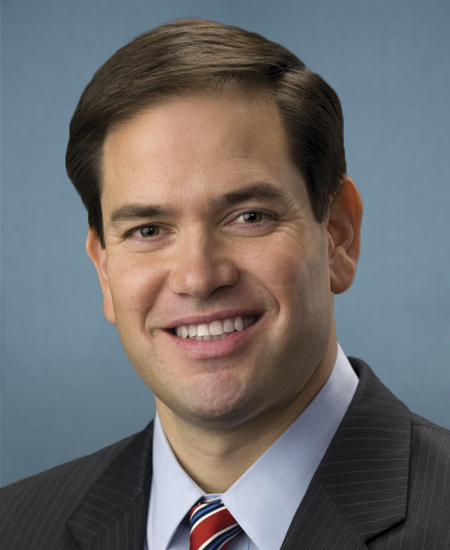
Sen. Marco Rubio
Sponsored bills
This joint resolution nullifies a Bureau of Alcohol, Tobacco, Firearms and Explosives rule published on April 26, 2022, concerning regulatory definitions and identification of firearms.
Preventing Terrorist Transfers to Afghanistan Act This bill prohibits Department of Defense funds from being used to transfer, release, or assist in the transfer or release of any individual detained in the custody or control of the Department of Defense at United States Naval Station, Guantanamo Bay, Cuba, to the custody or control of Afghanistan.
Protecting Americans' Data From Foreign Surveillance Act of 2022 This bill establishes certain export controls on personal data of U.S. nationals and individuals living in the United States. Among other requirements, the bill directs the Department of Commerce to identify categories of personal data that could be exploited by foreign governments and harm U.S. national security if exported, reexported, or in-country transferred in a quantity that exceeds the threshold established by Commerce.
Prohibiting Federal Emergencies for Abortion Act This bill prohibits the President and the Department of Health and Human Services (HHS) from declaring a federal emergency relating to abortion. Specifically, neither the President nor HHS may declare a national emergency for purposes of (1) promoting, supporting, or expanding access to abortion; or (2) taking adverse action against or litigating against states that prohibit or otherwise restrict abortion.
This resolution commemorates the passage of one year since the building collapse in Surfside, Florida, on June 24, 2021, and expresses support for the survivors and community.
Protecting Minors from Medical Malpractice Act of 2022 This bill makes a medical practitioner who performs a gender-transition procedure on an individual who is less than 18 years of age liable for any physical, psychological, emotional, or physiological harms from the procedure for 30 years after the individual turns 18. Additionally, if a state requires medical practitioners to perform gender-transition procedures, that state shall be ineligible for federal funding from the Department of Health and Human Services. Gender-transition procedures generally include certain surgeries or hormone therapies that change the body of an individual to correspond to a sex that is discordant with the individual's biological sex. They exclude, however, interventions to treat (1) individuals who either have ambiguous external biological sex characteristics or lack a normal sex chromosome structure, sex steroid hormone production, or sex steroid hormone action; (2) infections, injuries, diseases, or disorders caused by a gender-transition procedure; or (3) a physical disorder, injury, or illness that places an individual in imminent danger of death or impairment of a major bodily function.
Ensuring National Security Using Reliable Energy Act or the ENSURE Act This bill reverts certain policies under which the Federal Energy Regulatory Commission processes applications for natural gas pipelines and related projects to previous policies until specified conditions for power system reliability and natural gas and electricity pricing are met.
Stop Supreme Court Leakers Act of 2022 This bill establishes new federal crimes for the unauthorized disclosure of confidential information by officers or employees of the Supreme Court. Specifically, the bill prohibits an officer or employee of the Supreme Court from knowingly publishing, divulging, disclosing, or making known in any manner or to any extent not authorized by law any confidential information coming to that officer or employee in the course of the employment or official duties of that officer or employee. A violation is subject to criminal penalties. Additionally, property involved in a violation or attempted violation, or which constitutes or is derived from proceeds traceable to a violation, is subject to civil forfeiture.
Veterans Expedited TSA Screening Safe Travel Act or the VETS Safe Travel Act This bill makes certain veterans eligible for the Transportation Security Administration (TSA) PreCheck Program at no cost if they meet the program's background check and security requirements. Veterans who are eligible for this fee waiver are those who are in the annual patient enrollment system of the Department of Veterans Affairs (VA) and require the use of a wheelchair, prosthetic limb, or other assistive device to aid with mobility due to (1) loss, or loss of use, of a limb; (2) full or partial paralyzation; or (3) permanent blindness. The VA and the TSA must develop and implement a process to provide disabled veterans effective outreach about TSA programs that are designed to improve the screening process for passengers with disabilities.