

Democracy Technology Partnership Act This bill establishes the International Technology Partnership Office, led by the Special Ambassador for Technology, in the Department of State. The office shall advance U.S. technology policy through the creation of an International Technology Partnership with specified foreign countries. Specifically, the office must create a partnership of democratic countries to develop technology governance regimes, with a focus on key technologies such as artificial intelligence and machine learning, 5G telecommunications, semiconductor chip manufacturing, biotechnology, and quantum computing. Partner countries must be democratic countries with advanced technology sectors that have a demonstrated record of trust or an expressed interest in international cooperation and coordination with the United States on defense and intelligence matters. The bill also establishes the International Technology Partnership Fund in the Department of the Treasury. The State Department may use amounts from this fund to support joint research projects from International Technology Partnership member countries and technology investments in third-country markets. The State Department must also submit reports (1) outlining a national strategy for technology and national security; and (2) assessing other countries' standards and governance regimes for privacy, human rights, consumer protection, and free expression.
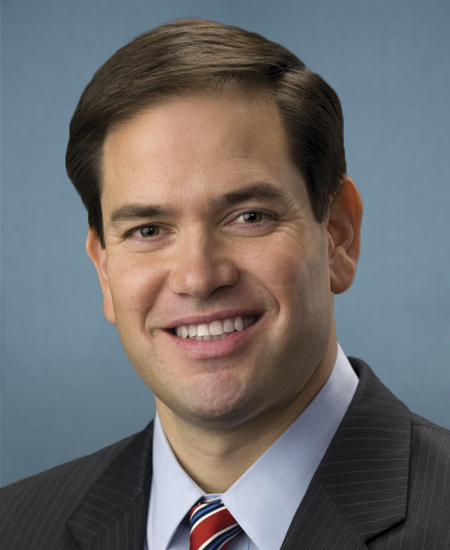
Sen. Marco Rubio
Sponsored bills
This resolution expresses that the Senate continues to refuse to recognize Alyaksandr Lukashenka as the legitimately elected leader of Belarus; condemns the ongoing harassment and persecution of opposition leaders, civil society activists, human rights defenders, and independent media carried out by the Lukashenka regime; urges the immediate release, without preconditions, of all political prisoners in Belarus; calls for new presidential and parliamentary elections to be held in Belarus and conducted in a manner that meets international standards and includes independent election monitoring; and encourages President Biden to swiftly appoint a new Special Envoy for Belarus to support the pro-democracy movement in Belarus.
This resolution reaffirms the interest of the United States in mutually beneficial relations with Mexico based on shared interests on security, economic prosperity, and democratic values. The resolution reaffirms support for stronger economic relations with Mexico, including to strengthen the resiliency of critical supply chains in North America and the Western Hemisphere in general. The resolution expresses deep concerns about the worsening investment climate in Mexico, and calls on the President to take meaningful actions to defend U.S. economic interests in Mexico and uphold the integrity of the United States-Mexico-Canada Agreement (USMCA). The resolution also urges the President to address the humanitarian and security crisis at the border with Mexico. Finally, the resolution urges the Mexican government to reduce the threat of deadly synthetic opioids.
This resolution congratulates the pro-life movement on the Supreme Court's ruling in Dobbs v. Jackson Women's Health Organization (that there is no constitutional right to abortion), recognizes the role of states as laboratories of democracy, and expresses a commitment to ensuring the safety of pro-life supporters, government officials, and court personnel in the wake of the Court's ruling.
Prohibiting Abortion on Federal Lands Act This bill prohibits the federal government from promoting, supporting, or contracting with abortion entities, or otherwise expanding access to abortions on federal lands or in federal facilities, including military installations, national parks, court houses, and other federal buildings.
Protecting Critical Ecosystems and Military Readiness in Florida Act This bill prohibits the Department of the Air Force from entering into an agreement that would provide for or permit the joint use of Homestead Air Reserve Base in Homestead, Florida, by the Air Force and civil aircraft.
Unborn Child Support Act This bill requires states to apply child support obligations to the time period during pregnancy. This requirement is applicable retroactively based on a court order at the request of the pregnant parent and a determination by a physician of the month during which the child was conceived. Existing state requirements are applicable to these obligations, such as proof of parenthood.
Veterans' Compensation Cost-of-Living Adjustment Act of 2022 This bill requires the Department of Veterans Affairs (VA) to increase the amounts payable for wartime disability compensation, additional compensation for dependents, the clothing allowance for certain disabled veterans, and dependency and indemnity compensation for surviving spouses and children. Specifically, the VA must increase the amounts by the same percentage as the cost-of-living increase in benefits for Social Security recipients that is effective on December 1, 2022. The bill requires the VA to publish the amounts payable, as increased, in the Federal Register. The VA is authorized to make a similar adjustment to the rates of disability compensation payable to persons who have not received compensation for service-connected disability or death.
This bill addresses Department of Veterans Affairs (VA) benefits and care for covered children. Under the bill, a covered child is an individual, regardless of age or marital status, who is the natural child of a Vietnam veteran or a veteran of specified service in Korea or Thailand who was conceived after the date on which the veteran entered service in Vietnam, Korea, or Thailand. The bill requires the VA to establish an advisory council on health care and benefits for covered children. Additionally, the VA must establish care and coordination teams for covered children. At least every 180 days, the teams must conduct outreach to ensure the continued care of the children and assist with any necessary changes in care. The VA must report to Congress a list of conditions that will trigger outreach to covered children, and contact such children as soon as practicable after the identification of a condition. The bill requires the VA to provide a covered child with health care and benefits for the duration of the child's life, regardless of the death of a parent preceding the death of the child. The Veterans Benefits Administration and the Veterans Health Administration must enter into a memorandum of understanding to better assist covered children and establish conditions to be included in the report required by this bill.
This bill prohibits federal funds from being used to require a member of the National Guard to receive a COVID-19 vaccination. In addition, the Department of Defense is prohibited from taking any adverse action (e.g., punishment) against a member of the National Guard because the member refuses to receive such a vaccination.