

Maddy summaryThis joint resolution (SJRES 20) seeks to block a 2023 rule from the Department of Justice and Bureau of Alcohol, Tobacco, Firearms and Explosives (ATF) that classified certain firearms with stabilizing braces as rifles under federal law. If passed, it would nullify the rule, meaning firearms equipped with these braces would no longer be subject to the rule’s classification requirements. The resolution uses the congressional disapproval process under Title 5, U.S. Code, to stop the rule from taking effect, directly affecting firearm manufacturers and owners who use stabilizing braces on weapons.
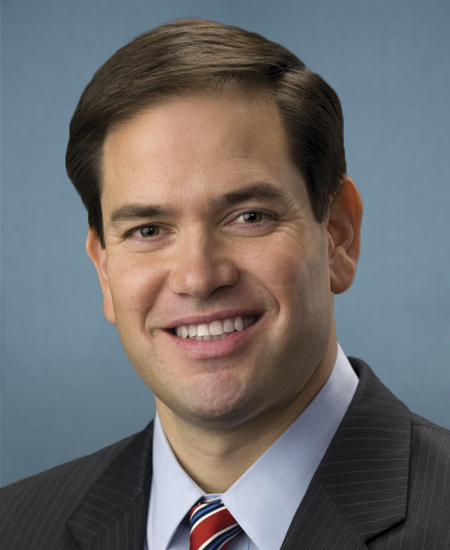
Sen. Marco Rubio
Sponsored bills
Maddy summaryThis is a ceremonial Senate resolution (SRES 110) honoring the late James George Abourezk, the first Arab American to serve in the U.S. Senate (1973-1979) from South Dakota. It commemorates his legacy, including his work re-establishing the Senate Committee on Indian Affairs and co-authoring key Native American rights legislation like the Indian Child Welfare Act. The resolution directs the Senate to adjourn in his memory and send a copy to his family, acknowledging his service as a representative and advocate for Native American communities. As a procedural resolution, it has no legislative effect beyond commemoration.
Maddy summarySRES 107 is a non-binding Senate resolution recognizing that the Equal Rights Amendment (ERA), proposed by Congress in March 1972, expired when its 7-year ratification deadline passed without enough states approving it. It affirms that Congress has no constitutional authority to alter the terms of a proposed amendment after it is submitted to states or after it expires. The resolution cites legal precedents, including Supreme Court rulings and a 2020 Department of Justice opinion, stating that ratification deadlines are binding and cannot be extended retroactively. It concludes that any future effort to adopt the ERA would require a new congressional proposal, not modifications to the 1972 version. This resolution does not change current law or affect ongoing state ratification efforts for a new ERA proposal.
Maddy summaryThis bill amends the Land and Water Conservation Fund to allow states to use federal funds for water quality projects that restore impaired rivers, wetlands, and other natural water systems. It directly affects states with existing water quality control plans under the Clean Water Act, enabling them to apply for funding for projects like wetland restoration or nutrient load reduction. Key provisions define "water quality projects" as those restoring impaired waters identified under federal law, require consultation with the EPA, and prohibit using funds to reimburse already-completed work. The bill does not expand federal authority over waterways or create new regulatory powers.
Maddy summaryThis bill restricts tax credits for electric vehicles (EVs) and related components by barring eligibility for vehicles or parts manufactured or assembled by companies tied to certain foreign entities deemed "of concern." It directly affects EV buyers and manufacturers seeking federal tax credits under Sections 30D and 48C of the tax code. Key provisions amend these sections to exclude credits for: (1) EV batteries made by entities controlled by foreign "concerns," (2) domestic companies using foreign technology via licensing, and (3) projects using technology from foreign-owned entities. The law applies to vehicles sold or credits certified after enactment.
Maddy summaryThis bill amends a 1999 appropriations law to prevent U.S. government entities from honoring trademarks tied to confiscated foreign assets. It directly affects businesses or individuals claiming trademark rights over marks previously used in connection with assets seized by foreign governments, unless the original owner or their legal successor consented. The key change requires that anyone asserting trademark rights must have known or had reason to know the mark was linked to confiscated assets. The bill also adds a new requirement that such rights can only be enforced if the claimant had actual knowledge of the confiscation at the time of acquisition.
Maddy summaryThis bill authorizes the U.S. President to lend or lease defense articles (like weapons or equipment) to Taiwan's government to strengthen its defensive capabilities against potential aggression by China's military. It requires Taiwan to pay for damages, replacement costs, and interest on financed defense services or construction. The President must establish expedited delivery procedures within 60 days and submit a detailed report to Congress within 90 days assessing defense needs, logistics, and timelines for Taiwan's military integration. The law specifically targets scenarios like naval blockades, amphibious assaults, missile strikes, or attacks on critical infrastructure by China's forces.
Maddy summaryS 764, the Hurricane Tax Relief Act, provides tax relief to individuals in areas affected by Hurricanes Ian, Nicole, and Fiona. It modifies how personal property damage losses are calculated for tax purposes, allowing victims to deduct more of their losses by removing the usual 10% adjusted gross income limit and increasing the deductible amount from $500 to $1,000 (for tax years after 2009). The bill also ensures Puerto Rico receives equivalent tax benefits by requiring the Treasury to pay amounts mirroring federal relief, provided Puerto Rico has an approved distribution plan. This directly affects residents in declared disaster zones who suffered property damage from these specific hurricanes.
Maddy summaryThe Stop Forced Organ Harvesting Act of 2023 requires the U.S. government to address forced organ harvesting by mandating annual reports on the issue in foreign countries and allowing passport denial or revocation for individuals convicted of organ trafficking. It directs the President to impose sanctions - including asset blocking and visa bans - on individuals or entities involved in forced organ harvesting, with exceptions for humanitarian aid. The bill defines "forced organ harvesting" as organ removal by coercion, deception, or abuse of power, and "trafficking" as recruiting or transporting people for organ removal through similar means. These provisions aim to hold accountable those exploiting vulnerable individuals for organ removal.
Maddy summaryThis bill prohibits the Secretary of the Air Force from entering into agreements that would permit civil aircraft to jointly use Homestead Air Reserve Base in Homestead, Florida, with the military. It directly affects the Air Force and any civil aviation entities seeking to share the base. The key provision is a straightforward ban on joint use agreements between military and civil aviation at this specific base. The bill does not address ecosystem protection, as the provided text only specifies the prohibition on joint use.