

Fairness and Accountability in Underwriting Chinese Institutions Act or the FAUCI Act This bill prohibits making any federal funding available to laboratories or research institutions in China for gain-of-function research. The President may waive this prohibition for national security interests. (Under the bill, gain-of-function research generally involves the enhancement of potential pandemic pathogens or related risky research with potentially dangerous pathogens.) Furthermore, if the Office of the Inspector General of the Department of Health and Human Services determines that a National Institutes of Health official, employee, or grantee has intentionally misled or omitted information in a relevant disclosure (e.g., to Congress) about federal funding for international gain-of-function research, such a person shall be ineligible for any federal funding or federal employment.
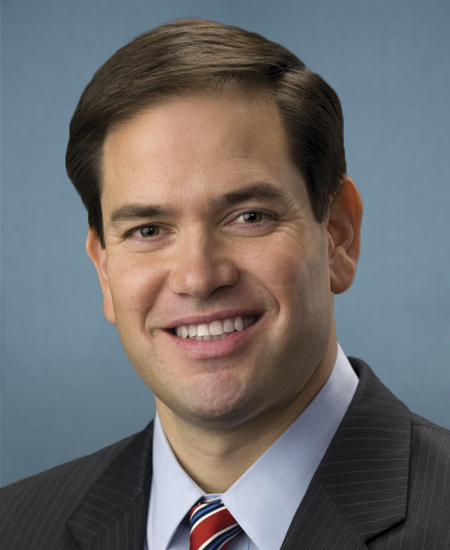
Sen. Marco Rubio
Sponsored bills
Prohibiting Taxpayer Funded Settlements for Illegal Immigrants Act This bill prohibits using federal funds to make settlement payments to compensate any individuals for being separated from family members while detained by U.S. Customs and Border Protection if the detention was (1) a result of the individual improperly entering (or attempting to improperly enter) the United States, and (2) in accordance with a Department of Justice memorandum that adopted a zero-tolerance policy for such improper entry into the United States.
Protecting Sensitive Personal Data Act of 2021 This bill expands the covered transactions that are subject to the review of the Committee on Foreign Investment in the United States (CFIUS), which analyzes the national security implications of foreign investment in the United States. Specifically, CFIUS may require declarations for foreign investments in U.S. businesses that maintain or collect sensitive personal data of U.S. citizens that may be exploited to threaten national security.
This resolution honors the 50th anniversary of Versailles, known as the "The World's Most Famous Cuban Restaurant," as a moment to celebrate Cuban heritage and the innovation of the people of South Florida.
This concurrent resolution celebrates the first anniversary of the signing of the Geneva Consensus Declaration on Promoting Women's Health and Strengthening the Family.
Maddy summaryThis non-binding Senate resolution supports parents' primary role in decisions about their children's education. It specifically opposes a Justice Department memo (issued October 4, 2021) directing federal resources to investigate parents protesting school policies, and demands that memo be rescinded. The resolution condemns efforts to restrict parental involvement in school decisions, such as limiting access to school meetings or curricula. It was introduced in response to controversies involving school board meetings in Loudoun County, Virginia, and a National School Boards Association letter comparing parent protests to domestic terrorism.
Research Advancing to Market Production for Innovators Act This bill provides commercialization services for federally funded small business research and development under the Small Business Innovation Research (SBIR) and Small Business Technology Transfer (STTR) programs. Specifically, the bill (1) expedites the application and award process for SBIR proposals and STTR solicitations, (2) requires determinations of commercialization potential for projects undertaken through SBIR and STTR awards, (3) provides continued flexibility of technical and business assistance for SBIR and STTR awardees, (4) instructs participating federal agencies to designate a technology commercialization official to help awardees commercialize, and (5) requires the Small Business Administration and the U.S. Patent Office to reach an interagency agreement to help SBIR and STTR awardees with intellectual property protection.
Senior Citizens' Freedom to Work Act of 2021 This bill eliminates provisions that reduce Social Security retirement benefits for certain beneficiaries who have outside income. Currently, benefits are reduced for beneficiaries who are younger than full retirement age if they earn more than $18,960 in outside income in a year.
Advancing the Quality and Understanding of American Aquaculture Act or the AQUAA Act This bill establishes standards for sustainable aquaculture in federal offshore waters in the exclusive economic zone and establishes related requirements. For example, it requires the National Oceanic and Atmospheric Administration (NOAA) to establish a national plan to identify and designate aquaculture opportunity areas. In addition, NOAA must establish a unified permitting and review process for aquaculture operations. NOAA must also establish a grant program for research and development to support the development of a sustainable marine aquaculture industry, such as research and services to create innovative design and engineering solutions to common obstacles within the aquaculture industry. Finally, the bill directs the Department of Commerce to create and provide resources for an Office of Aquaculture within NOAA to coordinate regulatory, scientific, outreach, and international issues related to aquaculture.
South China Sea and East China Sea Sanctions Act of 2021 This bill authorizes sanctions on Chinese individuals and entities that participate in certain activities related to China's territorial disputes in the South China Sea and the East China Sea. The President may impose property-blocking and visa-denial sanctions on certain Chinese individuals and entities, including those that are (1) responsible for or significantly contributing to certain large-scale projects, such as reclamation and militarization projects, in the disputed parts of the South China Sea; (2) responsible for or significantly contributing to actions that inhibit another country from protecting its sovereign rights to access resources in the South China Sea; and (3) responsible for or complicit in actions that threaten the peace, security, or stability in disputed South China Sea areas or in an East China Sea area administered by Japan or South Korea. The President may also (1) deny visas to the corporate officers and controlling shareholders of sanctioned entities, (2) subject sanctioned individuals or entities to certain export restrictions, and (3) prohibit U.S. individuals and entities from investing in sanctioned entities or individuals. The Department of State must periodically submit a report to Congress identifying countries that recognize China's claims to the contested territories.