

Veteran Education Empowerment Act This bill reauthorizes through FY2029 and otherwise revises a Department of Education (ED) grant program for student veteran centers. Specifically, ED must make grants to institutions of higher education (IHEs) or consortia of IHEs to establish, maintain, improve, or operate a student veteran center. A student veteran center is a dedicated space on a campus that provides students who are veterans or members of the Armed Forces with (1) a lounge or meeting space for themselves, their spouses or partners, their children, and veterans in the community; and (2) a centralized office for student veteran services that serves as a single point of contact to coordinate comprehensive support services for student veterans.
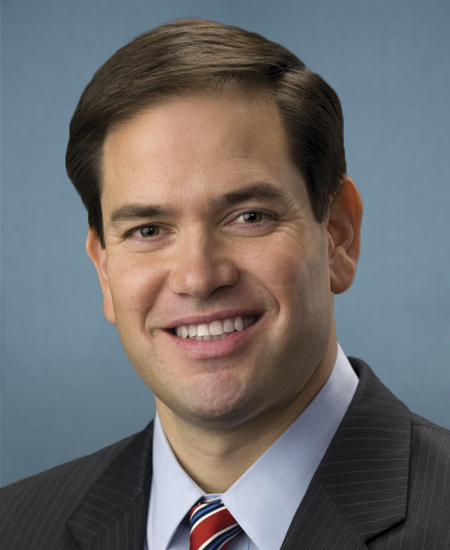
Sen. Marco Rubio
Sponsored bills
Maddy summarySRES 451 is a commemorative Senate resolution honoring the late Senator Max Cleland (D-GA), who died November 9, 2021. The resolution recognizes his service as a Vietnam War veteran (losing both legs and an arm in combat), his 50+ years of public service including roles as Georgia State Senator, Secretary of State, U.S. Senator, and Administrator of the Veterans Administration, and his advocacy for veterans. It formally expresses the Senate’s "profound sorrow" and "deep regret" over his death, commemorates his legacy of service to Georgia and veterans, and requests the Secretary of the Senate transmit the resolution to his family. This is a ceremonial resolution with no policy changes or legal effect.
Reinforcing Nicaragua's Adherence to Conditions for Electoral Reform Act of 2021 or the RENACER Act This bill establishes measures to monitor, report on, and address corruption and human rights abuses in Nicaragua. Specifically, the bill directs U.S. leadership at international financial institutions to advocate for increased oversight with respect to any loan or financial or technical assistance for projects in Nicaragua. The Department of State and the Department of the Treasury must establish a coordinated strategy to align diplomatic engagement with the implementation of targeted sanctions to facilitate free, fair, and transparent elections in Nicaragua. Pursuant to this strategy, the President must prioritize implementing targeted sanctions on persons obstructing the establishment of conditions necessary for such elections. The State Department must also engage in diplomatic efforts with partner countries to impose targeted sanctions on such individuals. The bill adds Nicaragua to a list of countries whose citizens are subject to visa-blocking sanctions for knowingly engaging in (1) actions undermining democratic processes or institutions, or (2) significant corruption or obstruction of investigations into such corruption. Further, the bill requires the State Department to report on the involvement of President Daniel Ortega, members of his family, and senior government officials in significant acts of public corruption; Russian activities in Nicaragua, including cooperation between Russian and Nicaraguan military personnel and intelligence services; all purchases and agreements entered into by Nicaragua with respect to its military or intelligence sector; and gross human rights violations by the Ortega government against campesinos (i.e., natives of Latin American rural areas, especially Latin American Indian farmers or farm laborers) and indigenous communities. In addition, the State Department must report on obstacles faced by Nicaraguans to obtaining accurate, objective, and comprehensive news and information about domestic and international affairs and submit a strategy for strengthening independent broadcasting, information distribution, and media platforms in Nicaragua.
Rachel Booth Act This bill provides eligibility for transitional compensation to dependents of members of the Armed Forces in situations where a member (1) has been convicted of a dependent-abuse offense in a civilian court but has been separated from duty for an offense other than the abuse offense, or (2) has been accused but not convicted of such an offense but has been determined to have committed the offense by a commander and required to forfeit pay and allowances pursuant to an offense other than the abuse offense.
Camp Lejeune Justice Act of 2021 This bill allows certain individuals to sue and recover damages for harm from exposure to contaminated water at Camp Lejeune in North Carolina between August 1, 1953, and December 31, 1987. This action is available only to individuals who were exposed to contaminated water for at least 30 days. The bill prohibits the U.S. government from asserting specified immunity from litigation in response to such a lawsuit. The bill also prohibits an individual who brings such an action from bringing a separate tort action against the United States based on the same harm.
Protecting Against Tyrants by Restoring Internet Access and Yielding Vital Interconnectivity in Designated Areas Act or the PATRIA Y VIDA Act This bill requires activities to expand the capacity of the U.S. government to transmit internet access and counter foreign internet censorship. The Federal Emergency Management Agency (FEMA) must obtain the capacity to transmit internet access domestically in the event of emergency-related network disruptions, while the Department of State must obtain the capacity to transmit internet access in foreign countries with repressive regimes. FEMA and the State Department must consult with other federal agencies on their efforts, including the National Telecommunications and Information Administration and the Federal Aviation Administration. Consulted agencies must provide necessary authorizations and support to allow FEMA and the State Department to transmit internet access. In addition, the Federal Communications Commission (FCC) must identify effective tools to counter large-scale internet censorship by foreign governments. In the event of increased demand for the tools, the FCC must rapidly provide funding to U.S. companies capable of deploying the tools to significant numbers of simultaneous users to circumvent internet censorship. The FCC and the U.S. Agency for Global Media must jointly report on matters concerning the capacity to domestically and globally transmit internet access and tools to circumvent internet censorship by foreign governments.
Strengthening Supply Chains for Servicemembers and Security Act This bill addresses Department of Defense (DOD) supply chain risk management, specifically risk management related to pharmaceuticals. The bill requires the Office of the Under Secretary of Defense for Acquisition and Sustainment within DOD to develop and issue implementing guidance for risk management for DOD supply chains for materiel (e.g., pharmaceuticals) and identify supply chain information gaps regarding reliance on foreign suppliers of drugs. After such guidance is issued, the Defense Health Agency must develop and publish implementing guidance for risk management for DOD's supply chain for pharmaceuticals and establish a working group to assess risks to the pharmaceutical supply chain, identify the pharmaceuticals most critical to beneficiary care at military treatment facilities, and establish policies for allocating scarce pharmaceutical resources. Finally, the Defense Logistics Agency must modify Defense Logistics Agency Instructions 5025.03 and 3110.01 to require Defense Logistics Agency Troop Support to coordinate annually with customers in the military departments to test responsiveness of the agency's contingency contracts for pharmaceuticals and to include the results of the testing in the annual Warstopper Program reports.
Taiwan Deterrence Act This bill authorizes defense-related assistance for Taiwan and addresses related issues. For FY2023-FY2032, the Department of State may provide foreign military financing grant assistance to Taiwan if (1) Taiwan commits to match such spending on a dollar-for-dollar basis, and (2) the United States and Taiwan agree to conduct joint long-range planning for capability development and on the expenditure of the funds. Furthermore, for the purposes of certain arms export control laws, Taiwan shall receive treatment identical to NATO member countries, Australia, Japan, South Korea, Israel, and New Zealand. (Currently, such countries receive benefits in regards to defense article transfers, such as the waiver of certain requirements and eligibility for assistance and fee waivers.) The State Department must report to Congress on U.S. priorities for building more capable Taiwan security forces and organizations. The State Department and the Department of Defense must jointly report to Congress on an annual basis on Taiwan's enhancement of its self-defense capabilities.
United States-Taiwan Public Health Protection Act This bill requires the Department of State to establish an Infectious Disease Monitoring Center within the American Institute in Taipei, Taiwan. (The U.S.-Taiwan relationship is unofficial, and the American Institute in Taiwan office in Taipei performs many of the same functions as an embassy.) The center must seek to partner with the Taiwan Centers for Disease Control to monitor infectious diseases in the region, including by regularly monitoring, analyzing, and disseminating open-source material, such as viral strains and other pathogens, from countries in the region.
This resolution (1) expresses support for the designation of the week of November 1-November 5, 2021, as National Family Service Learning Week, (2) recognizes the importance of family service learning in cultivating civic engagement and community investment, and (3) encourages the public to support family service learning and community development programs. Family service learning is a multigenerational problem-solving approach that utilizes active participation to meet community needs and develop the skillsets of children and families.