

Maddy summaryS 1212 establishes federal standards for remote and electronic notarizations, enabling notaries to perform these services across state lines for individuals not physically present. Key provisions require identity verification (using two methods or a credible witness), mandatory audio/video recording of remote notarizations (retained for 5-10 years), and secure attachment of electronic signatures to documents. The bill ensures courts and states recognize these notarizations as valid regardless of whether the notary used electronic records or served a remotely located individual. It does not require notaries to offer these services but creates a uniform baseline for interstate recognition, while allowing states to maintain stricter rules.
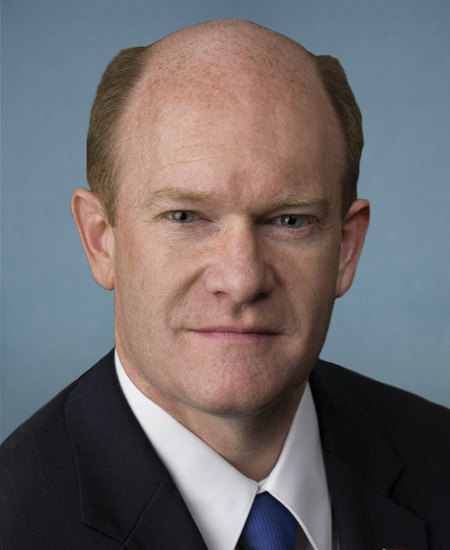
Sen. Christopher A. Coons
Sponsored bills
Maddy summarySRES 161 is a symbolic Senate resolution designating April 22-30, 2023, as "National Park Week." It does not create new laws or affect specific groups, but formally recognizes the National Park System's significance. The resolution highlights the parks' historical value, visitor impact (312 million visits in 2022), and economic contributions ($42.5 billion in 2021). It encourages public engagement with national parks but contains no funding, regulatory changes, or policy mechanisms. As a procedural resolution, it serves purely to honor the parks' legacy.
Maddy summaryThis bill requires employers in healthcare and social service sectors to develop and implement workplace violence prevention plans for their workers. It applies to a wide range of facilities including hospitals, nursing homes, mental health clinics, and community care settings, affecting healthcare and social service workers who provide care in these environments. The plans must include risk assessments, hazard prevention measures, incident reporting procedures, and annual training for employees. Employers must maintain records of violent incidents, conduct annual evaluations of their prevention plans, and submit annual summaries of workplace violence data to the Secretary of Labor. The bill also prohibits retaliation against workers who report violence or safety concerns and ensures compliance with existing safety standards.
Maddy summarySRES 139 is a non-binding Senate resolution recognizing the U.S. global HIV/AIDS program PEPFAR (President's Emergency Plan for AIDS Relief) for its role in reducing HIV/AIDS impact worldwide. It highlights PEPFAR's proven achievements, including saving over 25 million lives, providing antiretroviral treatment to 20.1 million people, and reducing new HIV cases among youth by 50-65% in supported regions. The resolution urges continued congressional funding for PEPFAR to advance the goal of ending HIV/AIDS as a public health threat by 2030. It directly affects PEPFAR's global operations and beneficiaries, including 1.6 million adolescent girls supported through the DREAMS program, without creating new laws or altering existing policy.
Maddy summarySRES 145 is a non-binding Senate resolution calling for the immediate release of Russian opposition leader Vladimir Kara-Murza, who was detained in April 2022 for criticizing Russia's invasion of Ukraine and advocating for democracy. The resolution condemns his unjust detention, expresses solidarity with him and other imprisoned Russian dissidents, and urges the U.S. government to work with allies to secure his release and increase support for democracy advocates in Russia. It does not impose new legal requirements but serves as a formal statement of the Senate's position to influence diplomatic efforts. The resolution directly affects U.S. foreign policy actions toward Russia and the welfare of Kara-Murza, who faces potential imprisonment for his public opposition to the war.
Maddy summarySRES 120 is a ceremonial Senate resolution designating March 23, 2023, as "National Women in Agriculture Day." It recognizes the significant contributions of women in U.S. agriculture, citing that they represent over one-third of agricultural producers and generated $148 billion in sales in 2017. The resolution encourages citizens to acknowledge women in the field and supports their roles as producers, educators, mentors, and leaders. As a symbolic gesture, it does not create new laws or funding but aims to highlight their impact on the agricultural workforce and food systems.
Maddy summaryS 1098, the Global Health, Empowerment and Rights Act, changes U.S. aid rules for foreign nongovernmental organizations (NGOs) receiving funding under the Foreign Assistance Act. It removes eligibility barriers for these NGOs if they provide health services (like counseling) using their own funds, as long as those services comply with local laws and would be legal in the U.S. It also eliminates extra restrictions on how foreign NGOs can use non-U.S. government funds for advocacy or lobbying, making these rules the same as those applied to U.S. NGOs receiving similar aid. This directly affects foreign health-focused NGOs working in international development and rights advocacy.
Maddy summaryThis bill removes the requirement that background checks for gun sales must be completed within 10 business days. It directly affects federally licensed gun sellers who conduct these checks, eliminating the specific deadline they previously had to finalize the process. The key provision amends existing law (18 U.S.C. § 922(t)(1)) to eliminate the 10-day timeframe, allowing sellers to complete checks without that strict deadline. The bill also includes minor technical corrections to related laws like the Brady Act and Bipartisan Safer Communities Act.
Maddy summaryThis bill repeals two specific legal authorizations for U.S. military force against Iraq: the 1991 authorization (Public Law 102-1) and the 2002 authorization (Public Law 107-243). If enacted, it would end the legal basis for military operations in Iraq under these two resolutions. The repeal directly affects the executive branch’s authority to use military force against Iraq under these specific laws. It does not create new policy but removes existing legal permissions.
Maddy summarySRES 136 is a Senate resolution recognizing the contributions of AmeriCorps members, alumni, and AmeriCorps Seniors volunteers to communities across the United States. It highlights their service in areas like education support, disaster response, environmental protection, and assisting vulnerable populations, while encouraging the public to honor their work and consider joining national service programs. The resolution does not create new policies or allocate funds but serves as a symbolic acknowledgment of their impact.