

Maddy summaryThe Election Worker Protection Act of 2023 provides federal grants to states for recruiting and training election workers (including poll workers and election volunteers) with specific requirements for cultural competence and diversity in recruitment efforts. It also funds physical security services and social media threat monitoring for election workers to protect them from threats. The bill establishes new criminal penalties for intimidating, threatening, or harassing election workers while they perform their duties, and creates a grant program to help protect election workers' personally identifiable information from public disclosure. These provisions apply to workers involved in federal elections and require states to submit reports on how the funds are used.
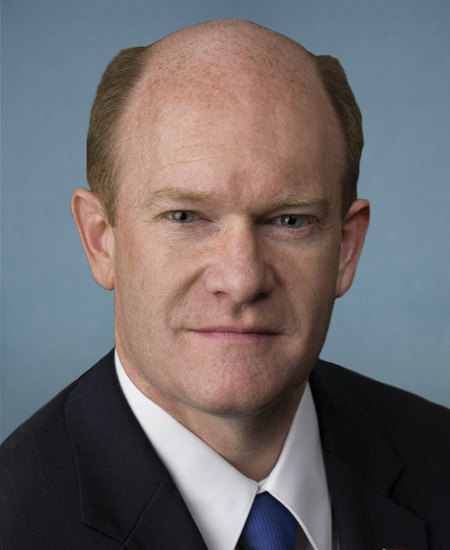
Sen. Christopher A. Coons
Sponsored bills
Maddy summaryThe COPS Reauthorization Act of 2023 (S 1306) reauthorizes the COPS ON THE BEAT grant program, which provides funding to local law enforcement agencies for hiring and training officers. It sets a new annual funding level of $651 million for fiscal years 2024 through 2029, replacing the previous $1.047 billion annual amount for 2006-2009. This bill directly affects state and local police departments that apply for these grants to support community policing initiatives. The key change is the reduced funding level for the program's next six-year authorization period.
Maddy summaryThis bill strengthens penalties for individuals or organizations charging veterans unauthorized fees when assisting with VA benefit claims. It directly affects veterans who might be targeted by unscrupulous representatives and the representatives themselves who attempt to charge such fees. The key provision adds a new subsection (b) to Section 5905, making it illegal to solicit, charge, or receive any fee for preparing or submitting VA claims - except as allowed under specific other sections. Violations can result in fines, up to one year in prison, or both.
Maddy summaryThis resolution (SRES 170) expresses the U.S. Senate’s support for World Malaria Day, observed annually on April 25. It acknowledges malaria’s global impact - citing 247 million cases and 619,000 deaths in 2021 - and highlights U.S. efforts like the President’s Malaria Initiative and contributions to the Global Fund. The resolution commends progress in reducing malaria deaths and urges continued U.S. leadership in global malaria-fighting efforts. As a symbolic resolution, it does not create new laws, allocate funding, or directly affect any individuals or programs.
Maddy summaryThis bill amends the Federal Employees Health Benefits (FEHB) program to add "assisted reproductive treatment benefits" to covered services. It directly affects federal employees and their families who use reproductive technologies like IVF, egg/sperm preservation, or artificial insemination, making these treatments eligible for coverage under their FEHB health plans. The bill defines "assisted reproductive treatment" to include specific procedures (e.g., IVF, sperm/egg preservation, intrauterine insemination) and grants the Office of Personnel Management Director authority to add additional covered treatments. The changes would take effect one year after the bill is enacted. This is a policy change expanding existing health benefits, not a procedural or commemorative measure.
Maddy summaryThe Love Lives On Act of 2023 restores survivor benefits for veterans' spouses who remarried before age 55 and before the bill's enactment, which they previously lost due to remarriage. It removes an expiration date for the Marine Gunnery Sergeant John David Fry Scholarship for surviving spouses and expands access to military commissaries and exchanges for remarried surviving spouses. The bill also extends TRICARE coverage to include remarried widows or widowers whose subsequent marriage ended.
Maddy summaryThe FISH Act of 2023 establishes a U.S. "black list" of foreign fishing vessels engaged in Illegal, Unreported, or Unregulated (IUU) fishing, including those using forced labor. Vessels on this list would be denied access to U.S. ports, services, and transshipment in U.S. waters, with sanctions imposed on their beneficial owners. The bill requires coordination between the National Oceanic and Atmospheric Administration, State Department, and Customs and Border Protection to implement the list, verify seafood imports, and share data to combat IUU fishing. It also authorizes $20 million annually for enforcement and includes provisions for technical assistance to help nations improve fisheries management. The law directly affects foreign fishing vessels, their owners, and U.S. agencies responsible for enforcement and import verification.
Maddy summaryThe Latonya Reeves Freedom Act of 2023 establishes a federally protected right for individuals with disabilities who require long-term services and supports (LTSS) to live in community-based settings rather than institutions. The bill defines specific requirements for "community-based" settings, including housing options that allow individuals to live in their own homes or shared residences with privacy rights, choice, and control over their services. It requires states to develop transition plans with measurable goals to move people from institutional settings to community-based supports within 12 years, along with annual reporting on progress. The Department of Justice and Department of Health and Human Services will enforce the law through investigations, compliance reviews, and the ability to seek injunctive relief for violations.
Maddy summaryThe Do No Harm Act amends the Religious Freedom Restoration Act (RFRA) to clarify that RFRA does not apply when federal laws protect against discrimination (like the Civil Rights Act of 1964), guarantee workplace protections (such as the Family and Medical Leave Act), prevent child exploitation, or ensure health care access. It specifically prevents religious freedom claims from blocking enforcement of these existing laws. The bill directly affects individuals or entities attempting to use RFRA to challenge such federal protections in court. This amendment ensures that religious freedom arguments cannot override established civil rights, workplace, child safety, or health care regulations.