

Maddy summaryThis bill (S 1424) improves access to dental and vision care by requiring health plans to allow doctors of optometry, dental surgery, or dental medicine to charge enrollees up to their standard fees for services not covered by the plan (with exceptions for dental cleanings). It prohibits plans from restricting providers' choices of laboratories or suppliers for materials used in care. The bill also mandates annual state enforcement notifications and clarifies that state laws governing dental/vision plans take precedence over federal provisions. It directly affects health insurance plans offering limited dental/vision coverage, enrollees using these services, and dental/optometry providers.
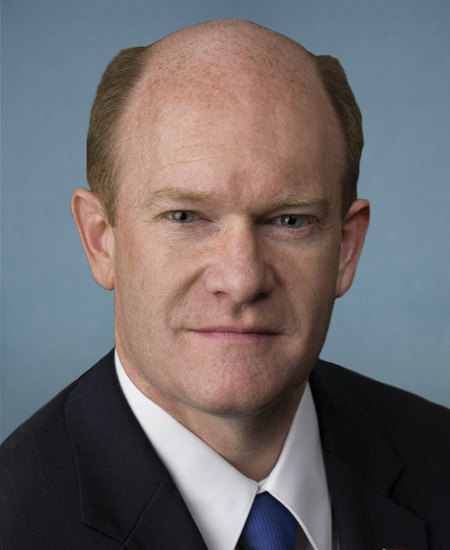
Sen. Christopher A. Coons
Sponsored bills
Maddy summarySRES 188 is a symbolic Senate resolution celebrating the 75th anniversary of Israel's founding on May 14, 2023. It formally recognizes Israel's establishment, reaffirms the U.S.-Israel partnership, and highlights shared democratic values, security cooperation, and diplomatic achievements like the Abraham Accords. The resolution has no policy impact or direct effect on individuals or legislation - it serves solely as a ceremonial expression of support. It was introduced by a bipartisan group of senators and passed without implementing new laws or funding.
Maddy summaryThis bill (S 1400) amends USDA conservation programs to expand access to technical service providers (TSPs) who help farmers and ranchers implement conservation practices. It creates new pathways for non-Federal entities (like state agencies, agricultural cooperatives, or professional societies) to certify TSPs, streamlines certification for existing professionals (e.g., certified crop advisors), and sets fair payment rates for TSP services. The law requires USDA to maintain a public registry of certified providers, track usage metrics, and report on how TSPs improve conservation outcomes. This directly affects agricultural producers seeking technical assistance and TSPs wanting to deliver services under USDA programs.
Maddy summaryThis bill, the Ending Forced Arbitration of Race Discrimination Act of 2023, prohibits employers from requiring employees to resolve claims of race discrimination through private arbitration. It invalidates any pre-dispute arbitration agreement or waiver for disputes involving discrimination, harassment, or retaliation based on race, color, or national origin under federal, tribal, state, or local law. Employees can now choose to file such claims in court instead of forced arbitration, and courts - not arbitrators - will determine if an arbitration clause applies. The law applies to claims arising after the bill's enactment date.
Maddy summarySJRES 4 is a joint resolution that removes the 1972 deadline for states to ratify the Equal Rights Amendment (ERA), which was originally proposed in House Joint Resolution 208. It declares that the ERA is valid as part of the U.S. Constitution if ratified by three-fourths of states (38), regardless of the expired deadline. The resolution directly affects the ERA ratification process, making it possible for states to complete ratification without time constraints. As of 2023, 38 states had already ratified the ERA, and this resolution would finalize its inclusion in the Constitution if enacted.
Maddy summarySRES 179 is a Senate resolution condemning Russia for wrongfully detaining U.S. citizens and residents, including Paul Whelan (wrongfully convicted of espionage) and Vladimir Kara-Murza (wrongfully convicted of treason). It demands the U.S. government designate Russia as a state sponsor of terrorism under existing law, which would trigger sanctions and pressure Russia to release detained Americans. The resolution also calls for the immediate release of all U.S. nationals wrongfully detained and supports Russian citizens' right to free expression. It cites Russia's violations of due process and international obligations as justification for the state sponsor designation request.
Maddy summaryThe Child Care for Working Families Act establishes a new federal program to provide affordable, high-quality child care for working families with children under age 6. It requires states to implement a sliding fee scale (with no copayment for families earning up to 85% of state median income) and develop a tiered quality system for child care providers, with payment rates that support staff wages comparable to elementary educators. The bill prioritizes access for underserved populations including children with disabilities, children experiencing homelessness, children in foster care, and children from low-income families, while requiring states to improve child care quality and supply through dedicated funding streams. States must submit detailed plans demonstrating how they will meet these requirements to receive federal funding, which will be provided through a combination of direct child care assistance and quality improvement activities.
Maddy summaryThis bill prohibits insurers from denying coverage, canceling policies, or increasing premiums for life, disability, or long-term care insurance solely because someone is a living organ donor, without considering actual health risks. It also updates the Family and Medical Leave Act to include recovery from organ donation surgery as a qualifying condition for leave for private-sector employees and federal workers. Additionally, the bill requires the Health and Human Services Secretary to update public educational materials about living organ donation within six months, covering benefits, risks, and the new insurance protections. These changes directly affect living organ donors, insurers, and employers who must comply with the updated leave and insurance rules.
Maddy summaryThe HELP Copays Act (S 1375) changes how health insurance plans calculate patient cost-sharing. It requires that discounts, financial assistance, or third-party payments (like drug manufacturer coupons) count toward a patient’s deductible, copayment, or out-of-pocket limit. This directly affects individuals enrolled in group or individual health insurance plans who receive such assistance. The bill amends the Public Health Service Act and Affordable Care Act to ensure these payments reduce the actual out-of-pocket costs patients face, rather than being treated as separate expenses.
Maddy summaryThe Forced Arbitration Injustice Repeal Act (S 1376) would prohibit businesses from requiring customers, employees, or small businesses to agree to private arbitration for future employment, consumer, antitrust, or civil rights disputes. It also bans agreements that prevent people from joining class or collective lawsuits in these areas. The bill makes such forced arbitration clauses unenforceable and ensures courts - not arbitrators - decide if the law applies. This directly affects individuals and small businesses in disputes involving workplace discrimination, product issues, unfair competition, or civil rights violations, allowing them to seek justice collectively in court.