This concurrent resolution recognizes the disparity in wages paid to Black women and its impact on women, families, and the nation, and reaffirms Congress' support for ensuring equal pay and closing the gender wage gap.
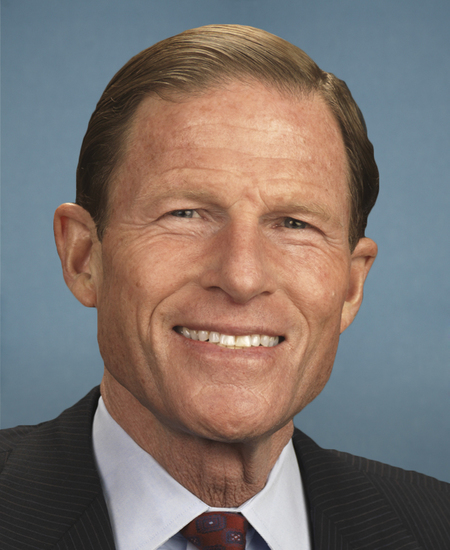
Sen. Richard Blumenthal
Sponsored bills
This resolution designates September 25, 2021, as National Lobster Day and encourages the people of the United States to observe the day with appropriate ceremonies and activities.
This resolution expresses support for the designation of the first Monday in March as COVID-19 Victims and Survivors Memorial Day.
Comprehensive TB Elimination Act of 2021 This bill reauthorizes for FY2022-FY2027 and revises the tuberculosis (TB) prevention and treatment grant program administered by the Centers for Disease Control and Prevention. The Health Resources and Services Administration may also award grants for TB prevention and treatment efforts to (1) state and local governments; (2) Indian tribes, Native Hawaiian health organizations, and related entities; and (3) community health centers and federally qualified health centers. Additionally, the Government Accountability Office must report on national TB prevention and treatment efforts.
Food Labeling Modernization Act of 2021 This bill imposes additional labeling requirements for food and addresses related issues. A food intended for human consumption must include on its principal display panel a summary of nutritional information using a system that (1) clearly distinguishes between products of greater or lesser nutritional value; and (2) uses standardized symbols to provide warning about products that are high in certain substances, such as trans fats. The Food and Drug Administration (FDA) must promulgate regulations establishing the requirements for such a system. Labels that use certain terms, such as whole wheat , fruit , or vegetable , must include additional information, such as the amount or quantity of that item in the food. The FDA must promulgate certain regulations relating to the use of the terms natural or healthy on food labels. The bill also imposes labeling requirements for certain foods that contain added coloring, added flavoring, phosphorus, caffeine, gluten, allulose, polydextrose, sugar alcohols, or isolated fibers. The FDA may, by regulation, deem a food ingredient to be a major food allergen. The FDA must also impose certain restrictions on the types of beverages that may be identified as infant formula or formula. The FDA must require food manufacturers to submit all information on the label of a food offered for sale in package form and update such submissions as necessary. The information must be made available in a public database on the FDA's website.

This resolution expresses the condolences of the Senate regarding the death of the Honorable Carl Levin, former Senator for Michigan.
This bill extends through October 18, 2021, the order issued by the Centers for Disease Control and Prevention (CDC) titled Temporary Halt in Residential Evictions To Prevent the Further Spread of COVID-19 and published on September 4, 2020. The bill also permits the CDC to further extend the order as it determines necessary.
This resolution expresses the condolences of the Senate regarding the death of the Honorable Mike Enzi, former Senator for Wyoming.
Mapping Housing Discrimination Act This bill provides grants to institutions of higher education to analyze, digitize, and map historic housing discrimination records. The Department of Housing and Urban Development's Office of Policy Development and Research must use data submitted by institutions under the bill to create a publicly available national database of historic housing discrimination records. Historic housing discrimination records are (1) deeds or historic property records that demonstrate housing discrimination, or (2) state or local ordinances that permitted housing discrimination.
Judiciary Accountability Act of 2021 This bill applies certain civil rights and employee protection laws to judicial branch employees. Specifically, the bill applies to judicial branch employees laws that prohibit discrimination based on race, color, religion, sex (including sexual orientation or gender identity), national origin, age, or disability. Further, the bill prohibits retaliation against whistleblowers within the judicial branch. Additionally, the bill establishes (1) the Commission on Judicial Integrity to oversee a program to prevent workplace misconduct; (2) the Office of Judicial Integrity to oversee confidential reporting systems regarding workplace misconduct, training programs on workplace behavior and bystander intervention, and other reporting initiatives regarding employee metrics and demographics; (3) the Special Counsel for Equal Employment Opportunity to investigate alleged workplace misconduct and complaints; and (4) the Office of Employee Advocacy to provide legal assistance, representation, and consultation to judicial employees. Finally, the bill establishes workplace discrimination, harassment, and retaliation as judicial misconduct.