Journalist Protection Act This bill establishes new criminal offenses for intentional acts (or attempts to commit acts) that cause bodily injury to a journalist.
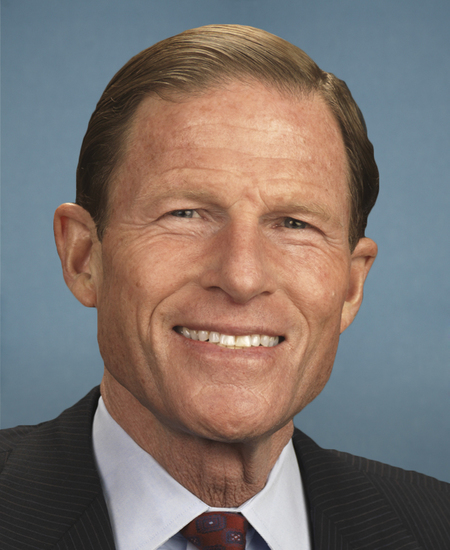
Sen. Richard Blumenthal
Sponsored bills
Domestic Workers Bill of Rights Act This bill provides rights and protections for domestic workers (e.g., housekeepers, nannies, caretakers, personal assistants, and chauffeurs), including pay and leave rights, and health and safety protections. Specifically, the bill repeals the exemption of domestic live-in employees from certain minimum wage and maximum hour requirements. Employers must provide written notice of termination and provide at least 30 days of lodging and two weeks of severance pay to terminated live-in employees. Live-in employees also must be provided with reasonable access to telephone and internet service during their employment. The bill requires employers to provide domestic workers with a written agreement covering wages, sick leave, benefits, and other matters. Further, domestic workers may request and be granted changes to work schedules due to personal events. The bill also provides domestic workers with certain privacy rights, extends to domestic workers protections against discrimination in employment, and increases the federal medical assistance percentage (FMAP) for certain Medicaid-funded medical services provided by domestic workers. The Department of Labor must (1) award grants for a domestic worker national hotline for reporting emergencies, training on hazards facing domestic workers, and workforce investment activities for domestic workers; and (2) establish a Domestic Worker Wage and Standards Board to investigate standards in the domestic workers industry. Labor must publish online a document that describes the rights and protections for domestic workers under this bill.

Improving Justice Programs through Science Act of 2021 This bill reestablishes the Science Advisory Board within the Department of Justice (DOJ). Specifically, it provides statutory authority for the board. Previously, the board was created in 2010 by DOJ and terminated in 2018.
Congressional Whistleblower Protection Act of 2021 This bill creates certain administrative and judicial remedies for federal employees whose right to provide information to Congress is interfered with or denied. Under current law, federal employees have the right to petition or furnish information to Congress or to individual Members of Congress, and this right may not be interfered with or denied. The bill explicitly allows employees who are aggrieved by a violation of this right to seek administrative remedies that are currently available to whistleblowers who are fired or experience other forms of retaliation. The bill also establishes a private right of action for aggrieved employees, including the option of a jury trial, if an administrative remedy is not issued within 210 days of a complaint being made. The bill applies to employees and contractors of the executive, legislative, and judicial branches of government, including members of the intelligence community.
Affordable Prescriptions for Patients Act of 2021 This bill prohibits product hopping by drug manufacturers, authorizes the Federal Trade Commission to enforce this prohibition, and imposes limits on patent litigation involving biological products. Generally, product-hopping describes a situation where, when the patents on a reference drug (or biological product) expire, the manufacturer switches to a follow-on product that is covered by a later-expiring patent. Under this bill, a follow-on product is a modified version of the reference drug that shares an indication (what the drug is used for) with the reference drug. The bill presumes product hopping has occurred when a reference drug manufacturer, after receiving notice that the Food and Drug Administration (FDA) has received an application to market a competing generic (or biosimilar) version, takes certain actions such as withdrawing the reference drug from the market and selling a follow-on product. A drug manufacturer may rebut these presumptions by demonstrating that its conduct was not intended to limit competition. The bill also limits in certain instances the number of patents that a reference biological product manufacturer can assert in a patent infringement lawsuit against a company seeking to sell a biosimilar version. Specifically, if the biosimilar manufacturer completes certain actions as part of an abbreviated pathway to get FDA market approval, the bill limits, subject to exceptions and waivers, the number of certain types of patents that the reference product manufacturer may assert, such as patents filed more than four years after the reference product received market approval.
Prescription Pricing for the People Act of 20 21 This bill requires the Federal Trade Commission (FTC) to report about anticompetitive practices and other trends within the pharmaceutical supply chain that may impact the cost of prescription drugs. The FTC also must provide recommendations to increase transparency in the supply chain and prevent anticompetitive practices.
Puerto Rico Recovery Accuracy in Disclosures Act of 2021 or PRRADA This bill requires professionals employed in debt adjustment cases involving Puerto Rico to file verified statements disclosing their connections with the debtor, creditors, and other interested parties before seeking compensation for their services.
Supreme Court Ethics Act This bill establishes a new statutory requirement for the Judicial Conference of the United States to issue a judicial code of conduct for judges and justices of U.S. courts, including Justices of the Supreme Court. Currently, the Judicial Conference issues a code of conduct for judges of U.S. courts (but not for Justices of the Supreme Court).
Exercise and Fitness for All Act of 2021 This bill requires the Architectural and Transportation Barriers Compliance Board (Access Board) to develop guidelines for exercise or fitness service providers regarding the provision of accessible exercise or fitness equipment. The Access Board must subsequently promulgate regulations, consistent with the guidelines, requiring that exercise or fitness classes and instruction provided by fitness providers are accessible to people with disabilities. The regulations also must require that each provider make at least one employee available to assist people with disabilities with using the accessible exercise or fitness equipment.
Nondebtor Release Prohibition Act of 2021 This bill addresses the release by bankruptcy courts of creditor or other third-party claims against non-debtors. Complex bankruptcies may involve third-party claims against non-debtors associated with the debtor, such as the debtor's officers, directors, or employees. Currently, in carrying out a bankruptcy plan, bankruptcy courts may release non-debtors from liability (there is a split in the judicial circuits regarding this practice). The bill generally prohibits a bankruptcy court from (1) releasing or modifying a non-debtor's liability through the approval of a bankruptcy plan or through an order, or (2) enjoining a judicial proceeding or other act to collect or otherwise enforce such a claim or cause of action against a non-debtor. However, the bill provides for the release of such liability if express consent is given by the third party. The bill also generally limits an order or decree to temporarily enjoin a proceeding against a non-debtor to 90 days. Additionally, the bill gives appellate jurisdiction to the appropriate U.S. court of appeals regarding an order or decree to temporarily enjoin or stay a proceeding against a non-debtor in a Chapter 11 reorganization bankruptcy case. Currently, U.S. district courts have appellate jurisdiction for these matters. Upon request of an interested party, and after notice and a hearing, the court shall dismiss a Chapter 11 reorganization bankruptcy case if the debtor was involved in certain restructuring activity that (1) had the intent or foreseeable effect of separating a debtor's assets from a debtor's liabilities and the debtor assuming or retaining such liabilities, and (2) occurred in the 10-year period prior to the filing of the bankruptcy petition.