Maddy summaryThis resolution (SRES 801) is a ceremonial Senate resolution honoring the late baseball legend Willie Mays (1931-2024) and his legacy. It commemorates his life, career achievements (including 660 home runs, 3,293 hits, and 24 All-Star selections), and his role as a trailblazer in baseball, particularly his early career in the Negro Leagues. The resolution does not create new laws or affect any policies; it is purely a symbolic tribute to recognize Mays' impact on baseball and his inspiration to generations.
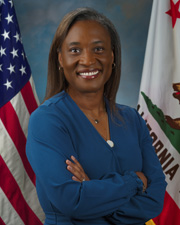
Sen. Laphonza R. Butler
Sponsored bills
Maddy summaryThis bill authorizes a Congressional Gold Medal to honor U.S. and Filipino military personnel who defended Bataan, Corregidor, and Attu during World War II, as well as the impacted Saskinax̂ people of Attu who were imprisoned by Japan. The medal, designed by the Secretary of the Treasury, would be presented by congressional leaders and permanently displayed at the Smithsonian Institution's National Museum of American History. Duplicate bronze medals may be sold to cover production costs, with proceeds returned to the U.S. Mint. The bill recognizes historical service through a commemorative medal without creating new benefits or entitlements.
Maddy summaryThe George Floyd Justice in Policing Act of 2024 establishes new accountability measures for law enforcement by requiring data collection on use of force, stops, and racial profiling; creating a national misconduct registry; banning chokeholds and no-knock warrants in drug cases; and mandating body cameras for officers. The bill would affect all Federal, State, Tribal, and local law enforcement agencies receiving federal funding, particularly those participating in Byrne or COPS grant programs. It includes requirements for agencies to collect and report data on stops and searches disaggregated by race, ethnicity, and gender, and to implement training on racial bias and de-escalation techniques. The legislation also creates new reporting requirements for use of force incidents and establishes penalties for agencies failing to comply with these provisions.
Maddy summaryThis bill expands tax exclusions for homeowners receiving rebates on water-related home improvements. It modifies IRS tax code to exclude from taxable income rebates provided by utilities, governments, or storm water providers for specific conservation measures. Key provisions include tax-free treatment for rebates covering water efficiency upgrades (like low-flow fixtures), storm water management (e.g., rain gardens), and wastewater systems (only for primary residences). The changes apply to rebates received after December 31, 2021, and clarify definitions for these measures.
Maddy summaryThe HEIRS Act of 2024 provides federal grants to help homeowners resolve issues with "heirs' property" - residential land inherited by multiple heirs without a will (intestacy), which often leads to ownership disputes or loss of homes. It funds two key programs: (1) grants to states, tribes, or local governments that adopt the Uniform Partition of Heirs Property Act, covering costs like title searches, legal fees, and estate planning; and (2) grants to HUD-approved housing counselors and legal clinics to assist low- or moderate-income homeowners with title clearing and estate planning. These programs target communities with high concentrations of minority and low-income residents affected by heirs' property issues, prioritizing partnerships and existing services. The bill aims to stabilize homeownership by making it easier to legally document property rights and avoid forced sales.
Maddy summaryThe Generation Now Workforce Representation Act of 2024 requires state workforce boards to include specific youth and nonprofit representatives in their structure. It mandates at least one youth representative who is either an out-of-school youth, a disconnected youth aged 16-24, or a participant in a youth workforce program. It also requires at least one representative from a 501(c)(3) youth-serving nonprofit organization providing supportive services to youth. Additionally, the bill establishes a standing youth workforce committee to advise state boards on youth-focused workforce programs under the Workforce Innovation and Opportunity Act. These changes directly affect state workforce boards and their planning for youth workforce development initiatives.
Maddy summary# Summary of Proposed Employment Rights and Anti-Discrimination Legislation This comprehensive bill proposes significant reforms to address workplace discrimination and harassment, with several key provisions: ## Key Provisions 1. **Expanded Protections**: - Extends protections to independent contractors, interns, volunteers, and trainees (Section 301) - Explicitly prohibits discrimination based on sex, sexual orientation, gender identity, and other protected characteristics 2. **Nondisclosure and Nondisparagement Agreements**: - Prohibits employers from requiring nondisclosure or nondisparagement clauses that cover harassment or discrimination claims (Section 302) - Establishes specific requirements for valid settlement agreements (21-day consideration period, written advice to consult attorney, 7-day revocation period) - Requires enforcement against employers who attempt to enforce prohibited clauses 3. **Arbitration Restrictions**: - Bans mandatory pre-dispute arbitration agreements for work disputes (Section 303) - Requires specific disclosures and waiting periods for post-dispute agreements - Allows civil actions for violations with attorney's fees 4. **Federal Contractor Requirements**: - Requires federal contractors to disclose labor and civil rights violations (Section 304) - Mandates periodic updates on compliance status - Establishes Labor Compliance Advisors within executive agencies 5. **Grant Programs**: - Creates national grants for preventing and addressing discrimination (Section 411-413) - Establishes legal assistance grants for low-income workers (Section 421-423) - Funds state advocacy systems to protect workers' rights (Section 431-436) ## Significance This legislation would substantially increase protections for workers by: - Making it easier to report harassment and discrimination - Preventing employers from silencing victims through restrictive agreements - Creating stronger enforcement mechanisms - Expanding access to legal assistance for vulnerable workers - Holding federal contractors accountable for labor violations The bill represents a major shift in workplace rights law, with implications for nearly all employers in the United States and significant changes to how discrimination claims are handled through legal processes.

Maddy summarySRES 781 is a symbolic Senate resolution expressing support for U.S. Olympic and Paralympic teams competing in the 2024 Paris Games. It commends athletes, coaches, and supporters without creating new laws or funding, and affirms commitment to safety for the 2028 Los Angeles Games. The resolution has no policy impact - it serves only to recognize Team USA’s achievements and solidarity. It directly addresses athletes, coaches, and organizers but does not alter any existing programs or obligations.
Maddy summaryThis Senate resolution (SRES 782) designates August 4-10, 2024, as "National Farmers Market Week" to symbolically recognize the role of farmers markets. It directly affects farmers markets across the U.S., which support local economies, connect urban and rural communities, and provide access to fresh food - particularly for low-income populations using nutrition benefits. The resolution highlights their economic impact ($1.7 billion in 2020), growth (8,771 markets in 2019), and contribution to sustainable farming and community health, without creating new laws or funding.
Maddy summaryThis bill establishes the Destination Reception Assistance Act, creating a federal program to provide medium-term support services to certain immigrants released into the U.S. by Homeland Security. It directly affects individuals granted parole, placed in removal proceedings, or with pending asylum applications ("eligible arrivals"). The program funds local governments and nonprofits to deliver concrete services including housing assistance, healthcare, job training, legal aid for work authorization/asylum applications, childcare, transportation support, and case management. Administered through a New Arrival Services Board and local community boards, it allocates $3 billion annually (2025-2028) to prioritize communities with high concentrations of eligible arrivals facing acute service needs.