

Steel Upgrading Partnerships and Emissions Reduction Act or the SUPER Act of 2021 This bill requires the Department of Energy (DOE) to establish programs to reduce greenhouse gas emissions from the production of iron, steel, and steel mill products. Specifically, DOE must establish a program of research, development, demonstration, and commercial application of advanced tools, technologies, and methods for low-emissions steel manufacturing. DOE, in collaboration with industry partners, institutions of higher education, and DOE's national laboratories, must also support an initiative for the demonstration of low-emissions steel manufacturing.
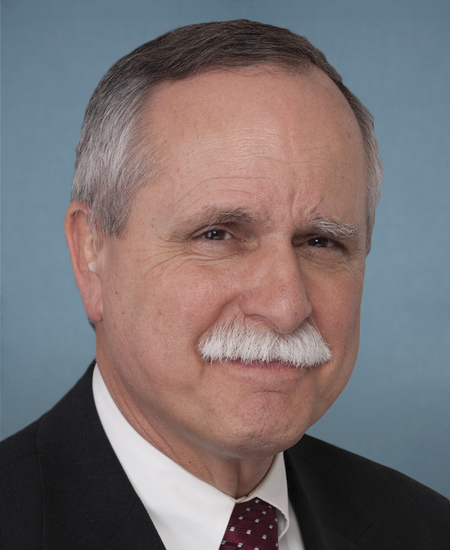
Rep. David B. McKinley
Sponsored bills
Tiny Homes for Homeless Veterans Act This bill requires the Department of Veterans Affairs to implement a six-year pilot program to provide grants for the creation of five villages of tiny homes for homeless veterans. Under the bill, the villages must have associated supportive services to allow veterans to build and live in energy efficient homes, maintain social connections with each other, learn skills, and receive critical counseling. Under the bill, a tiny home is an individual housing unit that is approximately 240 square feet for one person or approximately 340 square feet if the home is for a family.
Cures 2.0 Act This bill addresses pandemic preparedness and public health issues, caregiver and patient engagement, drug development, insurance coverage, and biomedical research. The Department of Health and Human Services (HHS) must undertake research and other activities concerning COVID-19 and develop a strategy for future pandemics and declared emergencies. Additionally, the bill specifies actions to combat antimicrobial resistance. HHS may award grants for caregiver training. The bill also addresses diversity in clinical trials, collecting patient experience data during clinical trials, and coverage for care related to participation in specified clinical trials. The bill modifies the timeframe and requires additional guidance relating to expedited approval of certain breakthrough drugs, devices, or products. It also establishes two intercenter institutes within the Food and Drug Administration (FDA) focused on particular diseases that meet specified criteria. The bill also addresses (1) coverage in Medicare, Medicaid, and the Children's Health Insurance Program for telehealth, genetic and genomic testing, and other services; (2) electronic prescribing standards for Medicare drug benefits; and (3) access to Medicare and Medicaid claims data by certain registries. Furthermore, the bill prohibits the use of geographic tracking or biometrics in Medicaid electronic visit verification systems. The bill establishes the Advanced Research Projects Agency for Health (ARPA-H) within the National Institutes of Health to accelerate biomedical research and innovation through grants, contracts, cash prizes, and other means. The FDA may work with ARPA-H to expedite the development of medical products through specified activities.
Domain Reform for Unlawful Drug Sellers Act or the DRUGS Act This bill requires a website domain name registrar (or registry operator) to take down a domain name under the registrar's control upon receiving an eligible notification that the domain name is facilitating illegal online drug sales. Upon receiving an eligible notification, the registrar must lock the domain name within 24 hours and suspend the domain name within seven days. An eligible notification must come from a trusted notifier and include certain information, such as a summary of the alleged illegal activities and a statement that the evidence supporting the allegations is available to be shared with the registrar. The bill defines trusted notifiers as (1) certain government agencies, such as the Food and Drug Administration or the office of a state attorney general; and (2) qualifying private or nonprofit entities given such status by specified government agencies. The registrant of the affected domain name may appeal a lock or suspension by providing the trusted notifier with information to establish that the registrant's drug sales are legal, such as pharmacy licenses and the licensing information of the prescribing medical practitioners, if applicable. The trusted notifier must conduct a reasonable investigation and consider the information provided by the registrant. If the appeal is successful, the registrar must reverse the lock and suspension within 15 days. The domain name must remain locked and suspended while the appeal is pending.
Accelerating Access to Critical Therapies for ALS Act This bill establishes grant programs to address neurodegenerative diseases, such as amyotrophic lateral sclerosis (also known as ALS or Lou Gehrig's disease), and contains other related provisions. The Department of Health and Human Services (HHS) shall award grants to eligible entities for scientific research utilizing data from expanded access to investigational ALS treatments for individuals who are not otherwise eligible for clinical trials. The Food and Drug Administration (FDA) shall award grants to public and private entities to cover the costs of research and development of drugs that diagnose or treat ALS and other rare neurodegenerative diseases. HHS shall also establish the Public-Private Partnership for Neurodegenerative Diseases between the National Institutes of Health, the FDA, and at least one eligible entity (generally, an institution of higher education or a nonprofit organization). The partnership shall support the development and regulatory review of drugs that address ALS and other rare neurodegenerative diseases. The FDA shall publish on its website a five-year action plan for fostering the development of drugs that improve or extend the lives of people living with rare neurodegenerative diseases. The Government Accountability Office must report to Congress about the grants provided under this bill, including an analysis of the impact of such grants on research and development of treatments for ALS.
This bill designates the federal building and U.S. courthouse located at 1125 Chapline Street in Wheeling, West Virginia, as the Frederick P. Stamp, Jr. Federal Building and United States Courthouse.
Protecting International Pipelines for Energy Security Act This bill requires the President to obtain the approval of Congress before revoking a permit or other authorization required under executive orders for constructing, connecting, operating, or maintaining an oil or natural gas pipeline, an electric transmission facility, or a border-crossing facility.
Stop Federal Vaccine Mandates for Employees Act This bill prohibits the Occupational Safety and Health Administration from issuing any emergency temporary standard that requires an employee to receive a drug, vaccine, or other biological product.
This bill posthumously provides for the award of a Congressional Gold Medal in commemoration of the 13 service members who died on August 26, 2021, while stationed at Hamid Karzai International Airport in Afghanistan.
Maddy summaryHRES 855 is a symbolic resolution passed by the U.S. House of Representatives to support designating the first week of December 2022 as "National United States Miners Week." It does not create new laws or policies but formally recognizes miners' contributions to the economy and supply chains. The resolution highlights miners' role in providing critical minerals and coal, supporting over 500,000 jobs, and securing domestic resources for everyday products. It directly affects miners and their communities by offering a formal, non-binding acknowledgment of their work. This is a procedural resolution with no concrete policy changes or funding implications.