

Maddy summaryThis bill amends Section 1983 of federal law (42 U.S.C. 1983) to explicitly allow lawsuits against federal officials for violating constitutional rights. It directly affects federal employees or agents who act under federal authority, expanding the current Bivens doctrine which previously only covered state actors. The key mechanism is a simple textual change inserting "of the United States" before "of any State" in the statute, enabling civil actions against federal officials for constitutional violations. This is a procedural amendment to existing law, not a new policy.
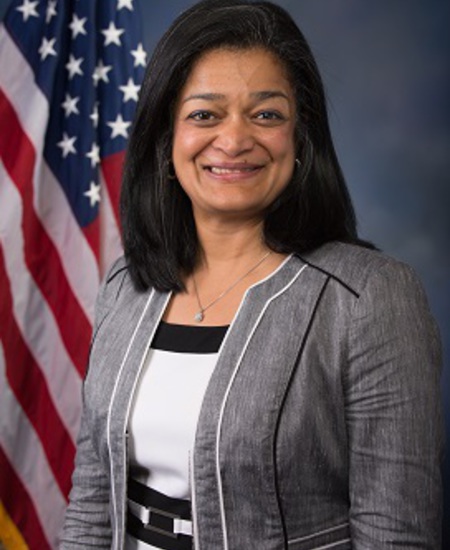
Rep. Pramila Jayapal
Sponsored bills
Maddy summaryThe Active Shooter Alert Act of 2024 establishes a national coordination system for active shooter alerts by designating a Department of Justice Coordinator. The Coordinator will work with federal agencies (FEMA, FCC, Transportation) and state/local governments to develop voluntary best practices for alert systems, including geotargeted notifications, multilingual messaging, and training for transportation authorities. The bill requires annual reports to Congress on state adoption of protocols and mandates a Comptroller General study on state response times to active shooter alerts, funded by $2 million for the Department of Justice. It does not mandate state adoption but encourages coordination to improve alert effectiveness.
Maddy summaryThe NO BAN Act (HR 9244) prohibits U.S. immigration authorities from denying visas or entry based on national origin, religion, or sex. It amends immigration law to explicitly ban such discrimination in visa decisions and tightens restrictions on the president’s power to suspend entry of certain groups under Section 212(f). The bill requires specific evidence, narrow tailoring, time limits, and congressional notification for any entry restriction, while mandating public reports on visa denials and waivers. It directly affects nonimmigrant visa applicants (e.g., students, workers) and federal agencies administering immigration policy.
Maddy summary# Summary of Proposed Workplace Discrimination and Harassment Prevention Bill This comprehensive legislative proposal aims to strengthen protections against workplace discrimination and harassment through multiple interconnected provisions: 1. **Expanded Protections**: Broadens coverage to include sexual orientation, gender identity, and other protected categories in workplace discrimination laws. 2. **Nondisclosure Agreement Restrictions**: Prohibits employers from requiring nondisclosure or nondisparagement clauses that would prevent workers from reporting harassment or discrimination, with limited exceptions for settlement agreements meeting specific requirements. 3. **Arbitration Prohibition**: Bans mandatory pre-dispute arbitration agreements for work-related disputes and imposes strict requirements for post-dispute agreements. 4. **Federal Contractor Requirements**: Mandates that federal contractors disclose labor and civil rights violations from the previous three years and requires corrective actions for violations. 5. **Grant Programs**: - National grants to prevent and address workplace discrimination through education, outreach, and complaint assistance - Grants for legal assistance to low-income workers facing employment discrimination - State-level advocacy systems with funding allotments to support worker rights protection 6. **Enforcement Mechanisms**: Establishes clear enforcement procedures, with the Equal Employment Opportunity Commission (EEOC) having authority to enforce these provisions with powers similar to those under existing civil rights laws. The bill also includes definitions, implementation details, and provisions for state and federal coordination to create a comprehensive system for preventing and addressing workplace discrimination and harassment across all sectors of employment.
Maddy summaryThe Workforce Opportunities for Communities in Recovery Act creates a federal grant program to address economic and workforce challenges linked to substance use disorder in affected communities. It provides two-year grants to state and local workforce boards to form partnerships with treatment providers, employers, education institutions, and community organizations. These partnerships will offer job training, supportive services (including mental health and recovery support), and employer engagement to help individuals with substance use disorder find and maintain employment. The program is funded at $25 million in fiscal year 2025, increasing to $37.5 million by 2030, with requirements for performance reporting and independent evaluation.
Maddy summaryHRES 1386 is a non-binding House resolution expressing the House's condemnation of Project 2025. It states that if enacted, Project 2025 would threaten healthcare access (including ending protections for pre-existing conditions and banning Medicare drug negotiations), restrict abortion and fertility services, cut education funding, raise costs for working families, and give tax breaks to wealthy corporations. The resolution specifically lists these potential impacts as reasons for the House to "condemn in the strongest terms" Project 2025. As a resolution, it does not create new law but formally expresses the House's position on this policy proposal.
Maddy summaryH.J. Res. 193 proposes a constitutional amendment to eliminate legal immunity for federal officials, including the President, from criminal prosecution for actions taken while performing official duties. It also prohibits the President from granting a pardon to themselves. The amendment would apply to all federal officers (such as the President, Vice President, and members of Congress) except for Congress members acting in their legislative role as defined in the Constitution. If ratified by 38 states, this change would become part of the U.S. Constitution, requiring no further congressional action.
Maddy summaryThe Corner Post Reversal Act amends federal law to establish a six-year deadline for filing lawsuits challenging federal agency actions. It requires that any legal challenge to an agency decision must be initiated within six years of the agency's final action, unless another law specifies a different timeframe. This change directly affects individuals, organizations, or entities seeking to contest agency decisions in court by limiting the window for legal action. The bill does not alter substantive policies but modifies procedural rules governing judicial review of agency actions.
Maddy summaryHR 8975, the Small Dollar Donor Protection Act, requires political committees to disclose contributions from individuals totaling less than $200 per election cycle - previously exempt from reporting. This change directly affects candidate committees and political organizations that receive small donations, mandating they report both the total amount and number of such contributions. The bill also directs the Federal Election Commission (FEC) to issue compliance guidance within 90 days and conduct a study on deceptive solicitation tactics within 180 days, reporting findings and recommendations to Congress. The policy aims to increase transparency for small contributions without altering the $200 disclosure threshold itself.
Maddy summaryHR 8988, the "Get Foreign Money Out of U.S. Elections Act," expands federal law to prohibit foreign-controlled businesses from influencing U.S. elections. It bans contributions or spending by any for-profit business entity where foreign nationals own 50% or more of voting shares, or where foreign entities collectively own 5% or more (or exert control over election activities). Businesses must certify compliance before making election-related spending, including contributions to political committees, and recipients cannot reuse uncertified funds for further election activities. This bill directly affects foreign-owned corporations, partnerships, and similar entities seeking to participate in U.S. elections.