

Maddy summaryHCONRES 118 is a symbolic congressional resolution recognizing the wage disparity faced by Black women in the U.S. It specifically highlights that Black women earn 69 cents for every dollar earned by White, non-Hispanic men, as noted in Census Bureau data. The resolution marks July 9, 2024, as Black Women’s Equal Pay Day to symbolize how long into 2024 Black women must work to earn what White men earned in 2023. It does not create new laws or policies but formally acknowledges this disparity and reaffirms congressional support for equal pay for equal work.
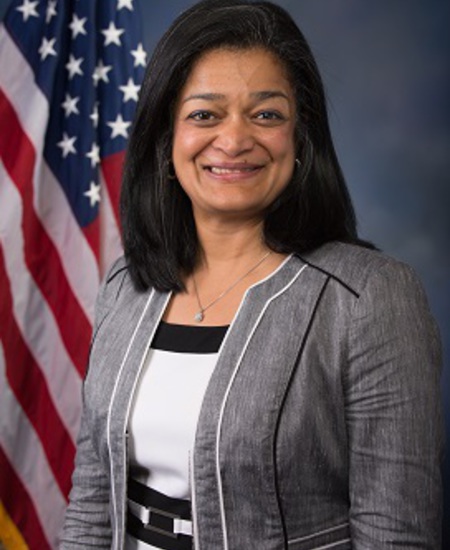
Rep. Pramila Jayapal
Sponsored bills
Maddy summaryThis bill amends the Federal Employees' Compensation Act to include physician assistants and nurse practitioners as eligible providers for injured federal workers. It defines "other eligible provider" as a nurse practitioner or physician assistant within their state-authorized scope of practice. The law updates key sections to replace "physician" with "physician or other eligible provider" for treatment, certification, and claim processes. The Secretary must finalize implementing regulations within six months of enactment.
Maddy summaryHRES 1332 is a symbolic resolution recognizing June as LGBTQIA+ Pride Month. It encourages the celebration of Pride Month to honor the historical struggles and achievements of LGBTQIA+ people in the United States, while acknowledging the ongoing challenges they face. This resolution does not create new laws or policies, but serves as a formal recognition of LGBTQIA+ rights as human rights and highlights their integral role in American history. The resolution was introduced by multiple members of Congress and passed by the House of Representatives.
Maddy summaryThe CHARTER Act prohibits charter schools receiving federal education funds under the Elementary and Secondary Education Act (ESEA) or Individuals with Disabilities Education Act (IDEA) from contracting with for-profit entities to manage school operations - including curriculum, budgets, or staff decisions. It directly affects public charter schools and their charter management organizations that receive these federal funds. The bill allows contracts with for-profits for specific services like food, payroll, or facilities maintenance but bans profit-driven management arrangements. The law takes effect 3 years after enactment and applies only to new or renewed contracts after that date, closing a loophole identified in a 2006 court case where for-profit schools reorganized as nonprofits to retain federal funding.
Maddy summaryThis resolution condemns Uganda's Anti-Homosexuality Act, which criminalizes consensual same-sex relationships with penalties including life imprisonment and the death penalty for certain acts. It directly affects LGBTQI+ Ugandans, who face increased violence, evictions, job loss, and barriers to healthcare due to the law's enforcement. The resolution calls on Uganda to repeal the law and supports maintaining U.S. sanctions like visa restrictions for officials involved in human rights abuses and reduced aid. It reflects U.S. government opposition to the law, which has been linked to severe human rights violations against marginalized communities.
Maddy summaryHR 8867, the REAL ID Gender Requirement Reform Act, amends federal ID standards to give states flexibility on gender fields for driver's licenses and ID cards. States may choose whether to include a gender/sex field, and if they do, individuals can select "unspecified" or "other" without needing medical documentation like a doctor's note. This directly affects people applying for or renewing state-issued IDs, particularly transgender and non-binary individuals who previously faced barriers. The bill removes the prior requirement for additional documentation when selecting non-binary gender options, allowing states to implement this change through their own policies.
Maddy summaryHR 8843, the American Music Tourism Act of 2024, amends the Visit America Act to direct the Assistant Secretary of Commerce for Travel and Tourism to identify and promote U.S. locations and events significant to music tourism for both domestic and international travelers. It requires the Assistant Secretary to specifically promote travel to music-related attractions (like museums, studios, and venues) and music festivals/concerts. The bill also defines "music tourism" as traveling to visit music sites or attend live music events. Finally, it mandates an annual report to Congress on progress toward these tourism goals, starting one year after the bill's enactment.
Maddy summaryThis bill creates a federal framework for "extreme risk protection orders" (ERPOs) that temporarily remove firearms from individuals who pose a risk of harming themselves or others. Family members or law enforcement officers can petition a federal court for a temporary order (up to 14 days) based on probable cause, followed by a hearing within 72 hours to determine if a longer-term order (up to 180 days) is warranted. The bill requires clear and convincing evidence of risk at the hearing and mandates respondents to surrender firearms to law enforcement within 48 hours. It also includes provisions for reporting, training law enforcement on ERPOs, and a federal grant program to support state ERPO implementation, without preempting state laws.
Maddy summaryThis resolution (HRES 1318) is a symbolic congressional recognition designating the Museum of Pop Culture in Seattle, Washington, as the "National Museum of Pop Culture." It does not create new laws, allocate funding, or alter the museum's operations - it solely affirms the institution's role in preserving pop culture history through its collections and scholarship. The resolution cites the museum's work in documenting pop culture's impact on society, including its holdings on hip-hop, science fiction, Jimi Hendrix, and Star Trek. As a procedural resolution, it has no direct effect on individuals, policies, or government programs.
Maddy summaryThis resolution, introduced around World Refugee Day, expresses congressional support for U.S. efforts to protect refugees and displaced persons globally and within the United States. It highlights that over 117 million people are displaced worldwide, references the U.S. resettling 60,000 refugees in fiscal year 2024, and calls on federal agencies to maintain the Refugee Admissions Program, uphold asylum protections, and support host countries. The resolution does not create new laws but reaffirms existing commitments to refugee resettlement, safety, and integration through current programs.