

Maddy summaryThe SAFE Lending Act of 2024 establishes new protections for consumers in small-dollar lending (transactions under $5,000, adjusted annually for inflation). It requires lenders to register with the Consumer Financial Protection Bureau before issuing small-dollar loans, prohibits unauthorized remotely created checks without explicit consumer authorization, and bans certain fees for prepaid accounts. The bill also restricts lead generation for small-dollar credit, requiring that anyone gathering applications must directly provide the credit. Additionally, it mandates a study on small-dollar credit access for Native American tribes on reservations to assess economic impacts.
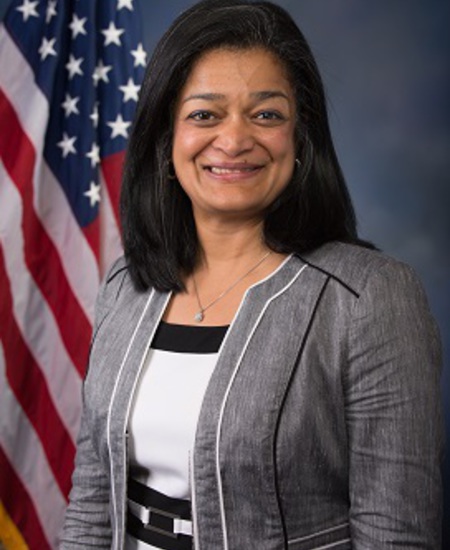
Rep. Pramila Jayapal
Sponsored bills
Maddy summaryHR 6319 (the 911 SAVES Act of 2023) requires the Office of Management and Budget to reclassify public safety telecommunicators as "Protective Service Occupations" within 30 days of enactment. This change corrects their current misclassification in the federal Standard Occupational Classification (SOC) system, which is used for statistical data on jobs. The bill directly affects how these professionals - critical in emergency calls involving missing children, active threats, and officer safety - are officially categorized in government workforce data. It does not create new benefits or funding but aims to better recognize their lifesaving role through accurate federal job classification.
Maddy summaryThe Homes Act of 2024 would establish a new Housing Development Authority within the Department of Housing and Urban Development to develop permanently affordable housing. The Authority would acquire properties and convey them to eligible entities (including community land trusts, tenant organizations, and public housing agencies) under strict requirements for permanent affordability, climate resilience, and community control. The bill would set rents at 25% of household income, limit annual rent increases to 3% or the Consumer Price Index, and require "just-cause" evictions with tenant protections. It would also create a tenant right to purchase their rental properties through a "first look" process and prioritize housing for underserved communities and families experiencing homelessness.
Maddy summaryThis bill directs the U.S. government to immediately restore funding to the United Nations Relief and Works Agency for Palestine Refugees (UNRWA), reversing a temporary funding pause. It repeals two appropriations acts that halted payments and requires the Secretary of State to resume UNRWA funding under existing authorities. The legislation specifically aims to support UNRWA’s critical humanitarian work - providing shelter, education, healthcare, and aid to Palestinian refugees across Gaza, the West Bank, Syria, Lebanon, and Jordan - during an acute famine risk in Gaza. It also mandates quarterly reports to Congress on UNRWA’s implementation of reforms from an independent review, ensuring accountability for its humanitarian mission.
Maddy summaryHR 9639, the AI Ads Act, amends the Federal Election Campaign Act to prohibit using AI-generated content (like deepfakes or synthetic media) in campaign materials as fraudulent misrepresentation of campaign authority or fraudulent fund solicitation. It directly affects political campaigns, candidates, committees, and anyone creating campaign ads by requiring that AI-generated content cannot falsely claim to represent a candidate, party, or committee. The bill updates existing rules to explicitly include "content generated in whole or in part with artificial intelligence" within the definitions of fraud under Sections 322(a)(1) and 322(b)(1). This ensures that misleading AI-generated ads - such as those falsely attributing a statement to a candidate - would be treated as illegal fraud under current campaign finance law.
Maddy summaryHRES 1448 is a non-binding House resolution stating that the House believes every person has the right to emergency health care, including abortion care, during medical emergencies. It specifically addresses concerns that abortion restrictions force medical providers to choose between treating patients in life-threatening situations or risking criminal charges. The resolution highlights that such restrictions disproportionately harm Black, Indigenous, people of color, immigrants, low-income individuals, and LGBTQI+ patients. It does not change existing laws but expresses congressional support for ensuring access to emergency care without legal barriers. The resolution was introduced by multiple House members and referred to the Energy and Commerce Committee.
Maddy summaryThe Polluters Pay Climate Fund Act of 2024 would require major fossil fuel companies that emitted more than 1 billion metric tons of carbon dioxide between 2000 and 2022 to pay a tax based on their historical emissions. The tax revenue would fund a new Climate Fund that would provide $15 billion annually for disaster response and resilience programs through FEMA, $6 billion for clean air initiatives, and mandate 40% of funds support environmental justice communities. The fund would finance climate resilience projects including climate-resilient infrastructure, ecosystem restoration, and support for vulnerable communities affected by climate change. Companies could pay the tax over nine years, and the bill explicitly states it does not affect existing legal claims against polluters for climate-related damages.
Maddy summaryHR 9589, the "Stop Illegal Campaign Coordination Act," clarifies when independent campaign spending is considered coordinated with a candidate or party. It expands the definition of coordinated spending to include any expenditure that matches a candidate's or committee's instructions - such as targeting specific voters, using similar messaging, or following suggested media methods - even if those instructions weren't publicly shared. This change directly affects outside groups and political committees making election-related ads or communications, as it makes it easier for the Federal Election Commission to determine if their spending was coordinated. The bill adds six specific factors the Commission must consider when evaluating coordination, like whether instructions included audience details or messaging elements.
Maddy summaryThe CREATE AI Act of 2023 establishes a National Artificial Intelligence Research Resource (NAIRR) to improve access to AI research tools, computational resources, data, and educational materials for researchers and students across the United States. The NAIRR will provide computational resources, curated datasets, educational tools, and access to AI testbeds, with special emphasis on supporting groups historically underrepresented in STEM fields. Governed by a Steering Subcommittee chaired by the Director of the Office of Science and Technology Policy and managed by a Program Management Office within the National Science Foundation, the NAIRR includes specific requirements for ethical AI development, privacy protections, and security measures. The resource will be accessible to researchers at U.S. institutions of higher education, nonprofits, government agencies, and certain businesses, with priority given to projects addressing privacy, ethics, civil rights, and AI safety.
Maddy summaryThis bill (HR 9391) designates the U.S. Postal Service facility at 108 North Main Street in Bucoda, Washington, as the "Mayor Rob Gordan Post Office." It updates all official references to this location to reflect the new name, affecting only the postal facility's official designation. The bill is purely ceremonial and does not change any postal services, policies, or obligations.