

Maddy summaryThe Fossil Free Financing Act of 2023 requires large banks (with over $50 billion in assets) to create and implement plans to reduce their financed emissions - greenhouse gases linked to their investments - in line with science-based climate targets. Key requirements include ending all new fossil fuel projects by January 2023, stopping thermal coal financing by 2025, eliminating all fossil fuel financing by 2030, and achieving zero financed emissions by 2050. The bill prohibits using carbon offsets in these plans and mandates banks to prioritize communities disproportionately impacted by fossil fuel dependence. Banks must submit annual plans to the Federal Reserve, which can impose penalties for noncompliance, including loss of deposit insurance. The law also expands oversight of nonbank financial firms contributing significantly to climate emissions.
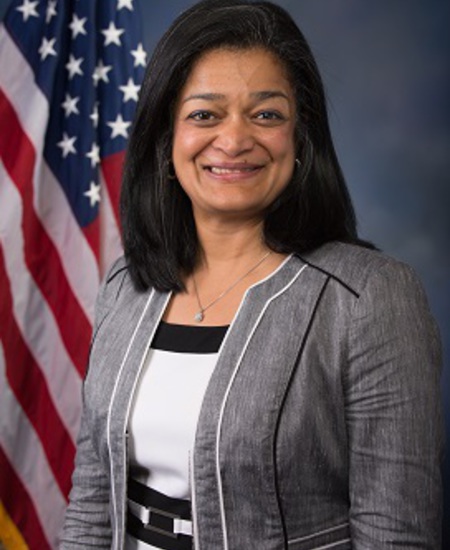
Rep. Pramila Jayapal
Sponsored bills
Maddy summaryThe International Human Rights Defense Act of 2023 creates a permanent Special Envoy at the State Department to coordinate U.S. efforts against discrimination and violence targeting LGBTQI+ people globally. The bill requires the development of an annual global strategy to address criminalization, discrimination, and violence based on sexual orientation, gender identity, or sex characteristics. It also mandates that U.S. country reports on human rights practices include detailed information about laws and practices affecting LGBTQI+ communities. The legislation authorizes U.S. foreign assistance programs to support LGBTQI+ rights through health services, legal protections, and community capacity building. This bill aims to strengthen U.S. diplomatic engagement on LGBTQI+ rights as part of broader human rights policy.
Maddy summaryThis bill establishes new salary thresholds for white-collar workers to qualify for overtime pay, starting at $45,000 annually in 2023 and increasing to $75,000 by 2026. It requires automatic annual adjustments based on the 55th percentile of full-time salaried workers' earnings, as tracked by the Bureau of Labor Statistics. The bill also limits non-exempt duties to no more than 20% of a worker's time. These changes would make more salaried employees eligible for overtime pay, reversing a long-term decline in coverage.
Protect Our Workers from Exploitation and Retaliation Act or the POWER Act This bill expands protections for non-U.S. nationals ( aliens under federal law) who are victims of crimes or serious workplace violations. U visas (nonimmigrant visas for certain crime victims) shall be available to individuals who have suffered substantial harm related to workplace claims. The Department of Homeland Security (DHS) may allow a non-U.S. national to work and temporarily remain in the United States if the individual (1) has filed for a U visa or T visa (nonimmigrant visas for victims of human trafficking), or (2) has filed or is a material witness to a workplace claim or civil claim arising from criminal activity and is helpful to authorities investigating the claim. The bill removes direct numerical limitations on U visas. A notice to an individual to appear at removal proceedings must contain specified certifications, if the individual was taken (1) at a facility where a workplace claim has been filed, or (2) as a result of information provided in retaliation against individuals exercising their legal rights. Specifically, the notice must state that (1) an adverse immigration determination may not be based solely on information furnished by the party engaged in the unlawful activity, and (2) the individual's information may not be disclosed. Such an individual may not be removed until law enforcement has had a chance to interview the individual. Removal proceedings against an individual who has filed or is a witness to a workplace claim must be stayed until the resolution of the claim, with limited exceptions.
Maddy summaryHR 1831 would award Billie Jean King a Congressional Gold Medal to honor her lifelong advocacy for equal rights in sports and society. The bill directs the Secretary of the Treasury to strike the medal and have it presented by congressional leaders, recognizing her pivotal role in advancing women's equality through tennis (including founding the Women’s Tennis Association and securing equal prize money) and her broader impact on society through initiatives like Title IX advocacy.
Maddy summary# Summary of the Agriculture Resilience Act of 2023 This comprehensive legislation aims to enhance agricultural sustainability, reduce greenhouse gas emissions, and decrease food waste across the food system. Key provisions include: 1. **Conservation Programs**: - Expanded Conservation Reserve Program with increased acreage limits through 2028 - New Grassland 30 pilot program for 30-year conservation contracts - Conservation of Private Grazing Land program focused on advanced grazing management - Alternative Manure Management Program to reduce methane emissions from livestock operations 2. **Renewable Energy**: - Enhanced Rural Energy For America Program with carbon accounting requirements - New agrivoltaic systems research and demonstration program - Continued support for the AgSTAR program (anaerobic digestion) 3. **Food Waste Reduction**: - Standardized quality date labeling ("BEST If Used By") and discard date labeling ("USE By") - Amendments to the Federal Food Donation Act requiring donation of excess food - School food waste reduction grant program for local educational agencies - Grants for composting and anaerobic digestion food waste-to-energy projects 4. **Additional Key Provisions**: - Composting recognized as a conservation practice - Technical assistance programs for sustainable agriculture - Support for beginning, socially disadvantaged, and small-scale farmers - Funding commitments for multiple programs through fiscal year 2028 The legislation emphasizes climate change adaptation and mitigation, environmental protection, food system resilience, and equitable support for diverse farm operations while reducing food waste across the supply chain.
Maddy summaryThis bill changes how U.S. foreign aid is provided to international health organizations. It prevents U.S. agencies from denying aid to foreign non-governmental organizations (NGOs) solely because they offer health services (like counseling or referrals) using their own funds, as long as those services follow local laws. It also stops applying stricter rules about how foreign NGOs can use their own funds for advocacy compared to U.S. NGOs receiving similar aid. The bill directly affects foreign health-focused NGOs that rely on U.S. foreign assistance funding.
Maddy summaryThe SAFEGUARD Act of 2023 restricts U.S. arms sales to countries committing genocide or war crimes. It prohibits defense exports to countries with credible evidence of such violations, with exceptions only if the government has punished perpetrators, prevented recurrence, and provided compensation. The bill requires recipient countries to agree not to use U.S. weapons to violate human rights, mandates end-use monitoring to ensure proper weapon use, and enhances congressional oversight for arms sales to countries with serious human rights concerns. These changes apply to all defense articles and services sold, exported, or transferred by the United States.
Historic Tax Credit Growth and Opportunity Act of 2023 This bill increases the rehabilitation tax credit and modifies certain requirements for the credit. The bill increases the rate of the credit for qualified rehabilitation expenditures in taxable years beginning after December 31, 2020, and before January 1, 2028, after which the rate reverts to 20%. The bill increases the rate of the credit to 30% for certain small projects whose qualified rehabilitation expenditures do not exceed $2.5 million. The bill also expands the types of buildings eligible for rehabilitation by decreasing the rehabilitation threshold from 100% to 50% of project expenses. It also eliminates the basis adjustment requirement for the credit and modifies rules relating to tax-exempt use property eligible for the credit.
Maddy summaryHR 1772, the WHEELChairs on Airplanes Act, requires airlines to follow federal safety standards for transporting lithium-ion-powered wheelchairs and mobility aids, directly affecting travelers with disabilities who use these devices. The bill mandates the FAA to conduct an annual survey of airline policies, identifying any that are stricter than safety standards (49 C.F.R. §175.10), and requires airlines to update noncompliant policies within 180 days or face civil penalties. It ensures airlines cannot arbitrarily deny boarding for compliant devices, aligning with existing disability protections under 49 U.S.C. §41705. The law focuses on enforcement through transparency and accountability, not new travel rules.