

Fighting Emerging Narcotics Through Additional Nations to Yield Lasting Results Act or the FENTANYL Results Act This bill creates two programs, establishes a reporting requirement, and otherwise modifies provisions to facilitate global cooperation against synthetic drug trafficking. Specifically, the bill requires the Department of State to establish a program to provide capacity-building assistance for law enforcement agencies of specified countries to identify, track, and detect certain synthetic drugs (e.g., fentanyl). The State Department must also carry out an international exchange program for drug demand reduction experts to provide educational and professional development on demand-reduction matters relating to the illicit use of narcotics and other drugs. The bill requires the State Department to include new sections in its annual international narcotics control strategy report that contain (1) an assessment of the countries likely involved in the trafficking of synthetic opioids; and (2) policies of responding to new psychoactive substances. The bill also expands the definition of major illicit drug producing country to include countries that produce synthetic drugs. Under current law, foreign assistance may be withheld from such countries.
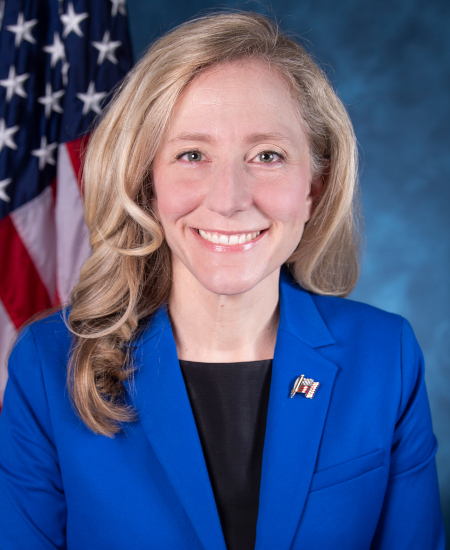
Rep. Abigail Davis Spanberger
Sponsored bills
Global Electoral Exchange Act of 2021 This bill authorizes the Department of State to establish a Global Electoral Exchange Program to promote sound election-administration practices around the world. The State Department may award grants to qualified, tax-exempt, U.S.-based organizations that have expertise and experience in relevant topics, such as election-system integrity. Grants may be used to design programs to bring relevant individuals, such as election administrators and poll workers, together to study and discuss election procedures. The State Department shall periodically report to Congress on the program's activities.
Countering Russian and Other Overseas Kleptocracy Act or the CROOK Act This bill requires various actions designed to combat public corruption in foreign countries. The bill establishes within the Department of the Treasury the Anti-Corruption Action Fund to help foreign states fight public corruption and develop rule-of-law-based governance structures. For certain fines and penalties imposed under the Foreign Corrupt Practices Act, an additional fine shall be imposed and deposited into the fund. The Department of State must (1) manage U.S. government efforts to fight foreign public corruption, and (2) establish an interagency task force to assist in coordinating such efforts. Each U.S. embassy must have a point of contact responsible for coordinating the embassy's anti-corruption efforts. The State Department must report to Congress on its anti-corruption activities and make various reports publicly available online.
This resolution states that the August 9, 2020, election in Belarus was neither free nor fair and, as such, the House of Representatives does not recognize Alyaksandr Lukashenka as the country's legitimate president. The resolution also states that the people of Belarus have the right to determine the country's future without unwelcome intervention from outside actors and condemns the human rights violations committed by Belarusian authorities.
No Oil Producing and Exporting Cartels Act of 2021 or NOPEC This bill prohibits a foreign state from engaging in collective action impacting the market, supply, price, or distribution of oil, natural gas, or any other petroleum product in the U.S. Specifically, a foreign state is prohibited from collective action that limits the production or distribution of such product, collective action to set or maintain the price of such product, or any other action that restrains trade of such product. Specified defenses such as sovereign immunity (i.e., a foreign state's immunity from the jurisdiction of U.S. courts) and the act of state doctrine (i.e., the prohibition of a court invalidating an official act of a foreign sovereign performed within its own territory) shall not apply to a foreign state's violation of this bill.
Southeast Asia Strategy Act This bill directs the Department of State to submit to Congress a strategy for engagement with Southeast Asia and the Association of Southeast Asian Nations (ASEAN). The strategy shall include various elements including (1) an identification of enduring U.S. interests in the region and efforts to bolster ASEAN's effectiveness; (2) a list of ongoing and planned initiatives to strengthen U.S. relationships in the region, including efforts to promote inclusive economic growth and energy innovation; and (3) a summary of ongoing efforts to promote human rights and democracy and strengthen the rule of law.
Tropical Forest and Coral Reef Conservation Reauthorization Act of 2021 This bill extends through FY2026 authority for debt-for-nature swaps and debt buyback programs that reduce or convert debt obligations from an eligible country to the United States into funding for nature conservation and protection efforts in that country.
This resolution condemns the actions taken by the governments of China and Hong Kong to put in place national security legislation that violates the freedoms and rights guaranteed to the people of Hong Kong. (Hong Kong is a part of China but, by agreement, has operated a legal and economic system largely separate from China's.)
Colorectal Cancer Payment Fairness Act This bill eliminates Medicare coinsurance requirements with respect to colorectal cancer screening tests, regardless of the code billed for a resulting diagnosis or procedure, beginning in 2023 (rather than 2030).
FDA Modernization Act of 2021 This bill allows an applicant for market approval for a new drug to use methods other than animal testing to establish the drug's safety and effectiveness. Under this bill, these alternative methods may include cell-based assays, organ chips and microphysiological systems, sophisticated computer modeling, and other human biology-based test methods.