

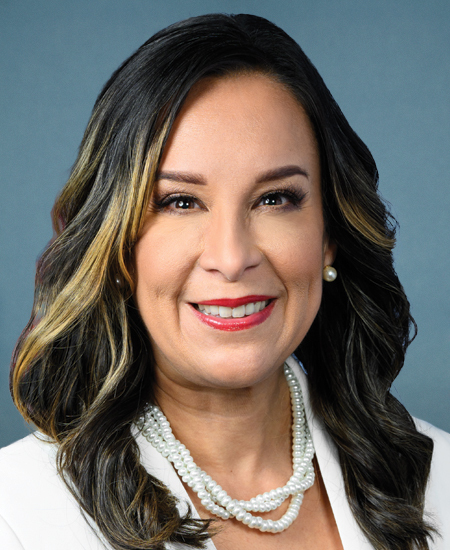
Photo of Monica De La Cruz
R United States House · District 15 · Texas On the 2026 ballot

Rep. Monica De La Cruz

Compare
Total votes
1,879
all sessions
Attendance
95%
94 missed
Lower than 85% of chamber peers
With party
96%
of cast votes
Near the chamber average
Bipartisan score
2%
crosses aisle rarely
Near the chamber average
Sponsored
561
bills & resolutions
Near the chamber average
Committees
6
assignments
561 bills and resolutions

Sponsored bills

Total
561
Primary
66
Co-sponsor
495
This page
561
matching current filters
Primary HR 6554
In committee · United States House · Lead sponsor
Community Bank Representation Act

Maddy summaryHR 6554, the Community Bank Representation Act, creates a new "Community Bank Member" position on the Federal Reserve Board of Governors. This member must have primary experience in community banking and is tasked with developing policy recommendations and overseeing regulation for banks with less than $17 billion in assets. The bill also requires the Federal Reserve to annually adjust this $17 billion threshold using changes in nominal U.S. GDP. The new member must report semi-annually to relevant congressional committees on the Federal Reserve's regulatory efforts for community banks.

In committee Feb 25, 2026 0 co-sponsors
Co-sponsor HR 1078
In committee · United States House · Co-sponsor
Respect State Housing Laws Act

Respect State Housing Laws Act This bill eliminates a provision that requires a 30-day notice period before a landlord may begin eviction proceedings against a tenant in federally assisted or federally backed housing.

In committee Feb 25, 2026 1 co-sponsor
Co-sponsor HR 7622
In committee · United States House · Co-sponsor
Iran Human Rights, Internet Freedom, and Accountability Act of 2026

Maddy summaryThis bill directs U.S. agencies to support Iranian people's access to uncensored information and hold Iranian officials accountable for human rights abuses. It requires the State Department and FCC to report on technologies (like satellite networks and mesh systems) that could bypass internet restrictions in Iran, and authorizes $2 million annually to develop such tools. The bill also establishes a new "Iran Kleptocracy Initiative" at FinCEN to track corruption, freeze assets of Iranian regime officials and state-owned businesses, and coordinate with international partners. These measures apply to U.S. policy toward Iran but do not alter Iran's domestic laws; they focus on U.S. sanctions, technology development, and anti-corruption efforts targeting the Iranian regime.

In committee Feb 20, 2026 1 co-sponsor
Co-sponsor HR 1028
In committee · United States House · Co-sponsor
Protection of Women in Olympic and Amateur Sports Act of 2026

Protection of Women in Olympic and Amateur Sports Act This bill requires certified national governing bodies (NGBs) of amateur sports (e.g., USA Gymnastics) to prohibit a person whose sex is male from participating in an amateur athletic competition that is designated for females, women, or girls. Under the bill, male  means an individual who has, had, will have—or would have, but for a developmental or genetic anomaly or historical accident—the reproductive system that at some point produces, transports, and utilizes sperm for fertilization.

In committee Feb 17, 2026 1 co-sponsor
Co-sponsor HR 7548
In committee · United States House · Co-sponsor
SCAM Act

Maddy summaryThe SCAM Act requires online platforms that display paid advertisements (like social media sites) to verify advertiser identities, implement scam detection systems, and remove fraudulent ads within 24 hours of confirmation. It directly affects platforms that accept payment for ads, targeting scams such as fake giveaways, romance scams, and AI impersonations that cost consumers $195 billion in 2024 (per FTC data). Key mechanisms include mandatory identity checks for advertisers, active monitoring systems, and a 72-hour investigation window for reported scams. The law aims to reduce fraud by shifting responsibility to platforms, with enforcement by the FTC and state attorneys general.

In committee Feb 12, 2026 1 co-sponsor
Co-sponsor HR 3682
Passed · United States House · Co-sponsor
Financial Stability Oversight Council Improvement Act of 2025

Maddy summaryThis bill amends the process for the Financial Stability Oversight Council (FSOC) when considering actions against U.S. nonbank financial companies. It requires the FSOC to first determine that alternative solutions - such as new regulatory standards, agency actions, or a company's written plan - are not possible or insufficient to protect financial stability before voting on a formal determination. The change directly affects the FSOC and large nonbank financial companies that could face regulatory scrutiny. The key provision adds a new step to ensure the Council explores other options before taking significant action. (Procedural bill; summary limited to 3 sentences as specified.)

Passed Feb 11, 2026 1 co-sponsor
Primary HR 3390
Passed · United States House · Lead sponsor
Bringing the Discount Window into the 21st Century Act

Maddy summaryHR 3390, the "Bringing the Discount Window into the 21st Century Act," requires the Federal Reserve Board to review and potentially modernize its discount window operations - the facility banks use to borrow during liquidity crises. Within 240 days, the Fed must assess the window's effectiveness, technology, cybersecurity, communications, oversight, and operating hours, including public input. The Fed must then develop a remediation plan with specific actions, timelines, and measures to maintain improvements, and submit a report to Congress within one year. Annual follow-up reports on progress will also be required. This bill directly affects the Federal Reserve’s operations and the banks relying on the discount window during financial stress.

Passed Feb 11, 2026 0 co-sponsors
Co-sponsor HR 260
Passed · United States House · Co-sponsor
No Tax Dollars for Terrorists Act

Maddy summaryThe No Tax Dollars for Terrorists Act requires the U.S. State Department to identify foreign countries and organizations receiving U.S. foreign aid that have provided financial or material support to the Taliban, including the amounts of aid they receive and the support they give to the Taliban. It mandates a strategy to use U.S. aid to discourage such support, with initial and follow-up reports to Congress on the strategy and its implementation. The bill also demands detailed reports on U.S. cash assistance programs in Afghanistan and the Afghan Fund, explaining how funds are transferred (including traditional money transfer systems) and how safeguards prevent Taliban access.

Passed Feb 10, 2026 1 co-sponsor
Co-sponsor HR 7391
In committee · United States House · Co-sponsor
Community Health Center Drug Pricing Protection Act

Maddy summaryHR 7391, the Community Health Center Drug Pricing Protection Act, requires that Federally Qualified Health Centers (FQHCs) pay the discounted 340B ceiling price for covered drugs **at the time of purchase**, not later through rebates or adjustments. This directly affects FQHCs, which rely on 340B discounts to provide affordable care to low-income patients. The bill amends the Public Health Service Act to prohibit manufacturers from entering agreements where FQHCs initially pay more than the ceiling price, with later reimbursement. It takes effect immediately upon enactment for all new drug purchases and applies to existing agreements starting then.

In committee Feb 5, 2026 1 co-sponsor
Co-sponsor HR 3699
In committee · United States House · Co-sponsor
Energy Choice Act

Maddy summaryThis bill prevents state or local governments from banning or restricting energy connections (like installation, modification, or access) based on the type or source of energy, such as electricity, natural gas, or renewable fuels. It directly affects consumers choosing energy providers and energy companies seeking to offer services. The key provision prohibits local laws, regulations, or policies that limit energy services sold in interstate commerce, covering all energy types listed in the bill’s definitions. It does not create new programs but limits regulatory authority at the state or local level. The law aims to ensure open access to diverse energy sources without source-based restrictions.

In committee Feb 4, 2026 1 co-sponsor
Showing 51 to 60 of 561 bills
Previous 1 … 5 6 7 … 57 Next