

Maddy summaryHRES 758 is a symbolic resolution designating the first Wednesday in October as National Energy Appreciation Day. It expresses the House's support for recognizing energy workers - across oil, gas, coal, nuclear, hydro, and renewable sectors - who power the U.S. economy and improve quality of life. The resolution cites statistics on energy's role in job creation (7.8 million U.S. jobs), poverty reduction, and national security, but does not create new laws or funding. As a non-binding resolution, it solely aims to raise awareness of the energy industry's contributions. (HRES 758, introduced October 3, 2023)
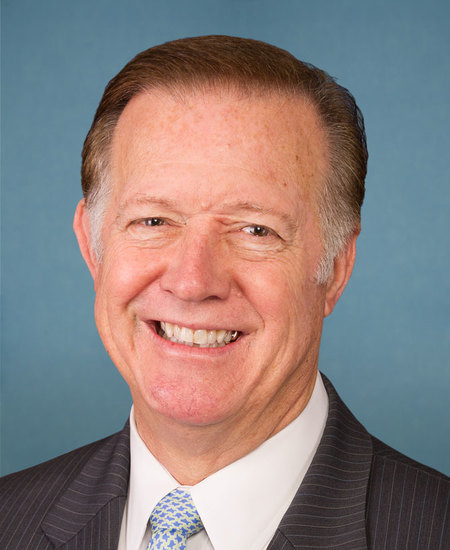
Rep. Randy K. Weber, Sr.
Sponsored bills
Drone Research and Innovation for Law Enforcement Act of 2023 This bill directs the Federal Aviation Administration (FAA) to study, and create an approval process for, nonlethal de-escalation unmanned aircraft (i.e., drones). Under the bill, nonlethal de-escalation unmanned aircraft means an unmanned aircraft that is equipped with one or more nonlethal weapons or devices and is used by law enforcement personnel in scenarios (1) that present significant risk to human life, and (2) in which the suspected criminal is in a position to potentially escalate the situation and expose human life to a high level of risk. Specifically, the FAA must initiate a pilot research program to study the potential use of nonlethal de-escalation unmanned aircraft by law enforcement agencies. As part of the study, the FAA must enter into interagency agreements with various federal, state, and local agencies. The FAA must submit a report on the results of the research program to Congress. The report must include a plan outlining a proposed FAA application process for law enforcement to seek permission to operate nonlethal de-escalation unmanned aircraft. Within 90 days of submitting the report, the FAA must initiate rulemaking to create a process through which the FAA may provide approval to operate these unmanned aircraft.
Maddy summaryHRES 755 is a procedural resolution introduced on October 2, 2023, that proposes expelling Representative Jamaal Bowman from the U.S. House of Representatives. It cites Article I, Section 5, Clause 2 of the Constitution, which grants the House authority to expel members. The resolution, referred to the Committee on Ethics, would remove Bowman from his seat if passed by the full House. This is a formal procedural step seeking to end Bowman's membership, not a law with broader policy effects.
Maddy summaryThe American Broadband Deployment Act of 2023 sets specific timeframes for state and local governments to approve requests for placing, constructing, or modifying broadband infrastructure, requiring decisions within 60-150 days depending on facility type. If deadlines are missed, requests are deemed approved, and local governments must avoid discriminatory regulations that would prevent service improvements or new infrastructure. The bill also establishes rules for fees that must be competitive, neutral, and based on actual costs, and requires written decisions with evidence for denials. This directly affects broadband providers seeking to deploy infrastructure and the local governments that regulate such deployments.
Maddy summaryHR 5838, the SAFER Act, changes how asylum claims are assessed for migrants apprehended at the U.S. border during large-scale migration events. It revises the "credible fear" interview standard to require officers to determine if an asylum seeker is "more likely than not" eligible for asylum and if their claims are "more likely than not" true. The bill also mandates prioritizing removal cases for these migrants, requires scheduling hearings to allow fair access to legal counsel, and directs the hiring of at least 150 additional immigration judges to speed up court processing. It includes reporting requirements on processing times, legal representation rates, and in-absentia removal orders for migrants in these prioritized cases.
Maddy summarySammy's Law of 2023 requires large social media platforms (defined as those with over 100 million monthly users or $1 billion in annual revenue) to create and maintain application programming interfaces that allow parents or legal guardians to delegate account management for children aged 13 or older to third-party safety software providers. These providers must register with the Federal Trade Commission, agree to use data solely for child safety, and follow strict rules about data disclosure. The law establishes a national standard that prevents states from creating their own requirements for this feature while including FTC enforcement mechanisms and data security provisions. The legislation aims to give parents more tools to monitor and protect children from specific online harms like cyberbullying, trafficking, and violence on major social media platforms.
Maddy summaryThis bill would criminalize the prescription, dispensing, distribution, or sale of chemical abortion drugs (mifepristone and misoprostol) for abortion purposes under federal law, with penalties up to 25 years in prison. It directly affects healthcare providers, pharmacists, and patients who use these drugs for abortion. Key exceptions include contraceptive use before pregnancy confirmation, treatment of miscarriage, and life-threatening pregnancy conditions certified by a physician. The bill defines "abortion" as intentionally ending a pregnancy with intent other than live birth or treating specific medical conditions, and explicitly prohibits prosecuting women who receive chemical abortions.
Maddy summaryHR 5791, the "Define the Mission Act," requires the President to submit a comprehensive strategy report to Congress within 30 days of the bill's enactment, detailing U.S. involvement in the Ukraine conflict. The report must define U.S. national interests in the conflict, set specific objectives with timelines, benchmarks, and resource estimates (including personnel and funding), list expected European NATO security contributions, and assess Russia’s natural gas market impact on resolving the conflict. It mandates the strategy must aim for a Russia-Ukraine cease-fire agreement and explicitly cannot depend on U.S. funding for Ukrainian reconstruction. The report must be unclassified but may include a classified annex for full transparency. This bill establishes a formal process for Congress to review and oversee U.S. policy toward Ukraine.
Maddy summaryThis bill denies pension payments to current or former congressional members convicted of certain crimes. Specifically, it removes eligibility for retirement benefits based on their service as a Member of Congress if convicted of a qualifying offense after the bill's enactment. If a conviction is later overturned, the individual would receive retroactive pension payments. The law only applies to pensions tied to congressional service, not other government employment, and excludes convictions occurring before the bill's effective date.
Maddy summaryHRES 684 is a symbolic congressional resolution passed by the U.S. House of Representatives on September 14, 2023, condemning New Mexico Governor Michelle Lujan Grisham's emergency order that temporarily suspended open and concealed carry firearm rights for 30 days. The resolution asserts the order violated the Second Amendment, citing Supreme Court precedents (Heller, McDonald, Bruen) and noting a federal judge had already blocked the order's firearm restrictions. It does not change any laws or impose legal consequences - it is solely a formal expression of disapproval from Congress. The resolution directly addresses the Governor's actions but has no effect on New Mexico's laws or citizens' rights.