

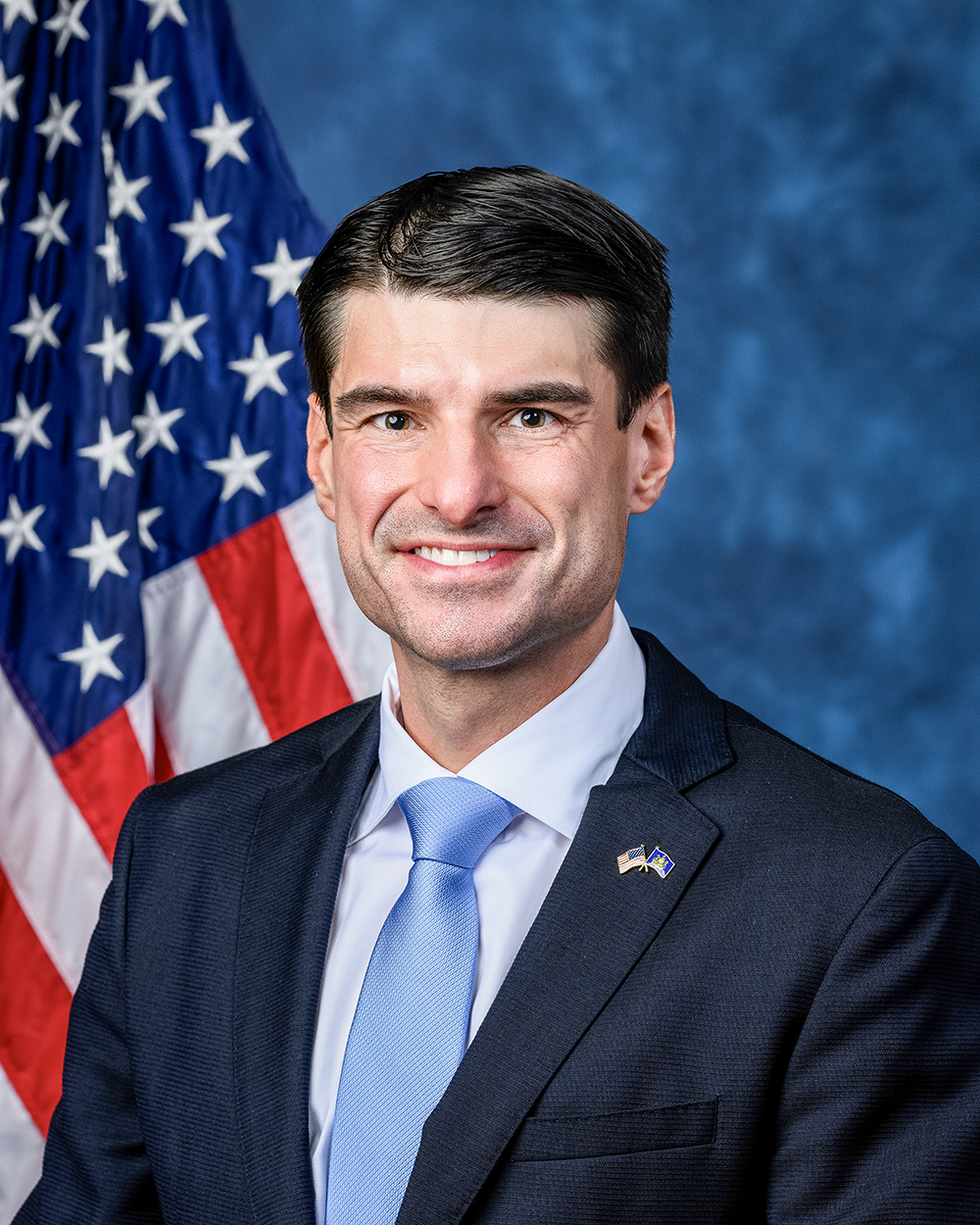
Photo of Robert P. Bresnahan, Jr.
R United States House · District 8 · Pennsylvania On the 2026 ballot

Rep. Robert P. Bresnahan, Jr.

Compare
Total votes
669
all sessions
Attendance
99%
6 missed
Higher than 75% of chamber peers
With party
94%
of cast votes
Lower than 80% of chamber peers
Bipartisan score
3%
crosses aisle rarely
Higher than 79% of chamber peers
Sponsored
335
bills & resolutions
Near the chamber average
Committees
10
assignments
335 bills and resolutions

Sponsored bills

Total
335
Primary
22
Co-sponsor
313
This page
335
matching current filters
Primary HR 5293
In committee · United States House · Lead sponsor
To authorize the President to award the Medal of Honor to Ret. Col. Robert J. Graham for acts of valor while as a member of the Air Force during the Vietnam War.

Maddy summaryHR 5293 authorizes the President to award Ret. Col. Robert J. Graham the Medal of Honor for his actions during the Vietnam War on May 1, 1966. It specifically recognizes his valor when he flew a damaged F-100 Super Sabre under heavy enemy fire, making over 15 strikes to destroy eight North Vietnamese anti-aircraft positions and neutralize over 1,500 enemy troops during Operation Birmingham. The bill waives standard time limits for Medal of Honor awards under U.S. Code, enabling this recognition for Graham's actions that saved hundreds of American lives. It directly affects only Ret. Col. Graham, who previously received a Silver Star for the same mission.

In committee Sep 10, 2025 0 co-sponsors
Primary HR 3428
Passed · United States House · Lead sponsor
Mid-Atlantic River Basin Commissions Review Act

Maddy summaryThis bill requires the Government Accountability Office (GAO) to review three river basin commissions (Susquehanna, Delaware, and Potomac River Basin Commissions) within one year of enactment. The review will examine each commission’s ethics policies, public communication, federal responsibilities, funding sources, and potential overlapping duties with other agencies. After completing the review, the GAO must submit a report to Congress with findings and recommendations for improving transparency or oversight. Each commission must then submit annual compliance plans to Congress for five years, detailing actions taken to address the report’s recommendations. The bill focuses on oversight, not new policy changes.

Passed Sep 9, 2025 0 co-sponsors
Co-sponsor HR 5145
In committee · United States House · Co-sponsor
Bipartisan Premium Tax Credit Extension Act

Maddy summaryHR 5145, the Bipartisan Premium Tax Credit Extension Act, extends enhanced federal subsidies for health insurance premiums through 2026. It directly affects individuals purchasing coverage through health insurance marketplaces who qualify for premium tax credits. The bill extends the period for increased credit amounts (through 2026 instead of 2025) and maintains the rule allowing tax credits for households earning above 400% of the federal poverty level. These changes apply to tax years beginning after December 31, 2025.

In committee Sep 4, 2025 1 co-sponsor
Co-sponsor HR 5128
In committee · United States House · Co-sponsor
Feed Hungry Kids Act

Maddy summaryThe Feed Hungry Kids Act adjusts eligibility for schools participating in the federal school meal program. Starting in the 2025-2026 school year, schools must have at least 25% of students eligible for free or reduced-price meals to qualify for a provision allowing all students to receive free meals without individual applications. This change directly affects public schools nationwide that receive federal meal funding under the National School Lunch Program. The bill sets a specific, measurable threshold for program access without altering other aspects of school meal eligibility.

In committee Sep 4, 2025 1 co-sponsor
Co-sponsor HR 5134
In committee · United States House · Co-sponsor
Appalachian Trail Centennial Act

Maddy summaryThe Appalachian Trail Centennial Act designates the Appalachian Trail Conservancy as the official "Designated Operational Partner" for the Appalachian National Scenic Trail, establishing a formal framework for federal-volunteer partnerships in trail management. It creates processes for developing "land and resource protection priority lists" to guide federal funding decisions for trail conservation, while ensuring volunteer organizations can continue their crucial role in trail maintenance and stewardship. The bill also requires regular economic impact assessments for communities near the trail ("gateway communities") and sets protocols for determining visitor capacity on specific trail segments. This legislation codifies and enhances the longstanding partnership model that has successfully maintained the Appalachian Trail for over a century, with potential application to other national scenic and historic trails.

In committee Sep 4, 2025 1 co-sponsor
Co-sponsor HR 5130
In committee · United States House · Co-sponsor
Prevent Government Shutdowns Act of 2025

Maddy summaryHR 5130, the Prevent Government Shutdowns Act of 2025, would automatically continue funding for most federal programs at previous year's levels if Congress fails to pass full-year appropriations by the start of the fiscal year. The bill would provide automatic funding for 14 days, extendable by 14-day periods until Congress passes an appropriations bill, while excluding entitlement programs like food stamps and Social Security. During these automatic funding periods, the bill restricts government travel to essential activities only, limits use of campaign funds for travel, and requires Congress to prioritize passing appropriations bills over other business. This would affect all federal agencies and programs that would otherwise face a shutdown, as well as Members of Congress and their staff who would face new travel restrictions during these periods.

In committee Sep 4, 2025 1 co-sponsor
Co-sponsor HR 5106
In committee · United States House · Co-sponsor
Restore Trust in Congress Act

Maddy summaryThis bill prohibits Members of Congress, their spouses, and dependent children from owning or trading certain investments, including stocks, commodities, and derivatives (referred to as "covered investments"). It requires affected individuals to divest these investments within 90-180 days, with specific exemptions for Treasury bonds, diversified mutual funds, small business interests, and family trusts meeting strict conditions. Violations incur penalties of 10% of the investment's value plus disgorgement of profits, paid directly to the U.S. Treasury. The law applies to all covered individuals during federal service, with exceptions for investments acquired through inheritance or occupational trading (e.g., a spouse’s finance job).

In committee Sep 3, 2025 1 co-sponsor
Co-sponsor HR 4669
In committee · United States House · Co-sponsor
FEMA Act of 2025

Maddy summary# Summary of Proposed FEMA Reform Legislation (FEMA Act of 2025) This comprehensive legislative document proposes significant reforms to the Robert T. Stafford Disaster Relief and Emergency Assistance Act, with four main sections addressing: ## 1. Disaster Assistance Reforms - **Expanded eligibility** for assistance, including clarifying that absence of a fixed address doesn't disqualify individuals from sheltering assistance - **Improved rental assistance** with consideration of local post-disaster rent increases - **Direct assistance** for those unable to use financial assistance, with no requirement to show other assistance can cover costs (except insurance) - **Enhanced notices** for applicants, including documentation of denial decisions - **Clarification of displacement assistance** eligibility, stating insurance shouldn't be considered a duplication of benefits ## 2. Mitigation Program Enhancements - **Preapproved project mitigation plans** requiring states to develop plans with peer review processes - **Improved allocation of funds** with formulas prioritizing vulnerable communities, high-risk areas, and rural/economically distressed communities - **Resilient buildings** requirements for housing retrofits using the latest building codes - **Streamlined application processes** for hazard mitigation funds across multiple programs - **Study on mitigation benefits** to evaluate cost savings and effectiveness ## 3. Transparency and Accountability Measures - **Public dashboards** for both individual assistance (431) and public assistance (432) showing application status, approvals, denials, and funding - **Transparency requirements** for disaster declarations with detailed justifications for approvals/denials - **GAO studies** on numerous topics including: - Identity theft in disaster assistance (409) - Insurance utilization for public assistance facilities (410) - Wildfire management plans (411) - Effectiveness of alerting systems (412) - Cost savings of repair/rebuilding reforms (415) - **Prohibition on political discrimination** in assistance distribution ## 4. Workforce and Operational Improvements - **Study on workforce retention** in noncontiguous communities - **Pilot program** for preliminary damage assessments in remote communities - **Fast-moving disasters working group** to develop best practices for rapid response The legislation focuses on improving efficiency, transparency, and effectiveness of disaster relief programs while prioritizing vulnerable populations and communities with higher risk of disasters. It also emphasizes data-driven decision making through required studies and reports to continuously improve disaster management policies.

In committee Sep 3, 2025 1 co-sponsor
Co-sponsor HR 747
Passed · United States House · Co-sponsor
Stop Chinese Fentanyl Act of 2025

Maddy summaryThis bill amends U.S. sanctions law to target Chinese entities and officials involved in fentanyl trafficking. It redefines "foreign opioid trafficker" to include Chinese chemical companies or government officials (like those in the National Narcotics Control Commission) that fail to prevent fentanyl precursor trafficking or cooperate with U.S. efforts. Key mechanisms include requiring China to implement stricter chemical shipment labeling and "know-your-customer" procedures, extending sanctions periods from 5 to 10 years, and mandating annual presidential reports to Congress on drug trafficking emergencies. The bill explicitly excludes importation of goods from sanctions coverage.

Passed Sep 3, 2025 1 co-sponsor
Co-sponsor HR 5024
In committee · United States House · Co-sponsor
Transit Funding Flexibility Act

Maddy summaryHR 5024, the Transit Funding Flexibility Act, removes a population restriction that previously limited certain federal transit grants to urban areas with fewer than 200,000 residents. It requires transit agencies receiving these grants to annually certify they maintain local funding for operating costs covered by federal money. If an agency fails to maintain this local funding, the bill mandates a 1/3 reduction in their next year's federal grant amount. This bill directly affects public transit agencies in smaller urban areas that now gain access to operating cost funding, while requiring them to sustain local financial commitments.

In committee Aug 23, 2025 1 co-sponsor
Showing 141 to 150 of 335 bills
Previous 1 … 14 15 16 … 34 Next