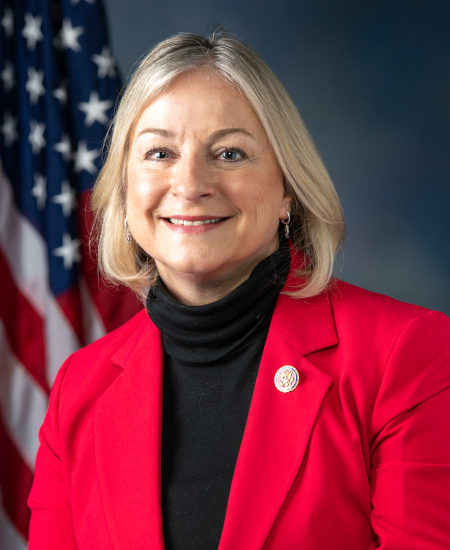
Photo of Susan Wild
D United States House · District 7 · Former member · Pennsylvania

Rep. Susan Wild

Compare
Total votes
2,168
all sessions
Attendance
97%
62 missed
Near the chamber average
With party
95%
of cast votes
Near the chamber average
Bipartisan score
3%
crosses aisle rarely
Near the chamber average
Sponsored
1,223
bills & resolutions
Higher than 80% of chamber peers
Committees
0
assignments
1,223 bills and resolutions

Sponsored bills

Total
1,223
Primary
45
Co-sponsor
1,178
This page
1,223
matching current filters
Co-sponsor HRES 1152
Passed · United States House · Co-sponsor
Condemning the atrocity that occurred in Buffalo, New York, on May 14, 2022, in which 10 Americans were killed and 3 were injured, and in which 11 of the 13 victims were Black Americans, condemning the Great Replacement Theory as a White supremacist conspiracy theory, and reaffirming the House of Representatives commitment to combating White supremacy, hatred, and racial injustice.

This resolution condemns in the strongest terms the great replacement theory, which it describes as a white supremacist conspiracy theory that has been used to falsely justify racially motivated, violent acts of terrorism domestically and internationally.

Passed Jun 8, 2022 1 co-sponsor
Co-sponsor HR 7987
In committee · United States House · Co-sponsor
DEFEND Act of 2022

Deterring Enemy Forces and Enabling National Defenses Act of 2022 or the DEFEND Act of 2022 This bill requires the Department of Defense to seek to cooperate with Middle East allies and partners (i.e., countries of the Gulf Cooperation Council, Iraq, Israel, Jordan, Egypt, and other countries in the region as appropriate) to identify and develop an approach for such allies and partners to implement an integrated air and missile defense capability to protect against attacks from Iran and groups linked to Iran.

In committee Jun 8, 2022 1 co-sponsor
Co-sponsor HR 6087
Passed · United States House · Co-sponsor
Improving Access to Workers’ Compensation for Injured Federal Workers Act

Improving Access to Workers' Compensation for Injured Federal Workers Act of 2022 This bill expands the role of nurse practitioners and physician assistants in providing services to injured federal workers under the federal workers' compensation program. Specifically, under the program, nurse practitioners and physician assistants acting within the scope of their practice may (1) prescribe or recommend treatment for injured federal workers; (2) certify the nature of an injury and probable extent of disability; (3) provide prescribed treatment for injured federal workers; and (4) participate, with a physician designated by the Department of Labor, in a mandatory workers' compensation examination of an injured worker. In general, only physicians may fulfill these roles under current law.

Passed Jun 8, 2022 1 co-sponsor
Co-sponsor HR 7933
In committee · United States House · Co-sponsor
Keep Infant Formula Safe and On the Shelves Act of 2022

Keep Infant Formula Safe and On the Shelves Act of 2022 This bill requires the Food and Drug Administration (FDA) to periodically inspect infant formula manufacturing facilities and addresses related issues. The FDA must periodically conduct inspections, including unannounced inspections, of infant formula manufacturer facilities. If the FDA makes a notable regulatory finding at such a facility, the manufacturer must undergo a comprehensive food safety audit that includes a root cause analysis, enhanced testing, and comprehensive environmental samples. A manufacturer of infant formula or essential medical food must notify the FDA no later than five business days after becoming aware of circumstances that could lead to a shortage of the relevant product in the United States. Further, the FDA must create and annually update a list of U.S. manufacturing facilities that could be converted to manufacture infant formula during a shortage. In the event of a shortage, the FDA may require infant formula manufacturers to provide certain information, such as the quantity of formula in a manufacturer's inventory. The bill also establishes under statute that food, including infant formula, is a critical material essential to the national defense and therefore subject to authorities under the Defense Production Act of 1950. (Such authorities authorize the President to take various actions, such as requiring businesses to prioritize certain government contracts and incentivizing the domestic industrial base to expand the production of critical materials.) The Occupational Safety and Health Administration must issue a fact sheet and provide technical assistance to infant formula manufacturers to promote compliance with occupational health and safety standards.

In committee Jun 3, 2022 1 co-sponsor
Co-sponsor HJRES 87
In committee · United States House · Co-sponsor
Directing the removal of United States Armed Forces from hostilities in the Republic of Yemen that have not been authorized by Congress.

This joint resolution directs the President to remove U.S. Armed Forces from hostilities against the Houthis in Yemen within 30 days of the enactment of this joint resolution unless Congress authorizes a later withdrawal date, issues a declaration of war, or specifically authorizes the use of the Armed Forces. Prohibited activities include sharing intelligence or providing logistical support to enable offensive strikes by the coalition led by Saudi Arabia. This joint resolution shall not affect any military operations directed at Al Qaeda or associated forces.

In committee May 31, 2022 1 co-sponsor
Co-sponsor HR 350
Passed · United States House · Co-sponsor
Domestic Terrorism Prevention Act of 2022

Domestic Terrorism Prevention Act of 2022 This bill establishes new requirements to expand the availability of information on domestic terrorism, as well as the relationship between domestic terrorism and hate crimes. It authorizes domestic terrorism components within the Department of Homeland Security (DHS), the Department of Justice (DOJ), and the Federal Bureau of Investigation (FBI) to monitor, analyze, investigate, and prosecute domestic terrorism. The domestic terrorism components of DHS, DOJ, and the FBI must jointly report on domestic terrorism, including white-supremacist-related incidents or attempted incidents. DHS, DOJ, and the FBI must review the anti-terrorism training and resource programs of their agencies that are provided to federal, state, local, and tribal law enforcement agencies. Additionally, DOJ must make training on prosecuting domestic terrorism available to its prosecutors and to assistant U.S. attorneys. It creates an interagency task force to analyze and combat white supremacist and neo-Nazi infiltration of the uniformed services and federal law enforcement agencies. Finally, it directs the FBI to assign a special agent or hate crimes liaison to each field office to investigate hate crimes incidents with a nexus to domestic terrorism.

Passed May 26, 2022 1 co-sponsor
Co-sponsor HR 3807
Passed · United States House · Co-sponsor
Restaurant Revitalization Fund Replenishment Act of 2021

Relief for Restaurants and other Hard Hit Small Businesses Act of 2022 This bill addresses support for restaurants, arts and entertainment venues, and small businesses impacted by the COVID-19 pandemic. The bill provides an additional $42 billion in FY2021 for the Restaurant Revitalization Fund and gives priority to previous applicants who have not received a grant. The Small Business Administration (SBA) must provide to applicants an explanation for denied applications, establish a reconsideration process for denied applications, and institute an audit and oversight plan with respect to grant recipients. Additionally, the bill establishes the Hard Hit Industries Award Program for small businesses that suffered a pandemic-related revenue loss of 40% or more. Aggregate grant amounts are capped at $1 million. Funds may be used for expenses including mortgage, rent, and utility payments and payroll. SBA must prioritize entities that have experienced significant pandemic-related revenue loss, with first priority going to those that experienced a loss of at least 80%, and second priority going to those that experienced a loss of at least 60%. Finally, the bill extends to March 11, 2023 (or a later date as determined by the SBA), the time frame during which Shuttered Venue Operators Grant recipients may use grant funds to cover their expenses.

Passed May 25, 2022 1 co-sponsor
Co-sponsor HR 8
Passed · United States House · Co-sponsor
Bipartisan Background Checks Act of 2021

Bipartisan Background Checks Act of 2021 This bill establishes new background check requirements for firearm transfers between private parties (i.e., unlicensed individuals). Specifically, it prohibits a firearm transfer between private parties unless a licensed gun dealer, manufacturer, or importer first takes possession of the firearm to conduct a background check. The prohibition does not apply to certain firearm transfers or exchanges, such as a gift between spouses in good faith.

Passed May 25, 2022 1 co-sponsor
Co-sponsor HR 1620
Passed · United States House · Co-sponsor
Violence Against Women Act Reauthorization Act of 2021

Violence Against Women Reauthorization Act of 2021 This bill modifies and reauthorizes through FY2026 programs and activities under the Violence Against Women Act that seek to prevent and respond to domestic violence, sexual assault, dating violence, and stalking. The bill also authorizes new programs, makes changes to federal firearms laws, and establishes new protections to promote housing stability and economic security for victims of domestic violence, sexual assault, dating violence, and stalking.

Passed May 24, 2022 1 co-sponsor
Co-sponsor HR 7791
Signed into law · United States House · Co-sponsor
Access to Baby Formula Act of 2022

Access to Baby Formula Act of 2022 This bill authorizes the Department of Agriculture (USDA) to take certain actions to address emergencies, disasters, and supply chain disruptions (particularly the shortage of infant formula in the United States) affecting participants of the Special Supplemental Nutrition Program for Women, Infants, and Children (WIC). The bill directs USDA to require each infant formula cost containment contract to include remedies in the event of an infant formula recall, including how an infant formula manufacturer would protect against disruption to WIC participants in the state. USDA must, within 30 days, ensure there is a memorandum of understanding with the Department of Health and Human Services that includes procedures for coordination and information sharing regarding any supply chain disruption, including a supplemental food recall. The bill also authorizes USDA to waive or modify any WIC qualified administrative requirement during emergencies, disasters, and supply chain disruptions. Specifically, USDA may waive or modify such a requirement for one or more state agencies if (1) the requirement cannot be met by state agencies during the emergency, disaster, or disruption; and (2) the modification or waiver is necessary to provide assistance to WIC participants and does not substantially weaken the nutritional quality of supplemental foods. For example, USDA may waive the maximum monthly allowance for infant formula. The bill establishes notification requirements for USDA and state agencies related to supply chain disruptions.


Signed into law May 21, 2022 1 co-sponsor
Showing 701 to 710 of 1,223 bills
Previous 1 … 70 71 72 … 123 Next