Prohibition of Medicaid Funding for Conversion Therapy Act This bill prohibits state Medicaid programs from covering conversion therapy. The bill defines conversion therapy as any practice or treatment that seeks to change a person's sexual orientation or gender identity in exchange for monetary compensation.
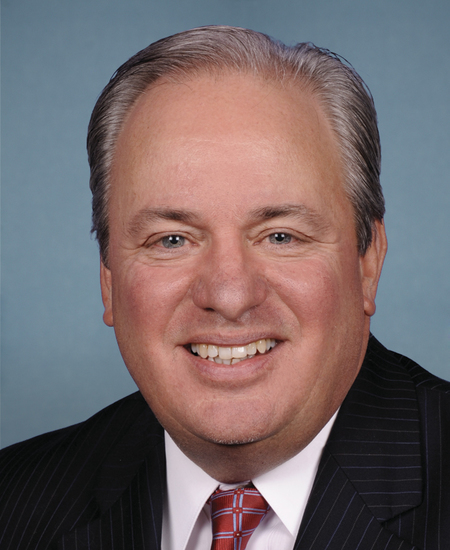
Rep. Michael F. Doyle
Sponsored bills
Harlem Hellfighters Congressional Gold Medal Act This bill provides for the award of a Congressional Gold Medal to the 369th Infantry Regiment, commonly known as the Harlem Hellfighters, in recognition of their bravery and outstanding service during World War I.
No Federal Funding for Confederate Symbols Act This bill prohibits federal funds from being used for the creation, maintenance, or display of any Confederate symbol on federal public land or other federal property. An exception to such prohibition is provided (1) if the use of such funds is necessary to allow for the removal of the Confederate symbol to address public safety; or (2) in the case of a Confederate symbol created, maintained, or displayed in a museum or educational exhibit.
Twenty-First Century Dams Act This bill addresses dam infrastructure and safety. First, the bill provides resources for programs related to state dam safety, the rehabilitation of high hazard potential dams, and the inspection of dams. In particular, the bill reauthorizes through FY2026 the National Dam Safety Program. In addition, the bill reauthorizes through FY2026 a program related to the rehabilitation of structural measures and a program related to water infrastructure. Next, the bill allows a new tax credit for maintaining and enhancing hydroelectric dams that is equal to 30% of the basis of any qualified dam safety, environmental, and grid resilience enhancement property placed in service in a taxable year. It also allows a 30% credit for qualified obsolete river obstruction removal expenditures for demolishing and removing certain nonpowered or hydroelectric dams. The bill directs the Department of the Army to establish a program to carry out dam removal projects. Further, the bill establishes the Dam Removal Council to (1) coordinate with participating federal agencies to annually notify all known dam owners of the availability of dam removal funding and provide guidance on the existing programs of participating agencies; (2) evaluate and submit to Army recommendations for dam removal projects, technical assistance programs, and funding allocations; and (3) develop a dam removal strategy. The bill requires certain dam assessments, including a joint assessment by the U.S. Geological Survey and the Department of Energy. The bill also authorizes specified federal agencies to undertake certain activities related to federal dam infrastructure.
9/11 Responder and Survivor Health Funding Correction Act This bill increases funding for and otherwise modifies a federal program that provides medical monitoring and treatment to responders and survivors who suffer from health conditions related to the September 11, 2001, attacks on the World Trade Center. Among the changes, the bill allows certain health care providers other than physicians to determine whether an individual's health condition is related to the attacks, and it establishes a research program to study the impacts of the attacks on health and educational outcomes of individuals who were 21 years of age or younger when the attacks occurred.
State Public Option Act This bill allows residents who are not already eligible for Medicaid and not concurrently enrolled in other health insurance coverage to buy into a state Medicaid plan beginning January 1, 2022, at the option of the state. State Medicaid programs may set premiums and cost-sharing requirements for such coverage in accordance with specified limitations. The bill also (1) provides the enhanced Federal Medical Assistance Percentage (i.e., federal matching rate) to every state that expands Medicaid coverage for individuals who are newly eligible under the Patient Protection and Affordable Care Act, regardless of when such expansion takes place; and (2) requires state Medicaid programs to cover comprehensive reproductive health care services, including abortion services.
Preserving Existing Nuclear Energy Generation Act This bill requires the Department of Energy to establish (1) a program to evaluate nuclear reactors that are projected to cease operations due to economic factors and to allocate financial credits to certain reactors, and (2) a grant program to assist communities with revenue shortfalls due to closures of nuclear power plants.
Clean Hydrogen Energy Act This bill sets forth provisions to advance the research, development, demonstration, and deployment of hydrogen gas that is produced in compliance with greenhouse gas emission standards established by this bill. Specifically, the bill expands an existing hydrogen research and development program of the Department of Energy (DOE) established under the Energy Policy Act of 2005. For example, the bill establishes a new program goal to demonstrate a standard of clean hydrogen production in the transportation (i.e., vehicles, locomotives, airplanes, and maritime vessels), utility, industrial, commercial, and residential sectors by 2040. The bill also requires DOE to establish a program that supports the development of regional clean hydrogen hubs. In carrying out those programs, DOE must award grants for research, development, and demonstration projects to advance new clean hydrogen production, processing, delivery, storage, and use equipment manufacturing technologies and techniques. DOE must also develop a technologically and economically feasible national strategy and road map to facilitate wide scale production, processing, delivery, storage, and use of clean hydrogen. In addition, DOE must establish a research, development, demonstration, commercialization, and deployment program to improve the efficiency, increase the durability, and reduce the cost of producing hydrogen using electrolyzers. Electrolyzers are systems that produce hydrogen using electrolysis, a process that uses electricity to split water into hydrogen and oxygen. In carrying out the program, DOE must award grants for projects that reduce the cost of hydrogen produced using electrolyzers as specified by the bill.

Medicare Advantage Quality Payment Relief Act of 2021 This bill requires the Centers for Medicare & Medicaid Services to disregard the application of certain percentage quality increases when calculating the maximum payment that may be made to a Medicare Advantage organization.
Main Street Efficiency Act of 2021 This bill requires the Department of Energy to establish a grant program that provides incentives for small businesses to make energy efficiency upgrades.