

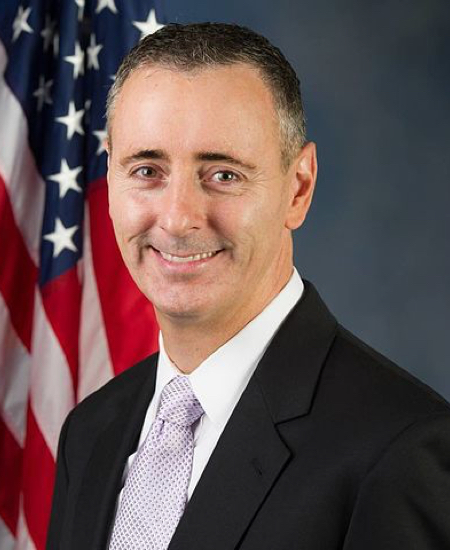
Photo of Brian K. Fitzpatrick
R United States House · District 1 · Pennsylvania On the 2026 ballot

Rep. Brian K. Fitzpatrick

Compare
Total votes
2,837
all sessions
Attendance
100%
9 missed
Higher than 75% of chamber peers
With party
76%
of cast votes
Lower than 98% of chamber peers
Bipartisan score
12%
some cross-party votes
Higher than 97% of chamber peers
Sponsored
4,059
bills & resolutions
Higher than 99% of chamber peers
Committees
6
assignments
4,059 bills and resolutions

Sponsored bills

Total
4,059
Primary
180
Co-sponsor
3,879
This page
4,059
matching current filters
Co-sponsor HR 3291
In committee · United States House · Co-sponsor
Certainty for Our Energy Future Act

Maddy summaryThe Certainty for Our Energy Future Act ends tax credits for new wind and solar energy projects that begin construction after December 31, 2030, effective January 1, 2026. It also denies clean energy tax benefits to companies controlled by governments of China, Russia, Iran, or North Korea. The bill uses existing IRS guidelines to define when construction begins for projects, avoiding new bureaucratic rules. Treasury must issue implementation guidance within 180 days, with country-related restrictions taking effect 180 days after that guidance is published.

In committee May 8, 2025 1 co-sponsor
Co-sponsor HR 3295
In committee · United States House · Co-sponsor
Federal Animal Research Accountability Act of 2025

Maddy summaryHR 3295, the Federal Animal Research Accountability Act of 2025, requires research institutions receiving National Institutes of Health (NIH) funding to submit detailed annual reports on animal use. These reports must categorize animals by species and specify: (1) animals used with no pain/distress, (2) animals with pain/distress using pain relief, (3) animals with pain/distress where pain relief would interfere with research, and (4) animals bred but not yet used. The NIH must make these reports publicly accessible online within three months of submission through a searchable database. The bill applies to all NIH-funded research entities and takes effect two years after enactment.

In committee May 8, 2025 1 co-sponsor
Co-sponsor HR 3304
In committee · United States House · Co-sponsor
Providing Child Care for Police Officers Act of 2025

Maddy summaryHR 3304, the Providing Child Care for Police Officers Act of 2025, establishes a federal grant program to help law enforcement agencies provide child care for officers' minor children during nonstandard shifts. The program awards competitive 3-year grants to state or local "lead agencies" (like state child care offices) to fund child care services through eligible law enforcement agencies or consortia, with 20% of funds reserved for small agencies (under 200 officers). Grants cover startup costs, provider training, sick child care, facility construction, and other needs, requiring local matching funds (10% to 33% over three years). The program is authorized for $24 million annually from 2026-2030 and includes studies to evaluate its impact on child care access for officers and other first responders.

In committee May 8, 2025 1 co-sponsor
Co-sponsor HR 2623
In committee · United States House · Co-sponsor
Innovative Therapies Centers of Excellence Act of 2025

Maddy summaryHR 2623, the Innovative Therapies Centers of Excellence Act of 2025, directs the Department of Veterans Affairs to establish at least five specialized medical centers focused on treating veterans with specific conditions like PTSD, depression, chronic pain, and substance use disorders using innovative therapies. These centers must meet strict criteria, including academic partnerships with medical schools, research capabilities, veteran advisory committees, and data-sharing systems for evaluating treatment effectiveness. The bill authorizes $30 million annually for these centers' research and education activities and requires the VA to submit annual reports to Congress on their operations and findings. It directly affects veterans seeking advanced treatments for covered conditions through VA facilities and establishes a peer review process to select designated centers based on scientific merit.

In committee May 8, 2025 1 co-sponsor
Co-sponsor HRES 395
In committee · United States House · Co-sponsor
Establishing a "Bill of Rights" to support United States law enforcement personnel nationwide in their work to protect our communities.

Maddy summaryHRES 395 is a non-binding resolution (not a law) that establishes a symbolic "Bill of Rights" for U.S. law enforcement officers during internal investigations into alleged misconduct. It outlines specific procedural protections, including the right to have legal counsel present during interviews, the right to know investigation details in advance, protection from offensive language or threats during questioning, and the right to not face discipline for invoking the Fifth Amendment. The resolution aims to support officers by ensuring fair investigation processes while condemning calls to defund or dismantle police departments. It does not create new legal rights or change existing laws but encourages states to adopt similar protections for officers.

In committee May 7, 2025 1 co-sponsor
Co-sponsor HR 3239
In committee · United States House · Co-sponsor
Research Advancing to Market Production for Innovators Act

Maddy summaryThis bill amends the Small Business Act to improve how federal agencies support small businesses in turning research into market products through the SBIR and STTR programs. It shortens peer review timelines from one year to 180 days, requires reviewers to assess commercialization potential alongside technical merit, and mandates agencies to appoint dedicated Technology Commercialization Officials. Agencies must also track success through annual reports measuring revenue from new products, patents, follow-on funding, and spin-out companies. The changes directly affect small businesses receiving SBIR/STTR grants and federal agencies managing these programs.

In committee May 7, 2025 1 co-sponsor
Co-sponsor HR 3248
In committee · United States House · Co-sponsor
American Ownership and Resilience Act

Maddy summaryThe American Ownership and Resilience Act establishes a new framework for "ownership investment companies" that provide capital to support employee stock ownership plans (ESOPs) and worker-owned cooperatives. The bill creates a licensing system requiring ownership investment companies to meet capital requirements, use independent financial advisors and trustees for transactions, and maintain employee ownership interests. It establishes a facility to provide leverage to these companies with specific limits ($5 billion total annual limit, $100 million per Protégé OIC), and requires detailed reporting on the impact of these investments. The act aims to facilitate and protect employee ownership structures while ensuring transparency and accountability through strict regulatory requirements.

In committee May 7, 2025 1 co-sponsor
Co-sponsor HR 3260
In committee · United States House · Co-sponsor
Mental Health Improvement Act

Maddy summaryHR 3260 extends the funding period for mental health education grants under Section 756(f) of the Public Health Service Act from fiscal years 2023-2027 to 2026-2030. This procedural change directly affects existing grant recipients and administrators of federal mental health education programs. The bill modifies the grant authorization timeline but does not alter the program's scope or eligibility. It focuses solely on extending the current grant funding period without adding new requirements or benefits.

In committee May 7, 2025 1 co-sponsor
Co-sponsor HR 3262
In committee · United States House · Co-sponsor
NURSE Act

Maddy summaryHR 3262, the NURSE Act, creates a federal grant program to help schools hire more registered school nurses, primarily targeting public elementary and secondary schools serving high-need communities. The bill prioritizes schools where at least 20% of students qualify for free/reduced-price lunches (indicating high poverty) or lack any nurse, with federal funds covering up to 75% of costs for hiring nurses. Eligible schools or consortia must demonstrate student health needs, such as chronic conditions or mental health support, and the program requires a report to Congress evaluating impacts on nurse staffing and student health outcomes. The grant program is authorized for fiscal years 2026-2030, aiming to address the current shortage where one-third of schools lack a school nurse.

In committee May 7, 2025 1 co-sponsor
Co-sponsor HR 3226
In committee · United States House · Co-sponsor
Law Enforcement Officers Equity Act

Maddy summaryThe Law Enforcement Officers Equity Act expands federal retirement benefits to include specific non-traditional law enforcement roles, such as IRS tax collection officers, U.S. Postal Inspection Service employees, Department of Veterans Affairs police, and certain U.S. Customs and Border Protection seized property specialists. It directly affects current and future federal workers in these positions who were previously excluded from law enforcement retirement benefits under the Federal Employees Retirement System and Civil Service Retirement System. The bill allows current employees (incumbents) to elect to count prior service toward retirement by paying a deposit covering the difference in retirement contributions, with government contributions made over 10 years. It also temporarily exempts law enforcement officers from mandatory separation for three years after enactment.

In committee May 7, 2025 1 co-sponsor
Showing 881 to 890 of 4,059 bills
Previous 1 … 88 89 90 … 406 Next