

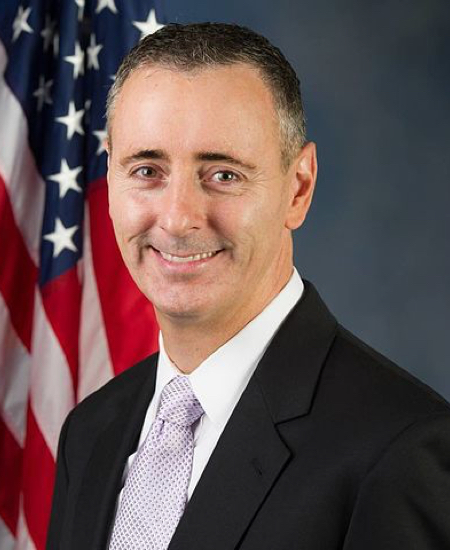
Photo of Brian K. Fitzpatrick
R United States House · District 1 · Pennsylvania On the 2026 ballot

Rep. Brian K. Fitzpatrick

Compare
Total votes
2,837
all sessions
Attendance
100%
9 missed
Higher than 75% of chamber peers
With party
76%
of cast votes
Lower than 98% of chamber peers
Bipartisan score
12%
some cross-party votes
Higher than 97% of chamber peers
Sponsored
4,059
bills & resolutions
Higher than 99% of chamber peers
Committees
6
assignments
4,059 bills and resolutions

Sponsored bills

Total
4,059
Primary
180
Co-sponsor
3,879
This page
4,059
matching current filters
Co-sponsor HR 464
In committee · United States House · Co-sponsor
Skills Investment Act of 2025

Maddy summaryThis bill changes the name of Coverdell education savings accounts to "Coverdell lifelong learning accounts" and expands their use to cover skill development expenses for people over 16. It allows funds to be used for career training, technical education, adult education, and related costs like computer equipment. The bill raises the age limit for contributions from 18 to 70, sets a $10,000 account limit after age 30, and creates a new tax credit for employers who contribute to these accounts for their employees. It also allows beneficiaries aged 18 and older to deduct their contributions to these accounts. The changes will take effect for contributions and distributions after 2025.

In committee Jan 15, 2025 1 co-sponsor
Co-sponsor HR 450
In committee · United States House · Co-sponsor
FORCE Act

Maddy summaryHR 450, the FORCE Act, prevents the U.S. government from removing Cuba from the State Sponsors of Terrorism list. It requires the President to make a specific determination under the 1996 LIBERTAD Act before Cuba can be removed. The bill directly affects Cuba's international designation status and U.S. foreign policy actions toward the country. It does not change existing law but blocks any removal until the specified determination is made. The provision applies to both the President and the Secretary of State.

In committee Jan 15, 2025 1 co-sponsor
Co-sponsor HR 468
In committee · United States House · Co-sponsor
Mel’s Law

Maddy summaryThis bill requires colleges and universities to establish a policy for awarding posthumous degrees to students who were enrolled in a degree program, died before completing it, and were in good academic standing at the time of death. It amends the Higher Education Act to mandate this institutional policy and updates accreditation standards to ensure they do not consider the number of posthumous degrees awarded. The policy must be implemented within one year of the law's enactment. This directly affects higher education institutions by changing their degree-issuance procedures for deceased students meeting specific criteria.

In committee Jan 15, 2025 1 co-sponsor
Co-sponsor HR 436
In committee · United States House · Co-sponsor
To prohibit the use of Federal funds to support or facilitate the participation of the Russian Federation in the Group of Seven, and for other purposes.

Maddy summaryHR 436 prohibits U.S. federal funds from being used to support Russia's participation in the Group of Seven (G7) or to reconstitute a Group of Eight (G8) including Russia. The bill blocks any federal spending for actions facilitating Russia's involvement in G7 meetings or the return of Russia to a G8 format. This directly affects U.S. government agencies and programs that manage international funding or diplomatic engagement. The policy change requires the U.S. to stop providing financial support for Russia's role in these international forums, without altering the G7's own rules.

In committee Jan 15, 2025 1 co-sponsor
Co-sponsor HR 378
In committee · United States House · Co-sponsor
Thin Blue Line Act

Maddy summaryHR 378, the Thin Blue Line Act, adds a new aggravating factor for the death penalty in federal cases where a defendant kills or targets a law enforcement officer, firefighter, or other first responder. It specifically applies when the victim was killed or targeted while performing official duties, because of those duties, or due to their status as a public official. This amendment to federal death penalty law would make the death penalty a potential sentencing option for such crimes, as the killing would be considered an aggravating factor. The bill directly affects defendants convicted of homicides meeting these specific circumstances involving public safety personnel.

In committee Jan 14, 2025 1 co-sponsor
Co-sponsor HR 344
In committee · United States House · Co-sponsor
Anti-Congestion Tax Act

Maddy summaryThis bill creates a toll credit for vehicles crossing specific bridges and tunnels before entering Manhattan's congestion zone. It requires the Transportation Secretary to certify that drivers using the Holland Tunnel, Lincoln Tunnel, or George Washington Bridge receive a credit equal to their bridge/tunnel toll when paying the congestion toll. The bill also adds a federal tax credit for taxpayers who pay congestion tolls before entering the zone, preventing double benefits with other deductions. It directly affects drivers using those crossings, the Metropolitan Transportation Authority (for grant eligibility), and taxpayers who pay these tolls. The policy change takes effect when congestion tolls begin and applies to tax years after enactment.

In committee Jan 14, 2025 1 co-sponsor
Co-sponsor HRES 33
In committee · United States House · Co-sponsor
Supporting the goals and ideals of Korean American Day.

Maddy summaryThis resolution expresses the House's support for Korean American Day, commemorating January 13, 1903 - the arrival of the first large wave of Korean immigrants to the U.S. It urges all Americans to observe the day to recognize Korean Americans' contributions to U.S. society, including their economic, cultural, and military service. The resolution honors the 122nd anniversary of this historical arrival, acknowledging the resilience of early Korean immigrants and their descendants. As a symbolic gesture, it does not create new laws or affect any specific group directly.

In committee Jan 13, 2025 1 co-sponsor
Co-sponsor HR 337
In committee · United States House · Co-sponsor
To provide technical and financial assistance for groundwater recharge, aquifer storage, and water source substitution projects.

Maddy summaryHR 337 redirects $3 million annually from unobligated funds to support groundwater recharge, aquifer storage, and water source substitution projects. It authorizes $3 million per year for fiscal years 2026-2031 to be transferred to the Secretary for these specific water management initiatives. The bill directly affects state and local water agencies implementing these projects by providing dedicated funding. It does not create new programs but reallocates existing unobligated funds from the Infrastructure Investment and Jobs Act. The key mechanism is the annual transfer of $3 million for these water storage and supply projects.

In committee Jan 13, 2025 1 co-sponsor
Co-sponsor HR 360
In committee · United States House · Co-sponsor
Oyster Reef Recovery Act of 2025

Maddy summaryHR 360, the Oyster Reef Recovery Act of 2025, establishes a federal program to conserve and restore oyster reefs through technical and financial assistance. The program provides competitive grants to eligible entities - including state/local governments, nonprofits, educational institutions, and the shellfish industry (defined as growers and harvesters) - to fund restoration projects, monitoring, and workforce training focused on coastal resilience. Grants require applicants to demonstrate projects won’t interfere with commercial fishing or other water uses. The bill authorizes $15 million annually from 2026-2030 for these efforts, while explicitly preserving state and tribal authority over oyster management.

In committee Jan 13, 2025 1 co-sponsor
Co-sponsor HR 354
In committee · United States House · Co-sponsor
Small Business Growth Act

Maddy summaryHR 354, the Small Business Growth Act, increases tax deduction limits for small businesses purchasing equipment. It raises the annual deduction cap from $1 million to $2 million and the phaseout threshold from $2.5 million to $3.5 million under Section 179 of the tax code. These changes directly affect small businesses that buy qualifying depreciable assets like machinery or vehicles, allowing them to deduct more of the cost upfront. The provisions apply to property placed in service after December 31, 2025, with inflation adjustments updated to reference 2025 and 2026.

In committee Jan 13, 2025 1 co-sponsor
Showing 1,311 to 1,320 of 4,059 bills