

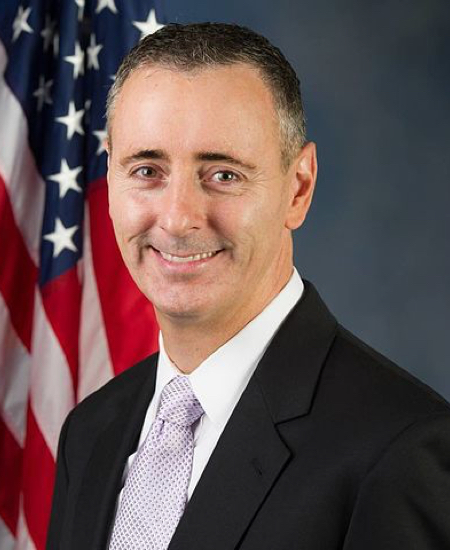
Photo of Brian K. Fitzpatrick
R United States House · District 1 · Pennsylvania On the 2026 ballot

Rep. Brian K. Fitzpatrick

Compare
Total votes
2,837
all sessions
Attendance
100%
9 missed
Higher than 75% of chamber peers
With party
76%
of cast votes
Lower than 98% of chamber peers
Bipartisan score
12%
some cross-party votes
Higher than 97% of chamber peers
Sponsored
4,059
bills & resolutions
Higher than 99% of chamber peers
Committees
6
assignments
4,059 bills and resolutions

Sponsored bills

Total
4,059
Primary
180
Co-sponsor
3,879
This page
4,059
matching current filters
Co-sponsor HR 1177
In committee · United States House · Co-sponsor
Improve and Enhance the Work Opportunity Tax Credit Act

Maddy summaryHR 1177, the "Improve and Enhance the Work Opportunity Tax Credit Act," increases tax credits for employers hiring from targeted groups. It raises the credit rate from 40% to 50% for qualified first-year wages up to $6,000, plus 50% for wages between $6,000 and $12,000. The bill also creates higher credit limits for veterans (up to $24,000/$48,000), removes an age cap for Supplemental Nutrition Assistance Program (SNAP) recipients, and adjusts rules for summer youth workers and long-term family assistance recipients. These changes apply to employees hired after December 31, 2024, directly benefiting employers who hire from these eligible groups.

In committee Feb 10, 2025 1 co-sponsor
Co-sponsor HR 1158
In committee · United States House · Co-sponsor
Freedom First Lend Lease Act

Maddy summaryHR 1158, the Freedom First Lend Lease Act, authorizes the U.S. President to lend or lease defense equipment to Ukraine and Eastern European countries impacted by Russia's invasion, for fiscal years 2026 and 2027. It specifically removes certain legal restrictions (like sections of the Foreign Assistance Act and Arms Export Control Act) that would normally apply to such assistance for Ukraine. The bill requires the President to establish expedited delivery procedures for defense articles within 60 days of enactment and mandates that any loan or lease must comply with standard return, reimbursement, and repayment requirements. This policy change directly affects U.S. foreign military assistance to these nations, streamlining support for defense capabilities and civilian protection.

In committee Feb 10, 2025 1 co-sponsor
Co-sponsor HR 1154
In committee · United States House · Co-sponsor
Space Infrastructure Act

Maddy summaryThe Space Infrastructure Act requires the Secretary of Homeland Security to designate space systems, services, and technology as a critical infrastructure sector within 30 days of enactment. It mandates that the Secretary issue detailed guidance within 180 days, defining the scope (including satellites, launch facilities, and related infrastructure), appointing a Sector-Specific Agency, and establishing coordinating committees. This procedural bill affects federal agencies managing critical infrastructure and the space industry by formally integrating space systems into existing national security frameworks under the Homeland Security Act.

In committee Feb 10, 2025 1 co-sponsor
Co-sponsor HR 1171
In committee · United States House · Co-sponsor
SAFE Act

Maddy summaryThe SAFE Act requires Medicare to cover falls risk assessments and fall prevention services for seniors aged 65+ who have fallen in the previous year. These services, provided by physical or occupational therapists, will be included in Medicare's annual wellness visits and initial preventive physical exams starting January 1, 2026. The bill also mandates annual reports to Congress beginning in 2027 on falls among seniors aged 65+ that required treatment for fall-related injuries. This policy directly affects Medicare beneficiaries with a documented history of falls by adding targeted preventive care to their covered benefits.

In committee Feb 10, 2025 1 co-sponsor
Co-sponsor HR 1131
In committee · United States House · Co-sponsor
Family Farm and Small Business Exemption Act

Maddy summaryHR 1131 exempts certain family farms and small businesses from being counted as assets when calculating financial need for federal student aid under the Higher Education Act. Specifically, it amends the law to exclude the net value of a family farm where the family resides and small businesses (with ≤100 employees) owned by the family from need analysis calculations. This change directly affects students from qualifying family farm or small business households when applying for federal financial aid. The exemption applies to need analysis conducted for award years beginning after the bill's enactment date. The bill modifies Section 480(f)(2) of the Higher Education Act of 1965 to implement this policy change.

In committee Feb 7, 2025 1 co-sponsor
Co-sponsor HR 1151
In committee · United States House · Co-sponsor
Freedom to Invest in Tomorrow’s Workforce Act

Maddy summaryThis bill expands 529 college savings account flexibility by allowing funds to cover costs for industry-recognized postsecondary credentials, not just traditional degrees. It defines "qualified expenses" to include tuition/fees for recognized credential programs (like certifications or apprenticeships), required testing fees, and continuing education needed to maintain credentials. To qualify, programs must meet specific criteria, such as appearing on state lists under the Workforce Innovation and Opportunity Act or being listed in VA or Defense directories. The change applies to 529 distributions made after the law's enactment, giving families more options to use these accounts for job-focused training.

In committee Feb 7, 2025 1 co-sponsor
Co-sponsor HR 1121
In committee · United States House · Co-sponsor
No DeepSeek on Government Devices Act

Maddy summaryHR 1121, the "No DeepSeek on Government Devices Act," prohibits U.S. federal executive agencies from using the DeepSeek application (or any successor by High Flyer) on government information technology devices. It requires the Office of Management and Budget to develop removal standards within 60 days, directing agencies to remove the application while complying with existing security rules. Exceptions are permitted for national security, law enforcement, and security research activities, but agencies must document risk mitigation plans for any authorized use under these exceptions. The bill directly affects all executive agencies covered under federal information technology policies.

In committee Feb 7, 2025 1 co-sponsor
Co-sponsor HR 1060
In committee · United States House · Co-sponsor
Modern Authentication of Pharmaceuticals Act of 2025

Maddy summaryThis bill requires manufacturers to include a unique physical or chemical identifier on each pill of certain controlled substances in solid oral dosage form (like tablets or capsules). It directly affects pharmaceutical companies producing these specific medications, mandating the identifier to be added to every dose manufactured five years after the bill's enactment. The identifier must be machine-readable and help verify the product's authenticity throughout the supply chain. This change aims to improve tracking and combat counterfeit drugs in the distribution system.

In committee Feb 6, 2025 1 co-sponsor
Co-sponsor HR 1056
In committee · United States House · Co-sponsor
To include the Czech Republic in the list of foreign states whose nationals are eligible for admission into the United States as E1 nonimmigrants if United States nationals are treated similarly by the Government of the Czech Republic.

This bill allows a national of the Czech Republic to qualify for E-1 nonimmigrant status if the Czech Republic provides similar nonimmigrant status to U.S. nationals. E-1 classification allows nationals of certain countries (i.e., those with a treaty of commerce and navigation with the United States, those under a qualifying international agreement, or those deemed to qualify through statute) to be admitted solely to engage in international trade, along with their families and employees.

In committee Feb 6, 2025 1 co-sponsor
Co-sponsor HR 1085
In committee · United States House · Co-sponsor
CARGO Act of 2025

Maddy summaryThe CARGO Act of 2025 prohibits the National Institutes of Health (NIH) from funding any research involving live animals conducted outside the United States. It directly affects foreign organizations and researchers who previously received NIH grants for animal research abroad, including projects funded under the $2.2 billion in grants from 2011-2021. The key provision amends the Public Health Service Act to ban NIH support for such overseas research, requiring all animal research funded by the NIH to occur within the U.S. (including territories and the District of Columbia). This change aims to address concerns about inadequate oversight of animal welfare in foreign labs where self-reported data may be inaccurate.

In committee Feb 6, 2025 1 co-sponsor
Showing 1,221 to 1,230 of 4,059 bills