

Maddy summaryThe Don’t Penalize Victims Act amends the Stafford Act to prevent disaster victims from having their federal aid reduced or denied if they also receive assistance from other sources, such as state programs or private insurance. It directly affects individuals seeking disaster relief under the Robert T. Stafford Disaster Relief Act, ensuring they can access full federal support without penalty for other aid. The key change removes the phrase "or any other source" from Section 312(a), eliminating a provision that previously restricted aid eligibility. This policy update applies to all federal disaster assistance programs administered under the Stafford Act.
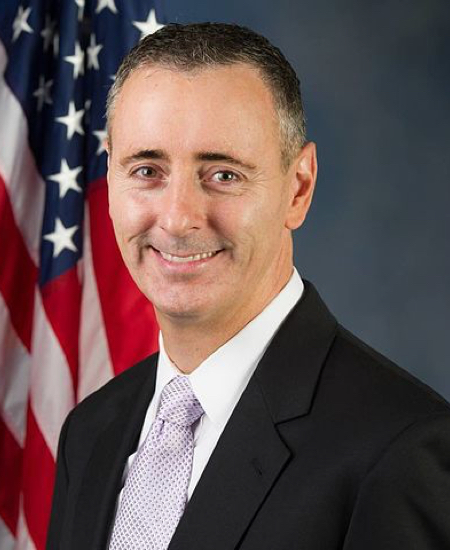
Rep. Brian K. Fitzpatrick
Sponsored bills
Maddy summaryThis bill reauthorizes and expands U.S.-Israel energy cooperation programs through 2031. It increases annual funding for the BIRD Energy Foundation from $2 million to $5 million and for the U.S.-Israel Energy Center from $4 million to $7 million, extending support through fiscal years 2026-2031. The bill adds new focus areas like hydrogen energy, fusion, industrial decarbonization, carbon management, agrivoltaics, grid modernization, and energy infrastructure cybersecurity to existing collaboration efforts. These changes directly affect U.S. and Israeli energy companies, researchers, and institutions working on commercializing clean energy technologies.
Maddy summaryHR 2257 authorizes the U.S. Mint to produce three commemorative coins (a $5 gold coin, a $1 silver coin, and a half-dollar) to honor fallen firefighters, with specific quantity limits and specifications. The bill requires a surcharge ($35 for gold, $10 for silver, $5 for half-dollar) on each coin sold, which is directed entirely to the National Fallen Firefighters Foundation to support its programs. The coins must be issued in 2026, will be legal tender, and the government must recover all costs through sales before distributing funds to the Foundation. This is a commemorative coin program, not a direct legislative policy change affecting broader public programs.
Maddy summaryHR 2256, the National Rosie the Riveter Day Act, designates March 21 as National Rosie the Riveter Day to honor the over 6 million American women who joined the workforce during World War II. The bill requests the President issue an annual proclamation urging Americans to observe the day with ceremonies and activities, while encouraging state, local, and tribal governments to hold educational programs. It directly affects the public and government entities by promoting awareness of women's wartime contributions, including their work in factories, farms, and volunteer roles despite facing discrimination. The legislation focuses solely on commemoration, not policy changes, and aligns with Women's History Month.
Maddy summaryHR 1376, the Healthy Poultry Assistance and Indemnification Act of 2025, provides compensation to poultry growers and layer facility owners whose operations were prohibited within USDA-designated "control areas" due to animal health restrictions. It directly affects poultry farmers raising birds bred for meat or eggs (like chickens, turkeys, or ducks), excluding doves and pigeons. The bill requires the Secretary to pay compensation equal to the average income from the farm's five most recent flocks multiplied by the number of prohibited flocks, minus any prior state compensation received, with payments due within 60 days of a claim. This mechanism ensures financial support for farmers impacted by USDA-mandated restrictions without requiring judicial review of payment amounts.
Maddy summaryH.J. Res. 77 is a joint resolution establishing U.S. policy to not recognize Russia’s territorial claims over Ukrainian regions occupied by force, including Crimea, Donetsk, Luhansk, Zaporizhzhia, and Kherson. It affirms Ukraine’s sovereignty and borders as defined in 1991 - the internationally recognized boundaries established after Ukraine’s independence. The resolution requires the U.S. government to avoid any actions implying recognition of Russia’s occupation, aligning with the principle that illegal acts (like invasion) cannot create legal rights. This policy statement guides U.S. diplomatic and foreign policy efforts toward Ukraine and Russia.
Maddy summaryThis bill creates a tax credit for cable, satellite, and internet-based video distributors (like streaming services) that carry content from independent video producers. Distributors can claim a credit equal to the lesser of their actual license fees paid for carrying independent programming or $0.10 per average monthly subscriber, with a maximum of $0.30 per subscriber. It also requires the Federal Communications Commission to submit biennial reports to Congress on how many independent programmers are being carried and for how long, to help assess the program's effectiveness. The credit applies to agreements where distributors carry independent content to at least 40% of their subscribers, targeting small, non-corporate video producers who aren't owned by major networks or distributors.
Maddy summaryThis bill authorizes $5 million annually (2026-2031) for the CDC to establish a research program focused on cerebral palsy. It directs the CDC to study diagnosis, treatment, prevention factors, health costs, and public health surveillance related to cerebral palsy, including evaluating impacts across different populations. The program aims to address gaps in understanding the condition - where 80% of causes are unknown - and support better care for the estimated 1 million Americans affected. This research funding directly benefits the CDC and researchers, with potential long-term benefits for people with cerebral palsy and their families.
Maddy summaryThis bill (HR 2199) prevents private health insurance plans from discriminating against patients with end-stage kidney disease (ESRD) who require dialysis. It amends the Social Security Act to prohibit plans from treating dialysis coverage differently than other medical services or applying network restrictions that disproportionately harm ESRD patients. The law clarifies that plans cannot deny or limit benefits for dialysis based on a patient’s diagnosis, while preserving a plan’s right to choose which dialysis providers are in their network. It directly affects ESRD patients and their private health insurance coverage, ensuring dialysis is treated equally with other covered medical services. The bill does not require plans to include specific dialysis providers but stops them from unfairly restricting access to necessary care.
Maddy summaryHR 2205, the NEDD Act, amends existing defense law to expand the Department of Energy's (DOE) authority over drone operations near nuclear facilities. It specifically shifts responsibility from the State Department to the DOE for: (1) exempting DOE from restrictions on purchasing foreign drones, (2) allowing DOE to operate drones near nuclear sites, and (3) managing classified tracking for nuclear facility security. The bill directly affects U.S. nuclear facilities that store, transport, or use special nuclear materials, or research/produce components for nuclear weapons. These changes streamline drone-related security protocols under the DOE’s existing nuclear safety oversight, without creating new restrictions.