

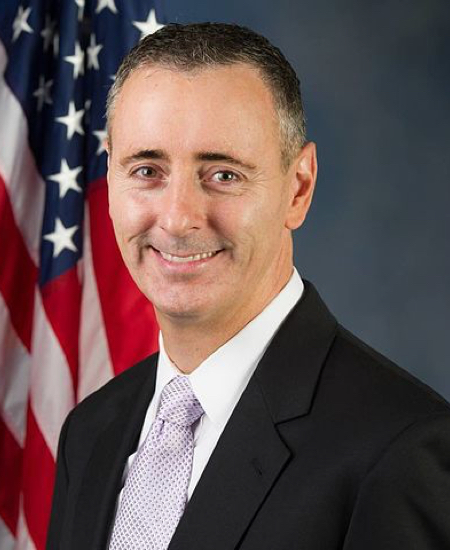
Photo of Brian K. Fitzpatrick
R United States House · District 1 · Pennsylvania On the 2026 ballot

Rep. Brian K. Fitzpatrick

Compare
Total votes
2,837
all sessions
Attendance
100%
9 missed
Higher than 75% of chamber peers
With party
76%
of cast votes
Lower than 98% of chamber peers
Bipartisan score
12%
some cross-party votes
Higher than 97% of chamber peers
Sponsored
4,059
bills & resolutions
Higher than 99% of chamber peers
Committees
6
assignments
4,059 bills and resolutions

Sponsored bills

Total
4,059
Primary
180
Co-sponsor
3,879
This page
4,059
matching current filters
Co-sponsor HR 2220
In committee · United States House · Co-sponsor
PARA–EMT Act of 2025

Maddy summaryHR 2220, the PARA-EMT Act of 2025, creates a federal grant program to address the shortage of emergency medical technicians (EMTs) and paramedics. It authorizes $50 million annually (2026-2030) for grants to EMS agencies to fund recruitment, training, and retention programs - prioritizing youth, rural areas, and veterans with military EMS training. A separate $20 million annually supports state grants to help veterans transition to civilian EMT roles by covering certification costs and licensing fees. The bill also mandates a federal study on projected EMS workforce needs through 2034 to inform future policy. It directly affects EMS agencies, training programs, and veterans seeking civilian EMT careers.

In committee Mar 18, 2025 1 co-sponsor
Co-sponsor HR 2198
In committee · United States House · Co-sponsor
To amend the Internal Revenue Code of 1986 to restore the taxable REIT subsidiary asset test.

Maddy summaryThis bill changes a tax rule for Real Estate Investment Trusts (REITs) that use taxable subsidiaries. It increases the percentage limit for assets held in these subsidiaries from 20% to 25% of a REIT's total assets, directly affecting REIT companies that operate through such subsidiaries. The key provision amends the Internal Revenue Code to restore this higher asset threshold, which had been reduced earlier. The change applies to taxable years starting after December 31, 2025.

In committee Mar 18, 2025 1 co-sponsor
Co-sponsor HR 2222
In committee · United States House · Co-sponsor
Lowering Egg Prices Act of 2025

Maddy summaryHR 2222, the "Lowering Egg Prices Act of 2025," modifies federal egg regulations to allow surplus broiler hatching eggs (used to hatch chicks for meat production) to be sold to egg breakers (facilities that process whole eggs into liquid products). The bill directs the FDA and USDA to create new rules within 180 days permitting these eggs to be stored under conditions compatible with hatching while also being sold for processing into liquid egg products. This change aims to increase the supply of eggs available for processing by making it easier to redirect surplus hatching eggs to egg breakers. The bill directly affects broiler hatcheries, egg breakers, and the broader egg processing industry by altering how certain surplus eggs can be handled and sold.

In committee Mar 18, 2025 1 co-sponsor
Co-sponsor HR 2173
In committee · United States House · Co-sponsor
Tools Tax Deduction Act

Maddy summaryThis bill allows employees in trades requiring specialized tools (like construction) to deduct work-related expenses directly from their gross income, rather than as itemized deductions. Specifically, it creates an above-the-line deduction for construction tools, personal protective gear, and other necessary work expenses. This change exempts these costs from the usual 2% floor on miscellaneous itemized deductions. The policy affects blue-collar workers who must purchase or maintain essential equipment to perform their jobs, making these costs fully deductible starting in 2026.

In committee Mar 18, 2025 1 co-sponsor
Co-sponsor HR 2194
In committee · United States House · Co-sponsor
Ending Drug Trafficking in Our Communities Act

Maddy summaryThis bill reauthorizes the High Intensity Drug Trafficking Areas (HIDTA) program, providing $400 million annually from fiscal years 2026 through 2031 to support federal efforts in designated high-drug-trafficking regions. It requires the program director to identify and develop evidence-based "promising practices" for HIDTA programs, focusing on tracking drug trafficking sources, coordinating multi-level responses to drug-related crimes, and implementing substance use disorder prevention strategies. These practices must be reviewed for effectiveness and shared with all HIDTA regions starting in 2026. The bill directly affects HIDTA-designated communities and federal agencies managing drug enforcement coordination.

In committee Mar 18, 2025 1 co-sponsor
Co-sponsor HRES 226
In committee · United States House · Co-sponsor
Commemorating the centennial of Delta Air Lines.

Maddy summaryHRES 226 is a ceremonial resolution commemorating Delta Air Lines' 100th anniversary, marking the centennial of its founding on March 2, 1925. It recognizes Delta's history as the first U.S. airline to reach 100 years (originally as Huff Daland Dusters, an aerial crop-dusting company) and highlights its current scale, including 100,000 employees, 5,000 daily flights, and global connectivity. The resolution contains no policy changes or binding provisions - it simply expresses the House's recognition of Delta's milestone and its role in connecting people and supporting communities. As a commemorative resolution, it does not affect any individuals, businesses, or regulations.

In committee Mar 14, 2025 1 co-sponsor
Co-sponsor HRES 221
In committee · United States House · Co-sponsor
Expressing support for designation of March 14, 2025, as "National Pi Day".

Maddy summaryThis resolution (HRES 221) is a symbolic gesture supporting the designation of March 14, 2025, as "National Pi Day." It does not create new laws or affect any specific group, but encourages schools and educators to use the day for math-related activities. The resolution recognizes the National Science Foundation's role in math and science education and urges schools to observe March 14 with events focused on the mathematical constant π (pi). It aligns with the date March 14 (3.14) and aims to promote interest in mathematics among students. The bill has no binding effect beyond expressing congressional support.

In committee Mar 14, 2025 1 co-sponsor
Co-sponsor HR 2160
In committee · United States House · Co-sponsor
Maintaining and Enhancing Hydroelectricity and River Restoration Act

Maintaining and Enhancing Hydroelectricity and River Restoration Act This bill establishes a new investment tax credit in the amount of 30% of the basis of any hydropower improvement property. The bill defines hydropower improvement property as property that adds or improves fish passage at a qualified dam; maintains or improves the quality of the water retained or released by a qualified dam; promotes downstream sediment transport and habitat maintenance; upgrades, repairs, or reconstructs a qualified dam to meet safety and security standards; improves public uses of, and access to, public waterways impacted by a qualified dam; removes an obsolete river obstruction; or places into service an approved remote dam. Further, written approval for hydropower improvement property must be obtained from the Federal Energy Regulatory Commission or state or local officials prior to January 1, 2032. The bill also allows an election to claim the investment tax credit for qualified progress expenses for some types of hydropower improvement property in advance of such property being placed into service. Any investment tax credit amount claimed for qualified progress expenses reduces the amount of the investment tax credit that may be claimed once the hydropower improvement property is placed into service.  The bill authorizes certain entities, including tax-exempt and governmental entities, to treat the investment tax credit for hydropower improvement property as a payment of tax and receive a refund of any overpayment (also known as elective pay).  Finally, the investment tax credit for hydropower improvement property may be transferred (i.e., sold).

In committee Mar 14, 2025 1 co-sponsor
Co-sponsor HR 2157
In committee · United States House · Co-sponsor
To provide that members of the Armed Forces performing services in Kenya, Mali, Burkina Faso, and Chad shall be entitled to tax benefits in the same manner as if such services were performed in a combat zone.

This bill treats Kenya, Mali, Burkina Faso, and Chad as combat zones for purposes of determining eligibility for certain federal tax benefits available to members of the U.S. Armed Forces. (Conditions apply.) Specifically, under the bill, a qualified hazardous duty area is treated as a combat zone for purposes of determining the filing status of an individual whose spouse is missing in action; excluding compensation received by a member of the Armed Forces serving in a combat zone from gross income and wages subject to withholding; forgiving the income tax liability of a member of the Armed Forces who dies in a combat zone; certain estate tax rules applicable to a member of the Armed Forces who dies in a combat zone or as a result of an injury, wound, or disease suffered while in a combat zone; the exemption from the federal excise tax imposed on certain telephone services for telephone calls originating from a combat zone by a member of the Armed Forces; and postponing certain federal tax deadlines (e.g., filing a tax return, paying taxes, and claiming a tax refund) for a member of the Armed Forces serving in a combat zone. The bill defines a qualified hazardous duty area as Kenya, Mali, Burkina Faso, and Chad if any member of the U.S. Armed Forces is entitled to special pay (e.g., hostile fire pay and imminent danger pay) for services performed in such locations.

In committee Mar 14, 2025 1 co-sponsor
Co-sponsor HR 2103
In committee · United States House · Co-sponsor
Protect Postal Performance Act

Maddy summaryHR 2103, the Protect Postal Performance Act, requires the U.S. Postal Service to hold public hearings and wait 180 days before closing or consolidating any post office, ensuring community input and transparency. It directly affects communities by preventing closures if a post office is the only one within 15 miles or serves 15,000+ residents, and blocks closures of processing centers that would leave entire non-contiguous state regions (with over 100,000 residents) without service. The bill also mandates that the Postal Regulatory Commission review proposed facility changes before implementation and prohibits reducing mail pickup/drop-off frequency through transportation optimization plans without prior approval. These provisions aim to stabilize postal services and maintain access for residents in underserved areas.

In committee Mar 14, 2025 1 co-sponsor
Showing 1,061 to 1,070 of 4,059 bills