

Maddy summaryThis bill designates Uyghurs and other Muslim minority group members from Xinjiang who have experienced or fear persecution for peaceful political, religious, or cultural expression as "persons of special humanitarian concern" for refugee resettlement. It provides for Priority 2 processing under the refugee system, waives the presumption that applicants are immigrants, and excludes them from numerical visa limits. The bill requires regular reporting on refugee applications from Xinjiang, including wait times and denial reasons, and encourages other countries to make similar accommodations for Xinjiang refugees. The provisions apply to individuals who fled Xinjiang due to detention, forced labor, family separation, or other human rights abuses documented in the bill's findings. The bill would expire 10 years after enactment.
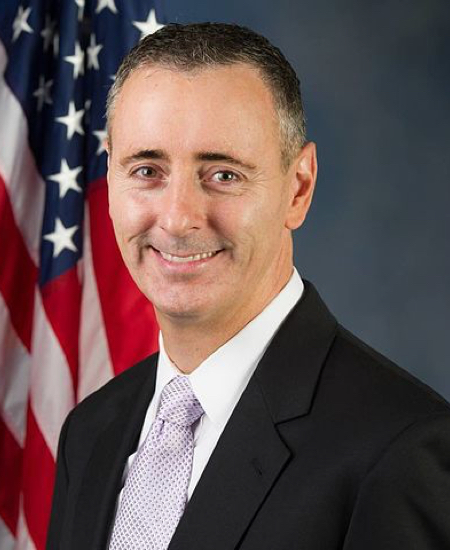
Rep. Brian K. Fitzpatrick
Sponsored bills
Brake for Kids Act of 2025 This bill directs the Department of Transportation (DOT) to produce and distribute a national public safety campaign on the dangers of illegally passing stopped school buses. Specifically, the campaign must increase awareness and education about the issue through a variety of media, including television, radio, and social media advertising. DOT must use Infrastructure Investment and Jobs Act funds to produce and distribute the campaign.
Maddy summaryThis bill imposes U.S. economic sanctions and visa restrictions on the Popular Resistance Committees (PRC) and related entities, targeting individuals and groups linked to the October 7, 2023, attacks on Israel. It requires the President to block assets and deny visas to PRC members, affiliates, and any group operating under their umbrella, effective 90 days after enactment. The law also mandates a report within 90 days on whether "Lion’s Den" meets criteria for terrorism designation under existing U.S. law. These measures apply specifically to designated terrorist organizations and their networks, without altering broader U.S. counterterrorism policy.
Maddy summaryThe Unity through Service Act of 2025 establishes an Interagency Council on Service (Section 2) composed of senior federal officials from departments including Defense, State, Labor, and Education. The Council advises the President on coordinating military, national, and public service recruitment strategies, developing joint marketing initiatives, and assessing service program impacts (Section 2(c)). It requires annual reports to Congress on service strategies, a joint report on integrating military and national service recruitment within four years (Section 5), and a study on advertising effectiveness and vaccine requirements' impact on retention (Section 6). The bill directly affects federal agencies managing military, Peace Corps, and national service programs by mandating cross-agency coordination and reporting, without authorizing new funding (Sections 8-9).
Maddy summaryThis bill authorizes $10 million annually (2026-2030) for the National Science Foundation to fund grants supporting mathematical and statistical modeling education in K-12 schools. It requires funded projects to focus on engaging students from groups historically underrepresented in STEM, using real-world data and computational tools, and addressing transitions like middle school to high school. The bill also allocates $1 million to fund a National Academies study on best practices for integrating these skills across curricula. These efforts aim to address a projected STEM workforce shortage by better preparing students for data-driven careers in fields like technology, healthcare, and engineering.
Maddy summaryThe Paycheck Fairness Act strengthens equal pay protections by expanding the definition of "sex" to include pregnancy, childbirth, sexual orientation, gender identity, and sex characteristics. It modifies employer defenses for pay disparities to require proof that any pay difference is job-related, not based on sex, and accounts for the entire pay gap. The bill prohibits employers from asking about salary history, enhances penalties for violations, and requires employers with 100+ employees to collect and report detailed pay data by race, sex, and job category. It also establishes training programs for employers on eliminating pay bias and creates a National Equal Pay Enforcement Task Force to coordinate enforcement efforts. This legislation directly affects employers, particularly those with 100+ employees, and aims to address pay disparities impacting women, people of color, and other underrepresented groups.
Maddy summaryHRES 244 is a symbolic resolution recognizing Nowruz, the ancient Persian New Year celebrated by hundreds of millions globally, including Iranian Americans in the U.S. It formally acknowledges Nowruz's cultural and historical significance, dating back over 3,000 years, and highlights Iranian Americans' contributions to U.S. society. The resolution expresses appreciation for their observance of Nowruz and connects the holiday's themes of renewal and compassion to shared values like human rights and freedom of expression. It does not create new laws or obligations but affirms support for the holiday's spirit and the aspirations of Iranians seeking democratic rights. The resolution was introduced by a bipartisan group of House members and refers to Nowruz as embodying "virtuous" conduct and compassion across all backgrounds.
Maddy summaryThis bill requires states to verify that Medicaid providers and suppliers are not deceased during enrollment and at least quarterly while enrolled. Starting January 1, 2027, states must check the federal Death Master File (a government database of deceased individuals) as part of provider onboarding and revalidation. The law directly affects all entities billing Medicaid for services, aiming to prevent fraud where deceased individuals' identities might be used. It creates a concrete, ongoing screening mechanism to ensure only active providers participate in the program.
Maddy summaryHR 2296, the National Weather Service Communications Improvement Act, requires the National Weather Service (NWS) to replace its internal instant messaging system (NWSChat) with a commercial cloud-based solution by October 1, 2027. The new system must accommodate future growth, support increased users, be user-friendly, and resemble common commercial platforms. Funding up to $3 million annually from 2026-2029 will cover this upgrade, sourced from existing NWS operational budgets. This bill directly affects NWS personnel who rely on internal communications for weather forecasting and warnings.
Maddy summaryThe WING Act of 2025 establishes a research program within the National Weather Service to address physical obstructions - like wind turbines and buildings - that block weather radar signals. The program requires testing technologies such as phased array radar, data replacement from commercial sources, and improved signal processing to maintain accurate storm detection and forecasting. It directly affects weather forecasting systems and communities relying on timely radar data for severe weather warnings. The initiative must report annually to Congress and conclude by September 2030, with a final recommendation due by 2030.