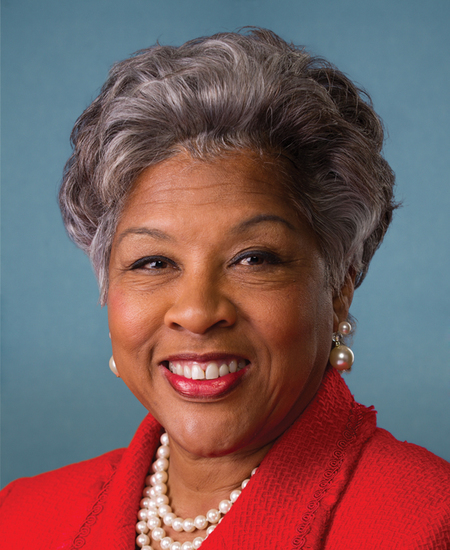
Photo of Joyce Beatty
D United States House · District 3 · Ohio On the 2026 ballot

Rep. Joyce Beatty

Compare
Total votes
2,837
all sessions
Attendance
97%
72 missed
Lower than 82% of chamber peers
With party
98%
of cast votes
Higher than 84% of chamber peers
Bipartisan score
1%
crosses aisle rarely
Lower than 85% of chamber peers
Sponsored
1,297
bills & resolutions
Higher than 77% of chamber peers
Committees
3
assignments
1,297 bills and resolutions

Sponsored bills

Total
1,297
Primary
82
Co-sponsor
1,215
This page
1,297
matching current filters
Co-sponsor HR 1770
In committee · United States House · Co-sponsor
Equitable Community Access to Pharmacist Services Act

Maddy summaryThis bill expands Medicare Part B coverage to include specific pharmacist services, directly affecting Medicare beneficiaries and pharmacists who provide these services. It adds new coverage for pharmacist evaluations and treatments related to certain illnesses (like COVID-19, flu, or strep throat) and public health emergencies, requiring payment at 80% of the lesser of actual charge or 85% of physician payment rates (100% during emergencies). The bill also prohibits balance billing for these services, ensuring beneficiaries pay only the standard Medicare copayment. These changes aim to improve access to pharmacist care during health crises while aligning payment with existing physician service frameworks.

In committee Dec 17, 2024 1 co-sponsor
Co-sponsor HR 11
In committee · United States House · Co-sponsor
Freedom to Vote Act

Maddy summary# Summary of Proposed Election Reform Legislation This document outlines a comprehensive federal election reform bill with multiple titles addressing various aspects of voting rights, election administration, and election integrity. ## Key Provisions: ### 1. Democracy Restoration (Title I) - Restores voting rights to citizens with felony convictions who are not serving a felony sentence in a correctional institution - Requires states to notify individuals of restored voting rights upon release from prison, completion of probation, or sentencing - Prohibits states from conditioning voting rights on payment of fines or fees - Requires states to provide notification of voting rights to citizens with criminal convictions ### 2. Voter Identification Requirements (Title II) - Establishes a broad definition of acceptable identification documents (including utility bills, bank statements, student IDs, etc.) - Requires states to provide free identification to voters who lack one - Authorizes $5 million annually for 5 years to cover costs of providing identification - Sets procedures for provisional voting when identification is not presented ### 3. Voter List Maintenance (Title III) - Prohibits "voter caging" (using undeliverable mail to challenge voter registration) - Bans use of unverified match lists to remove voters from registration lists - Sets strict conditions for removing voters from registration lists - Requires states to provide notice to voters removed from registration lists ### 4. Election Integrity Measures (Title V) - Prohibits hindering or interfering with voter registration (Section 2001) - Restricts removal of local election administrators (Section 3001) - Prohibits harassment of election workers (Section 3101) - Bans deceptive practices in elections (Section 3201), including false statements about voting locations, eligibility, or endorsements ### 5. Additional Provisions - Requires states to provide notice of voting rights restoration to citizens - Establishes private rights of action for violations of the law - Sets criminal penalties for violations (up to $100,000 fines and 5 years imprisonment) - Includes provisions for federal funding to be contingent on compliance with voting rights restoration This legislation represents a significant overhaul of voting rights and election administration procedures across the United States, with a focus on expanding voting access, protecting voter rights, and ensuring fair election administration.


In committee Dec 17, 2024 1 co-sponsor
Co-sponsor HR 716
In committee · United States House · Co-sponsor
Fair COLA for Seniors Act of 2023

Maddy summaryHR 716, the Fair COLA for Seniors Act of 2023, changes how cost-of-living adjustments (COLAs) are calculated for Social Security and related benefits by using the Consumer Price Index for Elderly Consumers (CPI-E) instead of the standard Consumer Price Index. This affects Social Security beneficiaries, veterans receiving disability compensation or survivor benefits, and federal retirees under the Civil Service and Military Retirement Systems. The bill requires that any COLA increase for Social Security also applies to these other benefits using the CPI-E, which better reflects inflation experienced by seniors. The change takes effect for benefit determinations starting September 2023.

In committee Dec 17, 2024 1 co-sponsor
Co-sponsor HR 549
In committee · United States House · Co-sponsor
Metastatic Breast Cancer Access to Care Act

Maddy summaryHR 549, the Metastatic Breast Cancer Access to Care Act, removes waiting periods for disability and Medicare coverage for people diagnosed with metastatic breast cancer. Specifically, it amends Social Security Act sections to allow immediate eligibility for disability insurance benefits (eliminating the standard waiting period) and immediate Medicare coverage (waiving the 24-month waiting period) for these patients. The bill directly affects individuals with metastatic breast cancer who would otherwise face delays in accessing critical benefits. These changes apply to applications filed or benefits beginning after the bill's enactment date. The law makes no other policy changes beyond these specific eligibility adjustments.

In committee Dec 17, 2024 1 co-sponsor
Co-sponsor HR 561
In committee · United States House · Co-sponsor
EACH Act of 2023

Maddy summaryThe EACH Act of 2023 would require federal health programs - including Medicaid, Medicare, the Indian Health Service, and TRICARE - to cover abortion services without restrictions. It repeals a provision in the Affordable Care Act that allowed states to limit abortion coverage in health insurance plans sold through state marketplaces. The bill also prohibits the federal government from restricting abortion coverage in private health insurance plans. This would directly affect millions of people, particularly low-income individuals and people of color, who are disproportionately enrolled in Medicaid and currently face barriers to abortion care due to coverage restrictions.

In committee Dec 17, 2024 1 co-sponsor
Co-sponsor HR 33
In committee · United States House · Co-sponsor
Medicare Dental, Vision, and Hearing Benefit Act of 2023

Maddy summaryHR 33 would expand Medicare to cover dental, vision, and hearing services for beneficiaries, which are currently not covered under Medicare. The bill provides 100% coverage for preventive dental services in 2024, with basic dental services gradually increasing to 80% coverage by 2027. Vision coverage would include routine eye exams and corrective lenses at 80% coverage, while hearing services would cover hearing exams and hearing aids at 80% coverage. The bill includes specific limitations, such as two dental cleanings per year and one pair of glasses every 24 months, with the Secretary of Health and Human Services having authority to apply additional limitations or modify coverage based on medical recommendations. The changes would take effect on January 1, 2024.

In committee Dec 17, 2024 1 co-sponsor
Primary HR 10417
In committee · United States House · Lead sponsor
Homeless Youth Menstrual Product Access Act of 2024

Maddy summaryThis bill amends the Runaway and Homeless Youth Act to require programs receiving federal funding to provide sanitary napkins and tampons that meet industry standards. It directly affects homeless youth programs funded under the Act by adding a specific requirement for menstrual product access. The key provision (added as clause (v)) mandates that these programs must offer such products as part of their services. This change ensures consistent access to essential hygiene items for homeless youth without altering existing funding levels or creating new programs.

In committee Dec 16, 2024 0 co-sponsors
Co-sponsor HR 1361
In committee · United States House · Co-sponsor
Safer Neighborhoods Gun Buyback Act of 2023

Maddy summaryHR 1361 establishes a federal grant program to fund community gun buyback initiatives. It authorizes $360 million annually (2022-2024) for states, local governments, and licensed gun dealers to conduct buybacks using "smart prepaid cards" loaded with 125% of a firearm's market value. The program prohibits using these cards to purchase guns or ammunition, requires recycling collected firearms within 60 days, and bans resale. It directly affects communities through local programs and licensed dealers participating in the buyback system, with criminal penalties for misusing the cards in firearm transactions.

In committee Dec 16, 2024 1 co-sponsor
Primary HR 10354
In committee · United States House · Lead sponsor
Diversity and Inclusion Data Accountability and Transparency Act of 2024

Maddy summaryThis bill requires financial institutions with 100 or more employees to submit diversity and inclusion data to federal regulators. It amends the Dodd-Frank Act to mandate that agencies like the Federal Reserve collect specific information on workforce demographics and inclusion practices from covered entities. The key provision directs agency directors to establish requirements for these disclosures, focusing on transparency in corporate diversity reporting. This policy change directly affects large financial firms by creating a standardized data collection process for regulators.

In committee Dec 11, 2024 0 co-sponsors
Primary HR 10336
In committee · United States House · Lead sponsor
Too Narrow to Succeed Act

Maddy summaryHR 10336, the "Too Narrow to Succeed Act," requires federal retirement funds managing over $1 billion in assets to annually report on their use of diverse-owned asset management firms (including women- and minority-owned firms). The bill mandates these funds to disclose specific data - like asset amounts managed by diverse vs. non-diverse firms, disaggregated by race, ethnicity, and gender - and detail barriers they face in engaging diverse firms. It also directs the Secretary of Labor to conduct surveys every three years on best practices for increasing diverse firm participation in fund management and publish findings for public review. The law applies only to federal retirement systems (like the Thrift Savings Fund and railroad retirement plans), not private sector plans.

In committee Dec 10, 2024 0 co-sponsors
Showing 481 to 490 of 1,297 bills
Previous 1 … 48 49 50 … 130 Next