

Deceptive Experiences To Online Users Reduction Act or the DETOUR Act This bill prohibits large online operators from manipulating their product to mislead consumers into providing personal information or giving consent. The bill further prohibits these operators from studying the behavioral patterns of subsets of users without first obtaining informed consent, and it prohibits designing online products that lead to compulsive usage by children. If meeting certain requirements, an association of large online operators may register with the Federal Trade Commission (FTC) as a professional standards body to develop and promote best practices and guidance for complying with the requirements of this bill. The bill provides authority for the FTC to enforce the requirements of this bill.
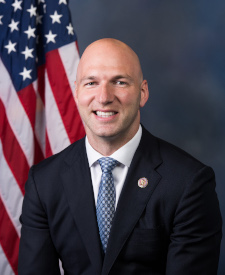
Rep. Anthony Gonzalez
Sponsored bills
Taiwan Non-Discrimination Act of 2021 This bill requires actions to support Taiwan's participation in the International Monetary Fund (IMF). The U.S. Governor of the IMF must advocate for (1) Taiwan's admission into the IMF as a member, (2) Taiwan's participation in the IMF's regular surveillance activities relating to Taiwan's economic and financial policies, (3) employment opportunities at the IMF for Taiwan nationals, and (4) Taiwan's ability to receive IMF technical assistance and training.
Bureau of Consumer Financial Protection-Inspector General Reform Act of 2021 or the CFPB-IG Act of 2021 This bill establishes a separate Office of Inspector General for the Consumer Financial Protection Bureau (CFPB). Currently, such oversight of the CFPB is combined with the Office of Inspector General for the Board of Governors of the Federal Reserve System.
This joint resolution nullifies a Department of Labor emergency temporary standard for preventing the transmission of COVID-19 in employment settings. Under the standard issued on November 5, 2021, employers with 100 or more employees must require their onsite employees to either be fully vaccinated against COVID-19 or undergo weekly COVID-19 testing.
Keep Innovation in America Act This bill modifies provisions enacted by the Infrastructure Investment and Jobs Act relating to the definitions of broker and digital assets and their reporting requirements. The bill redefines broker , for tax reporting purposes, to mean any person who (for consideration) stands ready in the ordinary course of business to effect sales of digital assets at the direction of their customers. The bill redefines digital asset to mean any digital representation of value which is recorded on a cryptographically secured distribution ledger (this revised definition eliminates the discretion of the Department of the Treasury to include similar technology in the definition of digital asset). The bill eliminates the cash reporting requirement for digital assets (i.e., receipt of more than $10,000) but requires Treasury to conduct a study of, and report on, the effect of expanding the definition of cash to include any digital asset.
Provider Relief Fund Improvement Act This bill extends deadlines, expands the uses of, and makes other changes pertaining to the Provider Relief Fund. The fund reimburses health care providers for increased expenses or lost revenue attributable to COVID-19. Specifically, the bill extends the deadline by which providers must use any reimbursements they received in 2020 from the fund to the end of the COVID-19 emergency. Providers must use reimbursements received in the first half of 2021 by the end of the emergency or June 30, 2022, whichever is later. Additionally, the Department of Health and Human Services must distribute the remaining provider relief funds by March 31, 2022. Providers must use these funds by June 30, 2023. The bill also allows the use of the funds for workplace safety activities, such as hiring additional security personnel.
This concurrent resolution declares that Congress should not impose any new performance fee, tax, royalty, or other charge relating to the public performance of sound recordings on a local radio station for broadcasting sound recordings over the air, or on any business for such public performance of sound recordings.
Ransomware and Financial Stability Act of 2021 This bill requires financial institutions to inform the Financial Crimes Enforcement Network of a ransomware attack and any associated demand of payment. Further, the institution may not make such a payment in an amount greater than $100,000 without authorization from the appropriate federal law enforcement agency. The President may waive the notification requirement if it is in the national interest.
Federal Initiative to Guarantee Health by Targeting Fentanyl Act This bill places fentanyl-related substances as a class into schedule I of the Controlled Substances Act. A schedule I controlled substance is a drug, substance, or chemical that has a high potential for abuse; has no currently accepted medical value; and is subject to regulatory controls and administrative, civil, and criminal penalties under the Controlled Substances Act. Additionally, the bill prohibits the application of a mandatory minimum prison term for certain drug offenses involving fentanyl-related substances.
David Dorn Back the Blue Act This bill directs the Department of Justice (DOJ) to provide programs to support the hiring and retention of law enforcement personnel and to increase their salaries. Further, DOJ may make grants to state and local law enforcement agencies for this purpose.