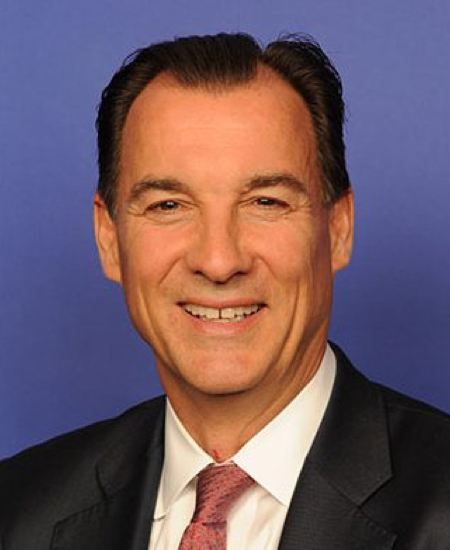
Photo of Thomas R. Suozzi
D United States House · District 3 · New York On the 2026 ballot

Rep. Thomas R. Suozzi

Compare
Total votes
2,089
all sessions
Attendance
98%
44 missed
Near the chamber average
With party
94%
of cast votes
Lower than 95% of chamber peers
Bipartisan score
3%
crosses aisle rarely
Higher than 94% of chamber peers
Sponsored
1,746
bills & resolutions
Higher than 92% of chamber peers
Committees
4
assignments
1,746 bills and resolutions

Sponsored bills

Total
1,746
Primary
52
Co-sponsor
1,694
This page
1,746
matching current filters
Co-sponsor HRES 1152
Passed · United States House · Co-sponsor
Condemning the atrocity that occurred in Buffalo, New York, on May 14, 2022, in which 10 Americans were killed and 3 were injured, and in which 11 of the 13 victims were Black Americans, condemning the Great Replacement Theory as a White supremacist conspiracy theory, and reaffirming the House of Representatives commitment to combating White supremacy, hatred, and racial injustice.

This resolution condemns in the strongest terms the great replacement theory, which it describes as a white supremacist conspiracy theory that has been used to falsely justify racially motivated, violent acts of terrorism domestically and internationally.

Passed Jun 8, 2022 1 co-sponsor
Co-sponsor HR 301
In committee · United States House · Co-sponsor
To amend title 36, United States Code, to establish the composition known as "Lift Every Voice and Sing" as the national hymn of the United States.

Maddy summaryHR 301 would amend U.S. law to officially designate "Lift Every Voice and Sing" as the national hymn of the United States. This change would add the song's full composition (words and music) to Title 36 of the U.S. Code, replacing the current designation of "The Star-Spangled Banner" as the sole national anthem for formal recognition purposes. The bill directly affects federal law and official government ceremonies where the national hymn is performed, though it does not alter the status of "The Star-Spangled Banner" as the national anthem. The policy change is purely procedural, establishing a new official designation without impacting any other laws or rights.

In committee Jun 7, 2022 1 co-sponsor
Co-sponsor HR 350
Passed · United States House · Co-sponsor
Domestic Terrorism Prevention Act of 2022

Domestic Terrorism Prevention Act of 2022 This bill establishes new requirements to expand the availability of information on domestic terrorism, as well as the relationship between domestic terrorism and hate crimes. It authorizes domestic terrorism components within the Department of Homeland Security (DHS), the Department of Justice (DOJ), and the Federal Bureau of Investigation (FBI) to monitor, analyze, investigate, and prosecute domestic terrorism. The domestic terrorism components of DHS, DOJ, and the FBI must jointly report on domestic terrorism, including white-supremacist-related incidents or attempted incidents. DHS, DOJ, and the FBI must review the anti-terrorism training and resource programs of their agencies that are provided to federal, state, local, and tribal law enforcement agencies. Additionally, DOJ must make training on prosecuting domestic terrorism available to its prosecutors and to assistant U.S. attorneys. It creates an interagency task force to analyze and combat white supremacist and neo-Nazi infiltration of the uniformed services and federal law enforcement agencies. Finally, it directs the FBI to assign a special agent or hate crimes liaison to each field office to investigate hate crimes incidents with a nexus to domestic terrorism.

Passed May 26, 2022 1 co-sponsor
Co-sponsor HR 3807
Passed · United States House · Co-sponsor
Restaurant Revitalization Fund Replenishment Act of 2021

Relief for Restaurants and other Hard Hit Small Businesses Act of 2022 This bill addresses support for restaurants, arts and entertainment venues, and small businesses impacted by the COVID-19 pandemic. The bill provides an additional $42 billion in FY2021 for the Restaurant Revitalization Fund and gives priority to previous applicants who have not received a grant. The Small Business Administration (SBA) must provide to applicants an explanation for denied applications, establish a reconsideration process for denied applications, and institute an audit and oversight plan with respect to grant recipients. Additionally, the bill establishes the Hard Hit Industries Award Program for small businesses that suffered a pandemic-related revenue loss of 40% or more. Aggregate grant amounts are capped at $1 million. Funds may be used for expenses including mortgage, rent, and utility payments and payroll. SBA must prioritize entities that have experienced significant pandemic-related revenue loss, with first priority going to those that experienced a loss of at least 80%, and second priority going to those that experienced a loss of at least 60%. Finally, the bill extends to March 11, 2023 (or a later date as determined by the SBA), the time frame during which Shuttered Venue Operators Grant recipients may use grant funds to cover their expenses.

Passed May 25, 2022 1 co-sponsor
Co-sponsor HR 8
Passed · United States House · Co-sponsor
Bipartisan Background Checks Act of 2021

Bipartisan Background Checks Act of 2021 This bill establishes new background check requirements for firearm transfers between private parties (i.e., unlicensed individuals). Specifically, it prohibits a firearm transfer between private parties unless a licensed gun dealer, manufacturer, or importer first takes possession of the firearm to conduct a background check. The prohibition does not apply to certain firearm transfers or exchanges, such as a gift between spouses in good faith.

Passed May 25, 2022 1 co-sponsor
Co-sponsor HR 1446
Passed · United States House · Co-sponsor
Enhanced Background Checks Act of 2021

Enhanced Background Checks Act of 2021 (Sec. 2) This bill revises background check requirements applicable to proposed firearm transfers from a federal firearms licensee (e.g., a licensed gun dealer) to an unlicensed person. Specifically, it increases the amount of time, from 3 business days to a minimum of 10 business days, that a federal firearms licensee must wait to receive a completed background check prior to transferring a firearm to an unlicensed person. (This type of transaction is often referred to as a default proceed transaction.) If a submitted background check remains incomplete after 10 business days, then the prospective purchaser may submit a petition for a final firearms eligibility determination. If an additional 10 days elapse without a final determination, then the federal firearms licensee may transfer the firearm to the prospective purchaser. (Sec. 3) The Government Accountability Office must report on the extent to which the changes have prevented firearms transfers to prohibited persons. (Sec. 4) The Federal Bureau of Investigation must report on the number of petitions it receives for final federal firearms determinations. (Sec. 5) The Department of Justice, in consultation with the National Resource Center on Domestic Violence and Firearms, must report on further amendments to the background check process that would likely reduce the risk of death or great bodily harm to victims of domestic violence, domestic abuse, dating partner violence, sexual assault, and stalking.


Passed May 25, 2022 1 co-sponsor
Co-sponsor HR 7872
In committee · United States House · Co-sponsor
DELIVER Act of 2022

Delivering Elderly Lunches and Increasing Volunteer Engagement and Reimbursements Act of 2022 or the DELIVER Act of 2022 This bill increases the standard charitable mileage rate for the delivery of meals to elderly, disabled, frail, and at-risk individuals. The rate shall be equal to the standard business mileage rate (58.5 cents per mile in 2022).

In committee May 24, 2022 1 co-sponsor
Co-sponsor HR 1620
Passed · United States House · Co-sponsor
Violence Against Women Act Reauthorization Act of 2021

Violence Against Women Reauthorization Act of 2021 This bill modifies and reauthorizes through FY2026 programs and activities under the Violence Against Women Act that seek to prevent and respond to domestic violence, sexual assault, dating violence, and stalking. The bill also authorizes new programs, makes changes to federal firearms laws, and establishes new protections to promote housing stability and economic security for victims of domestic violence, sexual assault, dating violence, and stalking.

Passed May 24, 2022 1 co-sponsor
Co-sponsor HR 1215
Passed · United States House · Co-sponsor
Fraud and Scam Reduction Act

Fraud and Scam Reduction Act This bill expands activities to address mail, telephone, and internet fraud, particularly such scams targeting older adults. The bill establishes a Senior Scams Prevention Advisory Group, which must create model educational materials to educate employees of retailers, financial-services companies, and wire-transfer companies on how to identify and prevent scams that affect older adults. Further, the Federal Trade Commission (FTC) must establish an advisory office in the Bureau of Consumer Protection to assist the FTC in monitoring scams targeting older adults, educating consumers, and receiving complaints.

Passed May 24, 2022 1 co-sponsor
Co-sponsor HR 7853
In committee · United States House · Co-sponsor
Aviation-Impacted Communities Act

Aviation-Impacted Communities Act This bill addresses noise mitigation for aviation-impacted communities. ( Aviation-impacted community is defined as a community that is located not more than one mile from any point at which a commercial or cargo jet route is 3,000 feet or less above ground level.) Specifically, the bill expands Airport Improvement Program noise mitigation program funding for aviation-impacted communities that are not currently within the 65 day-night average sound level (DNL) standard; requires the Federal Aviation Administration (FAA) to enter into an agreement with the National Academy of Sciences to conduct a study that summarizes the relevant literature and studies done on aviation impacts worldwide and focuses on large hub commercial airports and surrounding communities, including communities currently outside of the 65 DNL contour; directs the FAA to conduct outreach to aviation-impacted communities to inform them of the opportunity to be a designated community; requires the FAA to devise an action plan that alleviates or addresses the concerns of a designated community; and provides grants for necessary noise mitigation in a designated community for residences, hospitals, nursing homes, adult or child day care centers, schools, and places of worship.

In committee May 20, 2022 1 co-sponsor
Showing 1,091 to 1,100 of 1,746 bills