

Maddy summaryThis resolution expresses the U.S. House of Representatives' support for designating June 28, 2024, as "Stonewall Day" to commemorate the anniversary of the 1969 Stonewall Uprising in New York City, a pivotal event in LGBTQ+ rights history. It recognizes the significance of the uprising in sparking the modern LGBTQ+ civil rights movement and acknowledges the upcoming opening of the Stonewall National Monument Visitor Center on Christopher Street. The resolution does not create new laws or policies but formally supports the commemorative designation and the Visitor Center's role in honoring this history. It directly affects no individuals or groups, as it is a symbolic gesture of recognition. The resolution was introduced by multiple House members and referred to the Judiciary Committee.
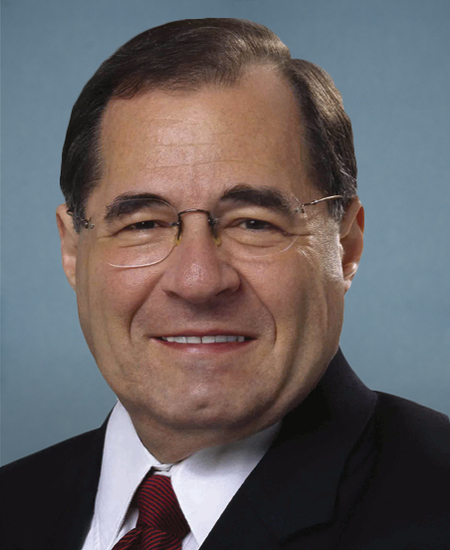
Rep. Jerrold Nadler
Sponsored bills
Maddy summaryThis bill (HR 8827) renames a specific U.S. Postal Service facility in Rochester, New York, at 216 Cumberland Street as the "Minister Franklin Florence Memorial Post Office." It directly affects USPS records, maps, and official documents by updating all references to this location to the new name. The bill contains no policy changes or funding provisions; it solely serves to honor Minister Franklin Florence through a ceremonial naming. This is a standard procedural bill with no impact on postal services or operations.
Maddy summaryThis resolution, introduced around World Refugee Day, expresses congressional support for U.S. efforts to protect refugees and displaced persons globally and within the United States. It highlights that over 117 million people are displaced worldwide, references the U.S. resettling 60,000 refugees in fiscal year 2024, and calls on federal agencies to maintain the Refugee Admissions Program, uphold asylum protections, and support host countries. The resolution does not create new laws but reaffirms existing commitments to refugee resettlement, safety, and integration through current programs.
Maddy summaryThis bill expands eligibility for the Public Service Loan Forgiveness (PSLF) program by allowing borrowers to count their first 60 monthly payments toward the required 120 payments, provided they're on specific repayment plans under the Higher Education Act. It directly affects federal student loan borrowers working in public service jobs who may have previously been excluded from counting certain payments. The law requires the Secretary of Education to notify affected borrowers within 180 days about this change and provide guidance on adjusting repayment plans. This update simplifies the path to loan forgiveness for qualifying public service workers by broadening which payments count toward the 120-payment threshold.
Maddy summaryThis bill amends the Occupational Safety and Health Act to explicitly include public employees - such as those working for federal, state, or local government agencies - under OSHA's coverage. It changes the definition of "employee" to specify that public sector workers are protected, removing previous exclusions. The law takes effect 90 days after enactment for most workplaces, but gives states and local governments without OSHA-approved plans up to 36 months to comply. This directly affects public service workers in government roles by bringing their workplace safety protections under the same federal OSHA framework as private-sector employees.
Maddy summaryHR 8732, the Domestic Workers Bill of Rights Act, would establish new labor protections for domestic workers including nannies, housekeepers, and caregivers who work in private homes. The bill requires written agreements between employers and domestic employees, provides earned sick days, ensures fair scheduling practices, and prohibits unfair wage deductions for cash shortages or communications. It also creates a Domestic Employee Standards Board to recommend workplace standards and establishes a National Domestic Employee Hotline for assistance. The bill specifically targets domestic workers who have historically been excluded from labor protections under the Fair Labor Standards Act and Civil Rights Act, benefiting an estimated 2.2 million domestic workers in the U.S. who are disproportionately women of color and immigrants.
Maddy summaryThis bill amends federal jury selection laws to explicitly prohibit discrimination based on sexual orientation and gender identity. It updates definitions in Title 28 of the U.S. Code by adding "sexual orientation and gender identity" to the protected characteristics under "sex" and defining key terms like "gender identity" and "sexual orientation." The changes directly affect federal jury pools by requiring courts to consider these factors when selecting jurors and preventing discrimination in the process. The law clarifies that discrimination based on these characteristics - including associations with others who share them - is prohibited during jury selection. This is a concrete policy change to expand anti-discrimination protections in federal jury service.
Maddy summaryHR 537 authorizes a Congressional Gold Medal to honor 60 diplomats who saved Jewish lives during the Holocaust by issuing visas and passports against their governments' orders, risking expulsion and personal danger. The medal will be presented to the next of kin of these diplomats, alongside representatives from their home countries, and permanently displayed at the United States Holocaust Memorial Museum. The bill also permits the sale of bronze duplicates to cover production costs, with proceeds going to the U.S. Mint. This legislation recognizes the diplomats' humanitarian actions without creating new government programs or altering existing laws.
Maddy summaryThis bill makes e-commerce platforms liable for counterfeit goods that pose health or safety risks (like fake medicine or unsafe toys) unless they implement specific safeguards. Platforms must verify seller identities, screen listings for fake marks, quickly remove confirmed counterfeits, terminate repeat offenders, and prevent banned sellers from returning under new identities. These requirements apply to platforms with over $500,000 in annual sales or after receiving 10 verified notices of health/safety-related counterfeits. The law targets dangerous counterfeits, not all fake goods, and focuses on concrete platform actions rather than outcomes.
Maddy summaryHR 8691, the Restoring Justice for Workers Act, prohibits employers from requiring workers to sign arbitration agreements before any dispute arises (predispute agreements) or retaliating against workers who refuse them. It also sets strict requirements for postdispute arbitration agreements, mandating written consent after a 45-day waiting period, clear disclosure of workers' rights, and proof the agreement wasn't forced. The bill directly affects all workers (including independent contractors) and employers covered under the Fair Labor Standards Act, ensuring collective claims and concerted activity cannot be barred through forced arbitration. Key provisions make predispute arbitration agreements void and require voluntary, informed postdispute agreements with specific safeguards.