

Maddy summaryHR 8005, the Child Exploitation and Artificial Intelligence Expert Commission Act of 2024, establishes a 13-member commission to investigate how artificial intelligence is used in child exploitation crimes and recommend solutions to improve law enforcement's ability to prevent, detect, and prosecute such crimes. The commission, appointed by congressional leaders with expertise in law enforcement, AI, or child welfare, must submit a final report to Congress within two years detailing findings and recommendations for legal or technical improvements. This bill does not create new laws but focuses on identifying legal barriers and developing actionable solutions for law enforcement agencies. The commission will operate independently without federal government employees serving as members.
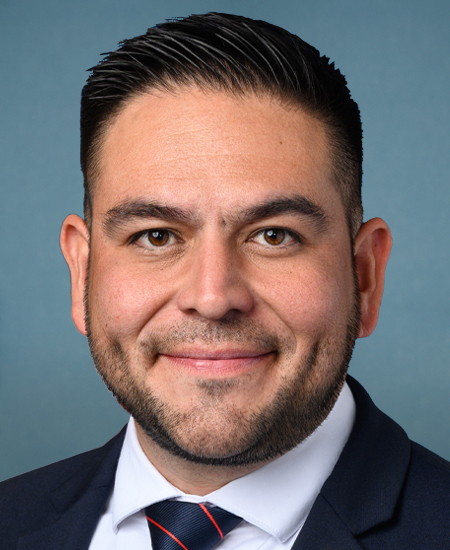
Rep. Gabe Vasquez
Sponsored bills
Maddy summaryThis bill amends U.S. Code to lower the minimum student enrollment required for high schools to establish or maintain a Junior Reserve Officers' Training Corps (JROTC) program, reducing the threshold from 100 to 50 students. It directly affects high schools seeking to start or sustain JROTC units, particularly those with smaller student populations. The key provision changes the existing requirement under Title 10, U.S. Code, making it easier for schools to qualify for JROTC participation. This is a straightforward policy adjustment to existing law, with no additional funding or program changes specified.
Maddy summaryHRES 1132 is a symbolic House resolution condemning Republican opposition to past immigration reform efforts. It does not create new laws or allocate funds but formally expresses disapproval of Republican inaction on immigration policy since 2007, citing specific failed bills like the 2013 Border Security Act and the American Dream and Promise Act. The resolution urges cooperation among federal, state, and local entities and calls for full funding of border resources like asylum officers and border security personnel. As a non-binding statement, it has no legal effect on policy or funding.
Maddy summaryThis bill corrects retirement benefits for certain U.S. Customs and Border Protection (CBP) officers hired between July 2008. It specifically affects individuals who received a tentative job offer before July 6, 2008, but began duty as officers on or after that date. The bill ensures these officers receive retroactive retirement pay adjustments and exemption from mandatory retirement age rules, as if they had been classified as officers on July 6, 2008. The Department of Homeland Security must identify eligible officers within 120 days and coordinate with the Office of Personnel Management to implement these changes, while the Government Accountability Office will review CBP’s hiring practices related to these benefits.
Maddy summary# Summary of the Federal Appropriations Bill This document is a comprehensive appropriations bill for fiscal year 2024, allocating funds across various federal departments and agencies. It contains five main titles: 1. **Department of the Treasury Appropriations Act, 2024**: Allocates funds for Treasury operations including the Internal Revenue Service (over $12 billion), the Bureau of Engraving and Printing, and the Financial Crimes Enforcement Network. Includes numerous restrictions on IRS activities, such as prohibitions on targeting citizens for First Amendment rights and restrictions on conference spending. 2. **Executive Office of the President Appropriations Act, 2024**: Funds the White House, Office of Management and Budget, National Security Council, and other executive offices. Includes requirements for budget impact statements on executive orders. 3. **Judiciary Appropriations Act, 2024**: Allocates over $5.9 billion for federal courts, including salaries for judges, court operations, defender services ($1.45 billion), and court security ($750 million). Includes provisions for court security improvements and judicial training. 4. **District of Columbia Appropriations Act, 2024**: Provides federal funding for District of Columbia programs including $40 million for resident tuition support, $292 million for District courts, $46 million for defender services, and $286 million for the Court Services and Offender Supervision Agency. 5. **Independent Agencies Appropriations Act**: Funds various independent agencies including the Consumer Product Safety Commission ($150.9 million), Election Assistance Commission ($55 million), and Administrative Conference of the United States. Key restrictions across the bill include: - Prohibitions on using funds to target citizens based on First Amendment rights - Restrictions on IRS activities related to taxpayer targeting - Requirements for transparency in information technology spending - Specific limitations on how funds may be transferred between accounts - Prohibitions on certain regulatory actions (like banning gas stoves) The bill contains numerous administrative provisions, reporting requirements, and specific funding allocations for various programs and services across the federal government.
Maddy summaryHR 7504, the Rural Veterans Transportation to Care Act, expands a VA transportation grant program to specifically assist rural veterans and tribal organizations. The bill modifies eligibility by adding "rural or highly rural" to program criteria, allows tribal organizations to apply for grants, and sets a maximum grant amount of $60,000 (up to $80,000 for ADA-compliant vehicles). It defines "rural" using USDA's RUCA system and "tribal organization" per the Indian Self-Determination Act, ensuring grants directly support transportation access for veterans in remote areas and tribal communities.
Maddy summaryHR 6727 establishes the United States Foundation for International Conservation, a nonprofit organization that will provide grants to support long-term management of protected and conserved areas in eligible countries. The Foundation requires a 2:1 cost match from other sources, demands host country and community consent through binding agreements, and prioritizes areas with high biodiversity or species of significant importance. It will be governed by a Board of Directors including government officials and private sector experts, operate for 10 years with $1 million authorized for 2024 and $100 million annually from 2025-2035, and must follow international conservation standards while prohibiting funding for countries supporting terrorism or violating human rights.
Maddy summaryHR 7470, the Secure U.S. Leadership in Space Act of 2024, changes tax rules to treat spaceports similarly to airports for financing purposes. It allows spaceports to issue tax-exempt bonds (like airports do) for construction and operations, directly benefiting spaceport developers and operators. Key provisions include defining "spaceport" broadly to cover manufacturing, launch/reentry services, and flight control facilities, while adding exceptions for federal use and excluding spaceport bonds from state bond limits. The bill clarifies that spaceports do not need public access to qualify for these tax benefits. This policy change aims to support private investment in U.S. space infrastructure through existing tax financing mechanisms.
This joint resolution nullifies the final rule issued by the Animal and Plant Health Inspection Service (APHIS) titled Importation of Fresh Beef From Paraguay and published on November 14, 2023. The final rule allows for the importation of fresh (chilled or frozen) beef from Paraguay into the United States under certain conditions. The United States prohibits or restricts the importation of certain animals and animal products to prevent the introduction of various animal diseases, including foot-and-mouth disease (FMD). In response to a request from Paraguay to allow the importation of fresh beef from Paraguay into the United States, APHIS conducted a risk analysis. APHIS concluded that fresh beef could be safely imported from Paraguay, provided that certain conditions are met. These conditions include that (1) FMD has not been diagnosed in the exporting region within the previous 12 months; (2) the meat originated from premises where FMD has not been present during the lifetime of any bovines slaughtered for U.S. meat export; and (3) APHIS may periodically conduct on-site evaluations and subsequent inspections of the slaughter facilities, records, and operations.
Inflation Relief Act This bill allows a refundable income tax credit for 10% of federal tax liability for a taxable year beginning in 2024. The credit is not available to taxpayers whose modified adjusted gross income exceeds $150,000 ($250,000 for joint tax returns) in any taxable year.