

Maddy summaryHR 8513, the CSFP Tribal Nutrition Sovereignty Act, allows tribal entities (including tribes, reservations, and tribal organizations) to directly purchase food under the USDA's Commodity Supplemental Food Program (CSFP) through self-determination contracts. The bill establishes a demonstration project where tribes can replace USDA-supplied food packages with domestically sourced food meeting specific nutritional standards and tribal significance, without increasing the total food amount. It requires tribes to maintain similar nutritional value to current packages and mandates annual reports to Congress on the project's progress. The bill authorizes $5 million for the demonstration project and $1.2 million annually for staffing to administer the contracts.
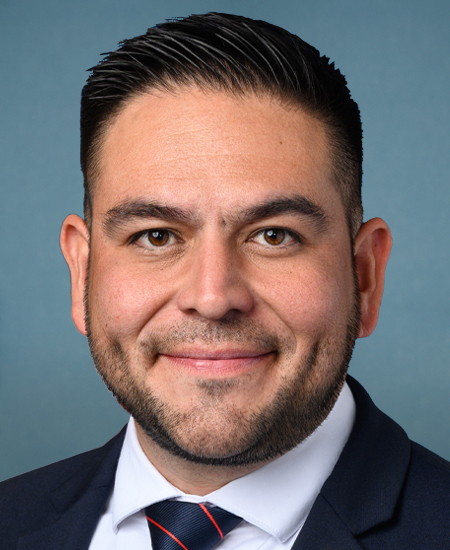
Rep. Gabe Vasquez
Sponsored bills
Maddy summaryHR 8488, the Farmer to Farmer Education Act of 2024, establishes a new program to support farmer-led networks that share agricultural knowledge and technical assistance. It amends the Food Security Act to create cooperative agreements with eligible entities - such as nonprofits, tribes, local governments, and institutions - to build farmer-to-farmer networks, prioritizing beginning, veteran, socially disadvantaged, and limited-resource farmers, ranchers, and forest owners. Key mechanisms include funding for mentor matching, skill-building training, and language access for non-English speakers, while requiring grantees to facilitate network access and develop community-specific conservation practices. The bill directly affects rural agricultural communities by connecting them with peer-based support systems to adopt science-based conservation methods.
Maddy summaryHR 7430, the Public Lands in Public Hands Act, prohibits the U.S. Interior and Agriculture Secretaries from transferring title to certain federal lands to non-federal entities. It specifically blocks transfers of lands that are publicly accessible (via roads, trails, or waterways) or contiguous to such lands, protecting areas people currently use. Exceptions include small parcels under 300 acres, specific historical land transfers (like the Alaska Statehood Act), and land exchanges authorized by existing law. This bill directly affects federal land management decisions and prevents private ownership of lands near public access points.
This resolution supports the designation of National FFA Week. It also (1) recognizes the important role of the National FFA Organization (Future Farmers of America) in developing the next generation of globally conscious leaders who will change the world; and (2) celebrates the 10th anniversary of the Give the Gift of Blue program, which has donated more than 17,000 FFA blue jackets to FFA members in need.
Maddy summaryHR 7064, the Farmers’ Market Expansion Act of 2024, amends the Senior Farmers' Market Nutrition Program (SFMNP) by expanding eligible food items. The bill changes the program’s provisions to include tree nuts (such as almonds or walnuts) alongside herbs, which were previously excluded. This directly affects low-income seniors who use SFMNP coupons to purchase fresh, locally grown foods at farmers' markets. The key mechanism is updating the list of permitted items under the program to allow tree nuts, broadening access to nutrient-rich foods. The change applies to the existing SFMNP administered under the Farm Security and Rural Investment Act of 2002.
Maddy summaryHR 7015, the CAREERS Act, expands federal funding for workforce training programs to better serve rural communities. It modifies eligibility to include career and technical education schools and requires training programs to align with specific rural industry sectors like broadband, healthcare, agriculture, manufacturing, and water services. The bill mandates grantees to report on employment outcomes for participants and addresses rural workforce challenges such as worker displacement and youth migration. This directly affects rural workforce development boards, training providers, and workers in designated rural industries seeking job skills and career pathways.
Maddy summaryThis bill amends the Department of Veterans Affairs' procurement rules to ensure women-owned small businesses receive equal priority in contracting preferences. It requires the VA to treat preferences for women-owned small businesses the same as other small business preferences under federal procurement law. Specifically, it adds a new provision (Section 8(m) of the Small Business Act) to VA procurement guidelines, mandating that all such preferences be afforded "the same degree of priority." This directly affects VA contracting officers and women-owned small businesses seeking federal contracts with the VA.
Maddy summaryThis bill authorizes a Congressional Gold Medal to recognize individuals who defended Bataan, Corregidor, Attu, and other Pacific locations during World War II. It specifically honors U.S. and Filipino military personnel who fought or were held as prisoners of war by Japan between December 1941 and August 1945, as well as the impacted Saskinax̂ people (indigenous Attu residents). The medal will be struck by the U.S. Treasury, displayed at the Smithsonian Institution, and made available for research. Duplicate bronze medals may be sold to cover costs, with proceeds deposited into the U.S. Mint fund. This is a commemorative measure with no new benefits or policy changes.
Maddy summaryHR 9274, the SHAWL Act, establishes two new Smithsonian museums: the National Museum of the American Latino and the American Women’s History Museum. It authorizes both museums to be located within the National Mall’s "Reserve" area, overriding prior restrictions, and requires federal agencies managing potential sites to transfer jurisdiction to the Smithsonian after notifying congressional committees. The bill mandates that both museums accurately represent diverse cultures, histories, and viewpoints within Latino and women’s communities through exhibits and programs, requiring input from a broad range of community experts. It also requires the Smithsonian to submit biennial reports to Congress detailing compliance with these representation requirements.
Maddy summaryThis bill reauthorizes the Debbie Smith DNA Backlog Grant Program, which provides federal funding to state and local law enforcement agencies to reduce backlogs in processing DNA evidence from crime scenes. It extends the program's funding period from fiscal years 2024 through 2029 (previously ending in 2024). The bill also updates audit requirements to ensure grant funds are used properly through 2029. This directly affects law enforcement agencies that receive these grants to accelerate DNA analysis for criminal investigations.