

Maddy summaryHRES 1480 is a symbolic resolution recognizing Hispanic Restaurant Week (September 22-October 3, 2024) and honoring Hispanic restaurant owners and employees. It acknowledges their economic contributions to the U.S. restaurant industry, citing data that 25.9% of restaurant workers are Hispanic and Hispanic-owned restaurants represent the second-highest number of Hispanic-owned businesses. The resolution does not create new policies or funding but formally celebrates their role during Hispanic Heritage Month. It was introduced by 14 House members and referred to the Energy and Commerce Committee.
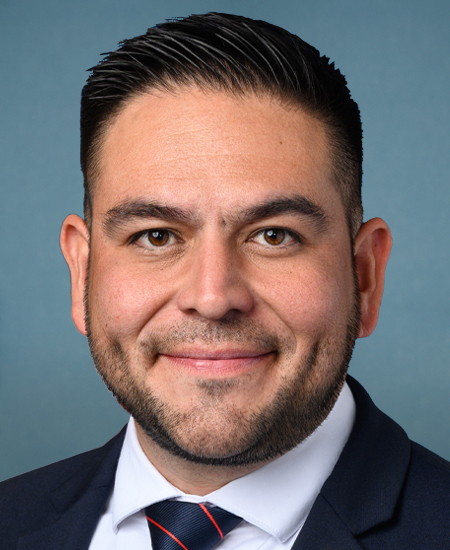
Rep. Gabe Vasquez
Sponsored bills
Maddy summaryHR 6319 (the 911 SAVES Act of 2023) requires the Office of Management and Budget to reclassify public safety telecommunicators as "Protective Service Occupations" within 30 days of enactment. This change corrects their current misclassification in the federal Standard Occupational Classification (SOC) system, which is used for statistical data on jobs. The bill directly affects how these professionals - critical in emergency calls involving missing children, active threats, and officer safety - are officially categorized in government workforce data. It does not create new benefits or funding but aims to better recognize their lifesaving role through accurate federal job classification.
Maddy summaryHR 1479, the Chiricahua National Park Act, renames Chiricahua National Monument in Arizona as Chiricahua National Park. The bill maintains the monument's existing boundaries, ensures all existing funds and administrative rules for the monument transfer to the new park designation, and updates all federal references from "National Monument" to "National Park." This procedural bill directly affects the park's official name and administrative management under the National Park System, with no new policies or land changes.
Maddy summaryThis bill renames a Department of Veterans Affairs clinic in Las Cruces, New Mexico, as the "Las Cruces Bataan Memorial Clinic." It directs all federal references in laws, documents, and records to use this new name after enactment. The change affects the clinic itself and any official materials or communications involving it. This is a procedural renaming with no policy or funding changes.
Maddy summaryHRES 1448 is a non-binding House resolution stating that the House believes every person has the right to emergency health care, including abortion care, during medical emergencies. It specifically addresses concerns that abortion restrictions force medical providers to choose between treating patients in life-threatening situations or risking criminal charges. The resolution highlights that such restrictions disproportionately harm Black, Indigenous, people of color, immigrants, low-income individuals, and LGBTQI+ patients. It does not change existing laws but expresses congressional support for ensuring access to emergency care without legal barriers. The resolution was introduced by multiple House members and referred to the Energy and Commerce Committee.
Maddy summaryHRES 1437 is a ceremonial resolution designating the week beginning September 9, 2024, as "National Hispanic-Serving Institutions Week." It recognizes Hispanic-serving institutions (HSIs) - colleges and universities with at least 25% Hispanic enrollment - and their role in educating low-income students, advancing economic mobility, and serving 31.7% of all undergraduate students. The resolution calls for the public and organizations to observe this week with ceremonies and activities during Hispanic Heritage Month. It does not create new laws, allocate funding, or change existing policies - it is purely a symbolic gesture of recognition.
Maddy summaryThis bill requires the Secretary of Veterans Affairs to redraw Veterans Integrated Service Network boundaries to include Otero and Eddy Counties in New Mexico within Veterans Integrated Service Network 17, effective within 180 days of enactment. It directly affects veterans living in these two rural counties by placing them under Network 17’s healthcare service structure. The key mechanism is an administrative boundary adjustment to expand the network’s geographic coverage, without creating new benefits or funding. This procedural change ensures these counties are formally integrated into an existing VA healthcare service network.
Maddy summaryThis bill increases the tax credit for railroad track maintenance from $3,500 to $6,100 per mile of track. It adds an inflation adjustment starting in 2026, linking future credit amounts to the cost-of-living index. The bill also extends the qualifying period for maintenance expenditures from January 1, 2015, to January 1, 2024. These changes apply to tax years beginning after December 31, 2024, directly affecting railroad companies that maintain tracks.
Maddy summaryHR 8836 establishes a grant program to fund projects improving habitat connectivity for migratory wildlife, particularly big game species like deer, elk, and pronghorn. It provides up to 90% federal funding for initiatives such as wildlife crossings, fence modifications, habitat restoration, and coordination with landowners, administered through the National Fish and Wildlife Foundation. Eligible recipients include state and tribal wildlife agencies, landowners, nonprofits, and transportation departments. The bill explicitly prohibits requiring changes to agriculture, mining, or existing land uses and preserves state/Tribal authority over wildlife management.
Maddy summaryThe Avian Influenza Research and Response Act establishes a new grant program to train dairy producers and workers on biosecurity measures - such as equipment cleaning and animal movement protocols - to prevent disease spread, including highly pathogenic avian influenza. It increases annual funding for related research and extension programs from $25 million to $50 million per year (2025-2029) and requires training materials to be available in English, Spanish, and other needed languages. The bill also updates research priorities to specifically include highly pathogenic avian influenza and expands emergency assistance to cover losses from this disease in dairy operations. These changes directly affect dairy farms, rural communities, and agricultural research institutions through enhanced prevention resources and funding.