

Maddy summaryThis bill, HR 2253 (Puppy Protection Act of 2025), sets new federal standards for commercial dog dealers who sell puppies to the public. It requires specific housing sizes based on dog size (e.g., 12-30 square feet per dog), daily exercise in safe outdoor areas, clean water and nutritious food twice daily, and annual veterinary exams including dental checks. The bill also limits breeding frequency (max 2 litters in 25 months), sets age minimums for breeding (18 months for small dogs, 2 years for large dogs), and mandates health screenings to prevent genetic diseases. These requirements apply directly to commercial dealers, with final regulations to be issued within 18 months of enactment.
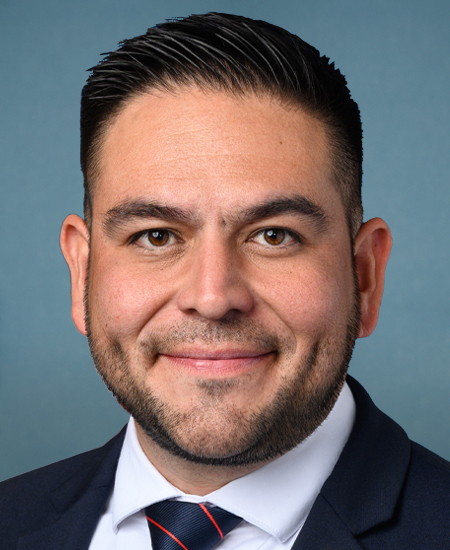
Rep. Gabe Vasquez
Sponsored bills
Maddy summaryHR 2244, the Michael Lecik Military Firefighters Protection Act, establishes a presumption that certain diseases suffered by military firefighters were incurred during service. It directly affects veterans who were trained in fire suppression and served at least five years in firefighting or damage control roles. The bill presumes service connection for 17 specific conditions - including heart disease, lung disease, and various cancers - if they manifest with at least 10% disability within 15 years of separation. This simplifies the process for these veterans to receive disability benefits without needing to prove direct service connection.
Maddy summaryThis bill, HR 2102 (Major Richard Star Act), allows veterans with combat-related disabilities to receive both full military retired pay and veterans' disability compensation simultaneously, without the previous offset that reduced retired pay. It directly affects veterans already eligible for both benefits due to combat-related injuries, removing the requirement that their retired pay be reduced by the disability compensation amount. The key provision amends Title 10 and Title 38 to eliminate the offset rule (sections 5304 and 5305 of Title 38) for these veterans. The change applies to payments starting after the bill’s enactment date, effective for all qualifying veterans. This is a policy change to increase financial support for affected veterans, not a new benefit.
Maddy summaryThis bill changes visa rules for foreign graduate students pursuing STEM master's or doctoral degrees in the U.S. It requires these students to apply for admission before starting their program and adds background checks and credential verification to their visa process. It also creates a new pathway to permanent residency for STEM degree holders who secure jobs in their field at median wage levels, and allows students to seek permanent residency while on student visas (dual intent). The bill directly affects international students in STEM fields, U.S. universities, and employers hiring these graduates.
Maddy summaryThis bill creates a new Medicare payment model (the "Comprehensive Alternative Response for Emergencies Model") that allows Medicare Part B to cover ground ambulance services provided in response to emergency medical calls *without* a full transport. It directly affects Medicare beneficiaries receiving emergency ambulance care and ambulance providers, ensuring they are paid for services like dispatch and initial response that don't include transport. The model requires payment rates to align with standard transport payments, mandates compliance with state protocols, and operates for a 5-year test period. A report by the Comptroller General will evaluate the model's impact on beneficiary access, outcomes, and regional differences after 4 years.
Sanctioning Russia Act of 2025 This bill imposes penalties on certain persons (individuals and entities) if the President determines that the Russian government or a person acting at Russia's direction is involved with (1) refusing to negotiate a peace agreement with Ukraine; (2) violating a negotiated peace agreement; (3) initiating another invasion of Ukraine; or (4) overthrowing, dismantling, or seeking to subvert the Ukrainian government. If the President makes such a determination, the bill requires certain actions including the President must impose visa- and property-blocking sanctions on specified persons such as the Russian president, certain Russian military commanders, and any foreign person that knowingly provides defense items to the Russian armed forces; the President must increase the rate of duty on all goods and services imported from Russia into the United States to at least 500% relative to the value of such goods and services; the President must increase the rate of duty on all goods and services imported into the United States from countries that knowingly engage in the exchange of Russian-origin uranium and petroleum products to at least 500% relative to the value of such goods and services; the Department of the Treasury must impose property-blocking sanctions on any financial institution organized under Russian law and owned wholly or partly by Russia, and any financial institution that engages in transactions with those entities; and the Department of Commerce must prohibit the export, reexport, or in-country transfer to or in Russia of any U.S.-produced energy or energy product.
Maddy summaryHR 2553, the Capping Prescription Costs Act of 2025, limits out-of-pocket costs for prescription drugs under health insurance. It sets a $2,000 annual cap per individual or $4,000 per family for covered prescriptions starting in 2026, with annual adjustments based on the medical care CPI. The bill applies directly to people with employer-sponsored group health plans, individual health insurance plans, and plans covered under the Affordable Care Act. It requires insurers and plan sponsors to ensure cost-sharing for prescriptions does not exceed these limits, effective for plan years beginning January 1, 2026.
Maddy summaryHR 2533, the EASE Act of 2025, requires Medicare and Medicaid to test a new telehealth model designed to improve specialty care access for rural and underserved Medicare/Medicaid beneficiaries. The bill mandates the Centers for Medicare & Medicaid Services (CMS) to partner with nonprofit provider networks - comprising at least 50 community health centers or rural clinics (half in rural areas) - to deliver specialty care via telehealth and coordinate with primary care providers. Eligible individuals must be enrolled in Medicare Part B, Medicaid, or CHIP and reside in designated rural or underserved areas. The model requires networks to collect and evaluate data on service delivery, with funding subject to existing program rules. This creates a structured pilot program focused on expanding remote specialty care access in underserved regions.
Maddy summaryThis bill requires the U.S. Department of Veterans Affairs to redraw healthcare network boundaries within 180 days of enactment, adding Otero and Eddy Counties in New Mexico to Veterans Integrated Service Network 17. It directly affects veterans residing in these two counties by expanding their access to VA healthcare services previously unavailable through this network. The key mechanism is a mandatory boundary adjustment to include these counties in an existing VA healthcare service network, streamlining access to care. This change makes no other policy modifications and focuses solely on geographic reassignment for service delivery.
Maddy summaryThis bill establishes a federal grant program to fund mental health crisis response training for law enforcement and corrections officers. It provides up to $10 million annually for state, local, and tribal agencies to cover training costs, including travel and lodging, for officers responding to mental health crises. The training must be evidence-based, developed with healthcare professionals and people with lived mental health experience, and cover de-escalation, empathy, community resources, and safety protocols. Agencies applying must demonstrate current training gaps, officer safety records, and how the training will reduce injuries to officers and the public during mental health emergencies. The grants are supplemental to existing funding and require annual reporting on training participation and outcomes.